Lingonberry / Partridgeberry / Mountain cranberry

Lingonberry / Partridgeberry / Mountain cranberry
Vaccinium vitis-idaea
Pflanzenfamilie
The Heath (Ericaceae)
Auch bekannt als
Cowberry
Anbaupause Fruchtwechsel
0 Jahre
Saisonübersicht
Voranzucht
Pflanzung
Ernte
Ernte
J
F
M
A
M
J
J
A
S
O
N
D
1. JAHR
FOLGEJAHRE
Details


Lichtbedarf
Halbschattig

Wasserbedarf
Feucht

Boden
Leicht (sandig)
Nährstoffbedarf
Niedrig

Lichtkeimer

Keimtemperatur
10 - 15 °C (Grad Celsius)

Pflanzabstand
60 cm

Reihenabstand
60 cm

Saattiefe
0.2 cm
Anleitungen
Beschreibung
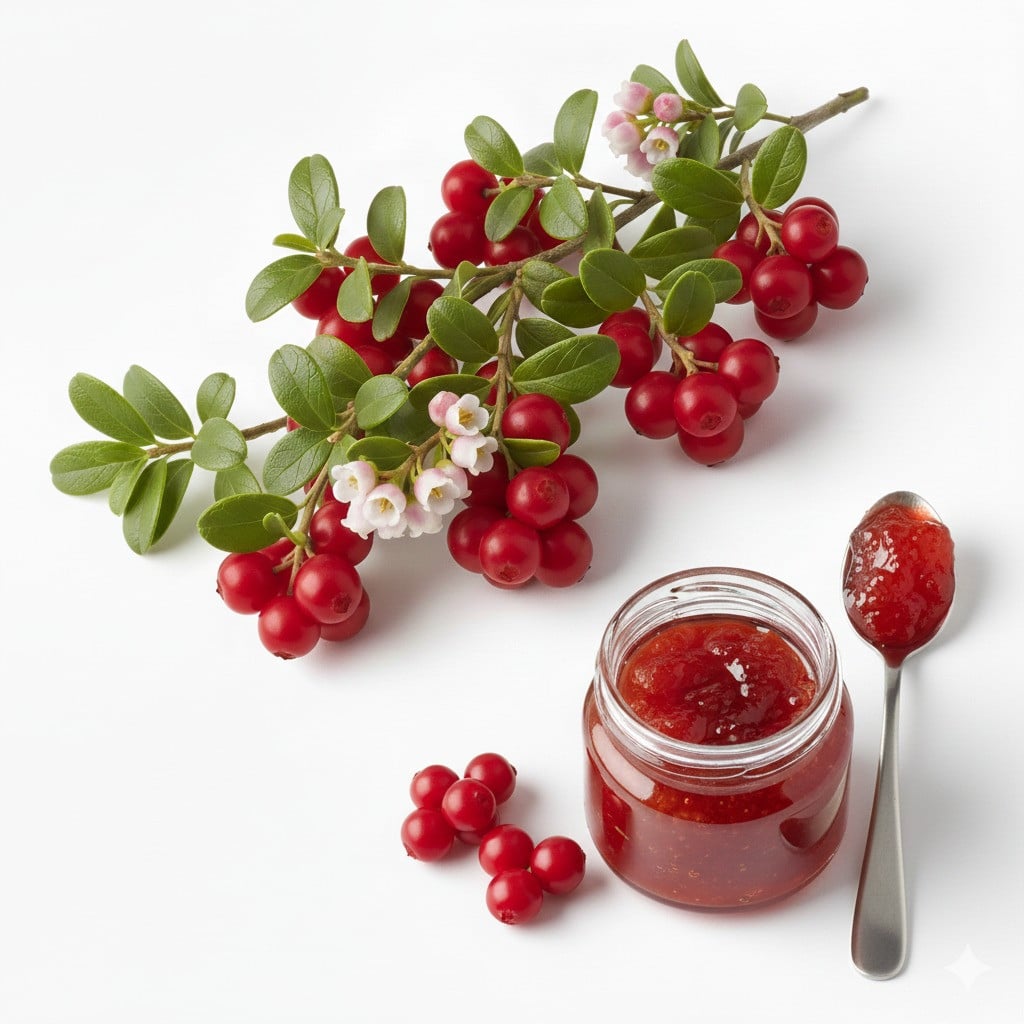
Cranberries (Vaccinium vitis-idaea), like blueberries and mossberries, belong to the heather family (Ericaceae). It is also called cranberry, cranberry, grantlberry or red bilberry. It occurs naturally on acid soils in bogs, heaths and forests. The plants grow between 10-30 cm tall. Grows ground-covering. Forms white-pink bell-shaped flowers in May-June, from which the light red fruits, about 0.5-1 cm in size, form in August and September. They can be eaten raw and have an aromatic, tart-sour taste. Cranberries differ from cranberries in their growth, and the berries of cranberries are slightly larger and lighter in color than those of cranberries. There are also ornamental varieties of cranberries, which taste quite sour, so cultivated cranberries should rather be grown for consumption.
Herkunft:
From Northern Europe to Siberia to Japan
Anbautipps
Need acidic soil with a pH of 4-5, so mix in acidic compost or blueberry or rhododendron soil, or immediately dig a hole and fill it with fresh acidic soil. Too high pH leads to chlorosis (yellowing of the leaves) and the death of the plants. Soils rich in lime are also unsuitable. Can also be planted in a pot. Hardy to -22°C. A layer of mulch keeps the soil acidic longer and prevents evaporation. Remove weeds regularly, as the cranberry is weak in competition.

Gute Nachbarn

Schlechte Nachbarn
Abessinischer Kohl / Äthiopischer Senf
Ahorne
Anemone
Aubergine / Eggplant
Beetroot
Blackberry / Brambles
Broccoli
Broccoli raab / Stem cabbage / Cima di rapa
Brussels sprouts
Cabbage (Cabbage)
Cabbage (Pointed cabbage)
Cabbage (red cabbage)
Cabbage (Savoy cabbage)
Cauliflower
Chili
Collard greens
Collard greens (Kale)
Collard greens (Tuscan kale / Dinosaur kale / Palm tree kale)
Courgette / Zucchini
Cucumber (African horned cucumber / Kiwano)
Cucumber (Caigua)
Cucumber (Melothria)
Cucumber / Gherkin
Efeu
Gartenkürbis - Patisson / Ufo-Kürbis
Gemüsekohl - Flower Sprouts / Kohlröschen
Gemüsekohl - Futterkohl
Gemüsekohl - Kai-Lan / Chinesischer Brokkoli
Gemüsekohl - Rippenkohl / Portugiesischer Kohl
Gemüsekohl - Wildkohl / Urkohl
Gliedkräuter
Gräser - Federborstengräser, Lampenputzergräser
Gräser - Pampasgräser
Gräser - Schmielen
Gräser - Schwingel
Green lavender cotton
Haargurken / Schlangenkürbisse
Hazelnut
Jaltomaten
Kohlrabi / German turnip / Turnip cabbage
Lavender
Maiglöckchen
Meerkohle
Mizuna / Japanese mustard greens
Nachtschatten (Sonstige)
Napa cabbage / Chinese cabbage
Nieswurzen
Okra
Oregano
Ornamental pumpkin
Pak Choi
Pepper / Paprika
Phlox, Flammenblume
Potato
Pumpkin / Squash
Rapini / Broccoli rabe
Raps
Raps - Scheerkohl / Sibirischer Kohl
Raspberry
Rose
Rosemary
Rübsen - Choy Sum / Chinesischer Blütenkohl
Rübsen - Mizuna
Rübsen - Ölrübsen
Rübsen - Tatsoi
Rübsen - Wilde Rübsen
Rutabaga / Swedish turnip
Sage
Schachtelhalm
Sponge gourd / Egyptian cucumber / Vietnamese luffa
Stinging nettle
Strawberry
Sukkulenten - Dickblattgewächse
Sweet woodruff / Sweetscented bedstraw
Thyme
Tomato (Bush tomato)
Tomato (Cocktail bush tomato)
Tomato (Cocktail Stake Tomato)
Tomato (Stake tomato)
Turnip
Waldrebe, Clematis
Walnut family
Weiden
Wild garlic

Krankheiten
Root Rot
Septoria
Grey mold
Schädlinge
Aphids
Spider mites
Schildläuse
Caterpillars
Spotted wing drosophila
Gall midges
Common winter moth