Yacon (Wildform)

Variety
Yacon (Wildform)
created by Lennox D. at 18.02.2025
Features
Location
planting: bed
planting: outdoor
planting: suitable for year-round cultivation
fertilization: lime-free
Soil: loosened
Cultivation Break
2 Years
Season Overview
Propagating
Planting
Harvest
Harvest
J
F
M
A
M
J
J
A
S
O
N
D
1ST YEAR
FOLLOWING YEARS
Description
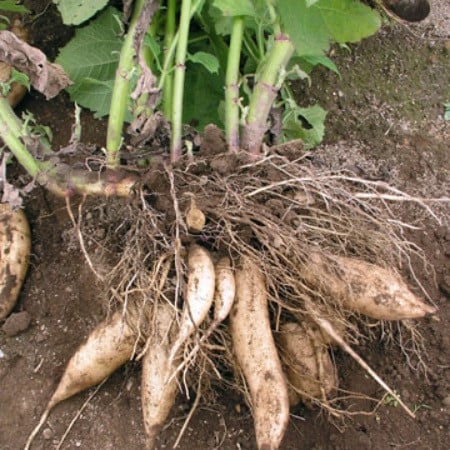
Yacon (Smallanthus sonchifolius) is a tuberous vegetable from the Asteraceae family, related to sunflowers and Jerusalem artichokes. Originally native to the Andes in South America, yacon grows to heights of up to 2.5 meters and forms edible root tubers. The plant can produce yellow flowers and is sensitive to frost.
F1 Hybrid
Growing tips
Yacón thrives best in a sunny, sheltered location with loose, well-drained soil. If the rhizomes are planted 5-10 cm deep and at least 80 cm apart, the roots can develop optimally. After the Ice Saints, the plants should be planted outdoors to avoid frost damage. Preparing the soil with compost and sand ensures good drainage, while regular, moderate watering and a layer of mulch stabilize the moisture and suppress weeds. Continuous monitoring for pests and diseases rounds off the cultivation process so that your yacón plants can grow healthily.
Details


Light requirement
Sunny

Water requirement
Moist

Soil
Light (sandy)
Nutrient requirement
High

Dark germinator

Plant distance
100 cm

Row spacing
150 cm

Seeding depth
10 cm

Companion Plants
Anemone
Aronia berries
Arugula / Rocket
Basil
Bean (Broad bean / Faba bean / Field bean)
Bean (Dwarf bean)
Beetroot
Borage
Calliopsis / Tickseed
Celery (Celeriac / Celery root)
Celery (Celery)
Celery (Leaf celery / Chinese celery)
Chard
Chickpea
Chives
Comfrey
Common marigold
Coriander / Cilantro
Currant
Daylilies
Dill
Dogwood
Garlic
Garlic chives
Gooseberry
Hyssop
Jostaberry
Lettuce (Endive / Escarole / Erisée)
Lettuce (Lamb's lettuce)
Lettuce (Lettuce)
Lettuce (Radicchio / Italian chicory)
Lettuce (Sugar loaf)
Nasturtium
Onion
Parsley
Pea
Phlox, flame flower
Rock pear (Amelanchier)
Rose
Rudbeckia (Coneflower / Black-eyed-susans)
Spinach (Summer)
Spirea
Sweet pea
Sweet woodruff / Sweetscented bedstraw

Antagonistic Plants
Abyssinian cabbage / Ethiopian mustard
Aster
Aubergine / Eggplant
Begonias
Black salsify
Blackberry / Brambles
Broccoli
Broccoli raab / Stem cabbage / Cima di rapa
Brussels sprouts
Brussels sprouts
Buddleja / Butterfly Bushes
Cabbage (Cabbage)
Cabbage (Pointed cabbage)
Cabbage (red cabbage)
Cabbage (Savoy cabbage)
Cauliflower
Cherry laurel
Chili
Chinese kale - Kai-lan / Chinese broccoli
Collard greens
Collard greens (Kale)
Collard greens (Tuscan kale / Dinosaur kale / Palm tree kale)
Corn / Maize
Courgette / Zucchini
Cucumber (African horned cucumber / Kiwano)
Cucumber (Caigua)
Cucumber (Melothria)
Cucumber / Gherkin
Fennel
Florence fennel / Finocchio
Forsythia
Funk
Garden squash - Patisson / UFO squash
Grasses - Bamboos
Grasses - reeds, cattails, bulrushes
Green lavender cotton
Hair cucumbers / snake gourds
Hellebores
horse chestnut
Horseradish
Ivy
Jerusalem artichoke / Topinambur
Kohlrabi / German turnip / Turnip cabbage
Larkspur
Lavender
Lilac
Lovage
Maples
Melon (Sugar melon)
Melon (Watermelon)
Mizuna / Japanese mustard greens
Napa cabbage / Chinese cabbage
Ornamental pumpkin
Pak Choi
Pepper / Paprika
Potato
Privet
Pumpkin / Squash
Rapeseed - Sheer cabbage / Siberian cabbage
Rapini / Broccoli rabe
Raspberry
Rhododendron
Rosemary
Sage
Sea buckthorn
Sea coal
Sponge gourd / Egyptian cucumber / Vietnamese luffa
Spruce trees
Stem herbs
Strawberry
Succulents
Summer asters
Sunflower
Taybeere, Tayberry
Thyme
Tomato (Bush tomato)
Tomato (Cocktail bush tomato)
Tomato (Cocktail Stake Tomato)
Tomato (Stake tomato)
Turnip
Turnip greens - Choy Sum / Chinese flowering cabbage
Turnip greens - Mizuna
Turnip greens - Tatsoi
Turnips - Oilseed turnips
Turnips - Wild turnips
Vegetable cabbage - Forage cabbage
Vegetable cabbage - Ribbed cabbage / Portuguese cabbage
Vegetable cabbage - wild cabbage / ancient cabbage
Walnut family
Willows
Yalta tomatoes

Diseases
Septoria
Powdery mildews
Root Rot
Fusarium
Pests
Land snails
Aphids
Voles