Nasturtium

Nasturtium
Tropaeolum
Plant family
Nasturtium family (Tropaeolaceae)
Cultivation Break
0 Years
Season Overview
Propagating
Planting
Harvest
J
F
M
A
M
J
J
A
S
O
N
D
Details


Light requirement
Sunny

Water requirement
Moist

Soil
Medium (loamy)
Nutrient requirement
Low

Dark germinator

Germination temperature
15 - 20 °C (Degrees Celsius)

Plant distance
20 cm

Row spacing
30 cm

Seeding depth
2 cm
Instructions
The season for this plant is over. The following instructions are for the next season.
Beginning of March

Sowing
Mid of March

Pest protection
Description
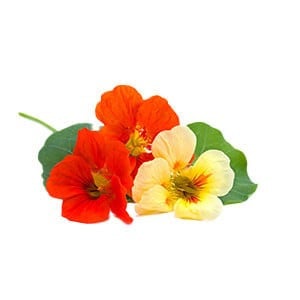
Nasturtium is an annual climbing plant. It belongs to the nasturtium family. Some plants can reach a length of up to 3 meters/3.3 yd. However, there are also some varieties that grow more bushy. The shield-shaped leaves have a slightly pungent taste. The flowers of the nasturtium can vary from bright yellow to orange to red.
Origin:
The nasturtium has its origin in Central and South America.
Growing tips
From March you can grow the seeds on the windowsill. Direct sowing starts in May. Here it is important to wait until after the last frost. Place the rows at least 30 cm/11.8 in apart from each other, as the cress will later spread strongly. Approximately 15 days after sowing the first seedlings can be seen. For the nasturtium to bloom abundantly, choose a sunny location. It prefers to thrive in a loose soil. Choose a suitable variety for you. Depending on the space, there are small to large climbing plants. You can let the tendril ends climb on a climbing aid or let them hang down from a tub.

Companion Plants
Abyssinian cabbage / Ethiopian mustard
Apple
Bean ((Scarlet) runner bean)
Bean (Broad bean / Faba bean / Field bean)
Bean (Dwarf bean)
Bean (Hyacinth bean / Lablab-bean)
Bean (Lima Bean)
Bean (Runner bean)
Borage
Broccoli
Brussels sprouts
Brussels sprouts
Cabbage (Cabbage)
Cabbage (Pointed cabbage)
Cabbage (red cabbage)
Cabbage (Savoy cabbage)
Cauliflower
Chinese kale - Kai-lan / Chinese broccoli
Collard greens
Collard greens (Kale)
Collard greens (Tuscan kale / Dinosaur kale / Palm tree kale)
Common marigold
Coneflower (Echinacea)
Cucumber / Gherkin
Garden cosmos / Mexican aster
Kohlrabi / German turnip / Turnip cabbage
Pea
Pear
Plum (tree)
Potato
Rudbeckia (Coneflower / Black-eyed-susans)
Sour cherry / Tart cherry
Soybean
Sunflower
Tagetes / Marigolds
Tomato (Bush tomato)
Tomato (Cocktail bush tomato)
Tomato (Cocktail Stake Tomato)
Tomato (Stake tomato)
Vegetable cabbage - Forage cabbage
Vegetable cabbage - Ribbed cabbage / Portuguese cabbage
Vegetable cabbage - wild cabbage / ancient cabbage
Wild Cherry / Bird Cherry / Sweet Cherry
Yalta tomatoes

Antagonistic Plants
Arugula / Rocket
Beetroot
Black salsify
Broccoli raab / Stem cabbage / Cima di rapa
Carrots
Coriander / Cilantro
Courgette / Zucchini
Cucumber (Caigua)
Fennel
Florence fennel / Finocchio
Green lavender cotton
Lavender
Lettuce (Common chicory)
Lettuce (Endive / Escarole / Erisée)
Lettuce (Lamb's lettuce)
Lettuce (Lettuce)
Lettuce (Puntarelle / Cicoria di catalogna / Cicoria asparago)
Lettuce (Sugar loaf)
Mizuna / Japanese mustard greens
Napa cabbage / Chinese cabbage
Okra
Ornamental pumpkin
Pak Choi
Parsnip
Pumpkin / Squash
Radish
Rapeseed
Rapeseed - Sheer cabbage / Siberian cabbage
Rapini / Broccoli rabe
Rosemary
Rutabaga / Swedish turnip
Sage
Stem herbs
Thyme
Turnip
Turnip greens - Choy Sum / Chinese flowering cabbage
Turnip greens - Mizuna
Turnip-rooted chervil
Turnips - Oilseed turnips
Turnips - Wild turnips

Diseases
Grey mold
Downy mildew
Powdery mildews
Pests
Land snails
Caterpillars
Aphids
Cabbage white
White fly