Turnip greens - Choy Sum / Chinese flowering cabbage

Turnip greens - Choy Sum / Chinese flowering cabbage
Brassica rapa subsp. parachinensis
Plant family
Crucifers (Brassicaceae)
Cultivation Break
4 Years
Season Overview
Propagating
Planting
Harvest
Harvest
J
F
M
A
M
J
J
A
S
O
N
D
1ST YEAR
2ND YEAR
Details


Light requirement
Sunny

Water requirement
Moist

Soil
Medium (loamy)
Nutrient requirement
Medium

Dark germinator

Germination temperature
18 - 25 °C (Degrees Celsius)

Plant distance
10 cm

Row spacing
30 cm

Seeding depth
1.5 cm
Instructions
Description
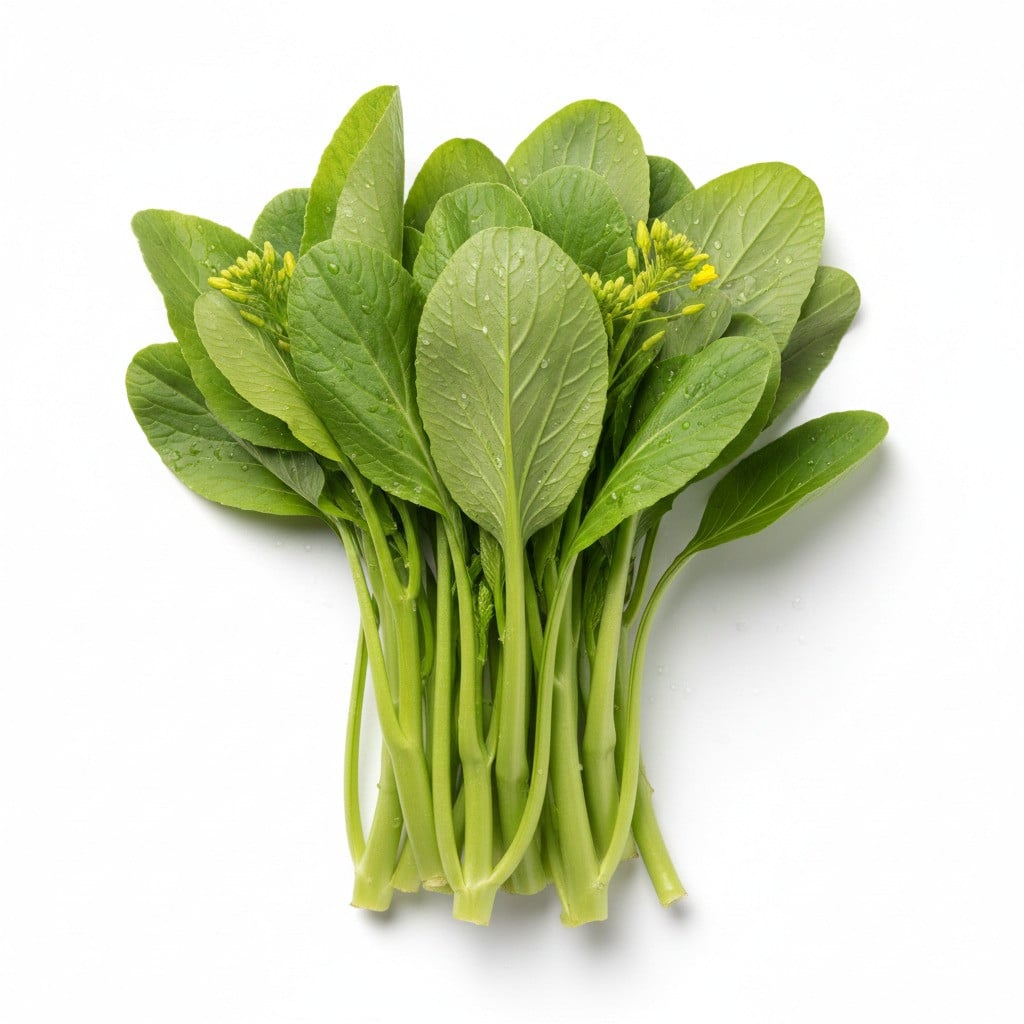
Choy Sum (also Choi Sum or Choi Sam in Cantonese, Cai Xin in Mandarin) is a leafy vegetable that is frequently used in Chinese cuisine. It belongs to the Brassica genus of the cruciferous family (Brassicaceae). The Latin name is Brassica rapa var. parachinensis or Brassica chinensis var. parachinensis. Choy Sum is a transliteration of the Cantonese name, which literally means "vegetable heart". Choy Sum is also called Yu Choy (you cai in Mandarin) or Pak Kwang Tung. It is also known as Chinese flowering cabbage. The vegetable originally comes from China. It is now also cultivated in Thailand and is often used in Thai cuisine. Choy sum is a green leafy vegetable, similar to kai lan. Choi sum has smooth green leaves and thick, light green stalks. It has small yellow flowers at the top of the inner shoots. Each flower has four yellow, oval to round petals with six stamens on fleshy, upright stems. These reach a diameter of 0.5 to 1 cm and a height of 15 to 20 cm. The leaves are light to dark green and oval (tapering to a point or basal just before flowering) with slightly serrated edges. Unlike cabbage, choy sum does not form compact heads. The fruits are produced by cross-pollination or self-pollination and are pod-shaped. They open when ripe by bursting or drying and release small, round, brown to black seeds. A single pod can contain 4 to 46 seeds. The height of the plant varies greatly and is between 10 and 40 cm, depending on the growing conditions and variety. Flowering usually begins when the plant has about 7 to 8 leaves or is about 20 cm high. The majority of the root system is located at a depth of 12 cm and is limited to a radius of 12 cm. The plant is generally annual and herbaceous, rarely perennial and rarely grows into a semi-shrub. It consists of a simple or (shortly before flowering) branched, leafy growth. It thrives best in soil with a pH value between 5.6 and 7.5. Choy sum is highly valued as a vegetable in China and Japan and is often eaten in soups, blanched or fried. In Thai cuisine, the young leaves and flowering stems are used as leafy vegetables in soups and stir-fry dishes. It is usually prepared briefly fried and has a pleasantly mild taste. Briefly fried in a wok, it retains its beautiful green color and remains pleasantly crunchy. It is also often steamed or pickled. However, it can also become bitter when steamed. Flowering cabbage is often eaten with an oyster sauce.
Origin:
China, Thailand
Growing tips
🌿 Location & soil - Light: Sunny to semi-shady - Soil: Loose, rich in humus, evenly moist - pH value: slightly acidic to neutral (6.0-7.0) - Nutrients: Medium feeder - work in compost or organic fertilizer 🌱 Sowing & planting - Sowing time: Spring to fall (March-September) - Direct sowing: Row spacing approx. 25-30 cm, plant spacing 10-15 cm - Sowing depth: 1-1.5 cm - Germination: 5-10 days at 18-25 °C 💧 Care - Watering: Keep evenly moist, avoid waterlogging - Fertilization: Light top dressing with organic liquid fertilizer possible - Neighborhood: Good with Chinese cabbage, lettuce, spinach; avoid other cruciferous plants (cabbage, rapeseed) to reduce pest pressure 🐛 Diseases & pests - Danger: Earth fleas, cabbage white butterfly, aphids - Prevention: Crop protection net, mixed cultivation with onions or garlic 🍽️ Harvest - Time: 30-50 days after sowing - Characteristic: Harvest young stems with buds before the flowers fully open - Harvesting method: Cut the whole plant or remove individual stems continuously

Companion Plants
Artichoke
Aubergine / Eggplant
Bean ((Scarlet) runner bean)
Bean (Broad bean / Faba bean / Field bean)
Bean (Dwarf bean)
Bean (Hyacinth bean / Lablab-bean)
Bean (Lima Bean)
Bean (Runner bean)
Black salsify
Carrots
Celery (Celeriac / Celery root)
Celery (Celery)
Celery (Leaf celery / Chinese celery)
Chamomile
Chili
Coriander / Cilantro
Cucumber / Gherkin
Dill
Leeks
Lettuce (Common chicory)
Lettuce (Endive / Escarole / Erisée)
Lettuce (Lamb's lettuce)
Lettuce (Lettuce)
Lettuce (Puntarelle / Cicoria di catalogna / Cicoria asparago)
Lettuce (Radicchio / Italian chicory)
Lettuce (Sugar loaf)
Parsnip
Pea
Pepper / Paprika
Soybean
Spinach (Summer)
Spinach (Winter)
Tomato (Bush tomato)
Tomato (Cocktail bush tomato)
Tomato (Cocktail Stake Tomato)
Tomato (Stake tomato)

Antagonistic Plants
Abyssinian cabbage / Ethiopian mustard
Broccoli
Broccoli raab / Stem cabbage / Cima di rapa
Brussels sprouts
Brussels sprouts
Cabbage (Cabbage)
Cabbage (Pointed cabbage)
Cabbage (red cabbage)
Cabbage (Savoy cabbage)
Cauliflower
Chinese kale - Kai-lan / Chinese broccoli
Collard greens
Collard greens (Kale)
Collard greens (Tuscan kale / Dinosaur kale / Palm tree kale)
Horseradish
Kohlrabi / German turnip / Turnip cabbage
Lovage
Mizuna / Japanese mustard greens
Napa cabbage / Chinese cabbage
Pak Choi
Rapeseed
Rapeseed - Sheer cabbage / Siberian cabbage
Rapini / Broccoli rabe
Rutabaga / Swedish turnip
Sea coal
Turnip
Turnip greens - Tatsoi
Turnips - Oilseed turnips
Turnips - Wild turnips
Vegetable cabbage - Forage cabbage
Vegetable cabbage - Ribbed cabbage / Portuguese cabbage
Vegetable cabbage - wild cabbage / ancient cabbage
Diseases
Root Rot
Club root of cabbage
Grey mold
Downy mildew
Powdery mildews
Pests
Land snails
Cabbage white
Cabbage fly
Cabbage heart midge
Cutworms
Flea beetles
Aphids
Voles