Stem herbs

Stem herbs
Sideritis
Plant family
Mint family (Lamiaceae)
Season Overview
Propagating
Planting
Harvest
Harvest
J
F
M
A
M
J
J
A
S
O
N
D
1ST YEAR
FOLLOWING YEARS
Details


Light requirement
Sunny

Water requirement
Dry

Soil
Light (sandy)

Nutrient requirement
Low

Light germinator

Germination temperature
20 - 25 °C (Degrees Celsius)

Plant distance
40 cm

Row spacing
40 cm

Seeding depth
0.5 cm
Instructions
Description
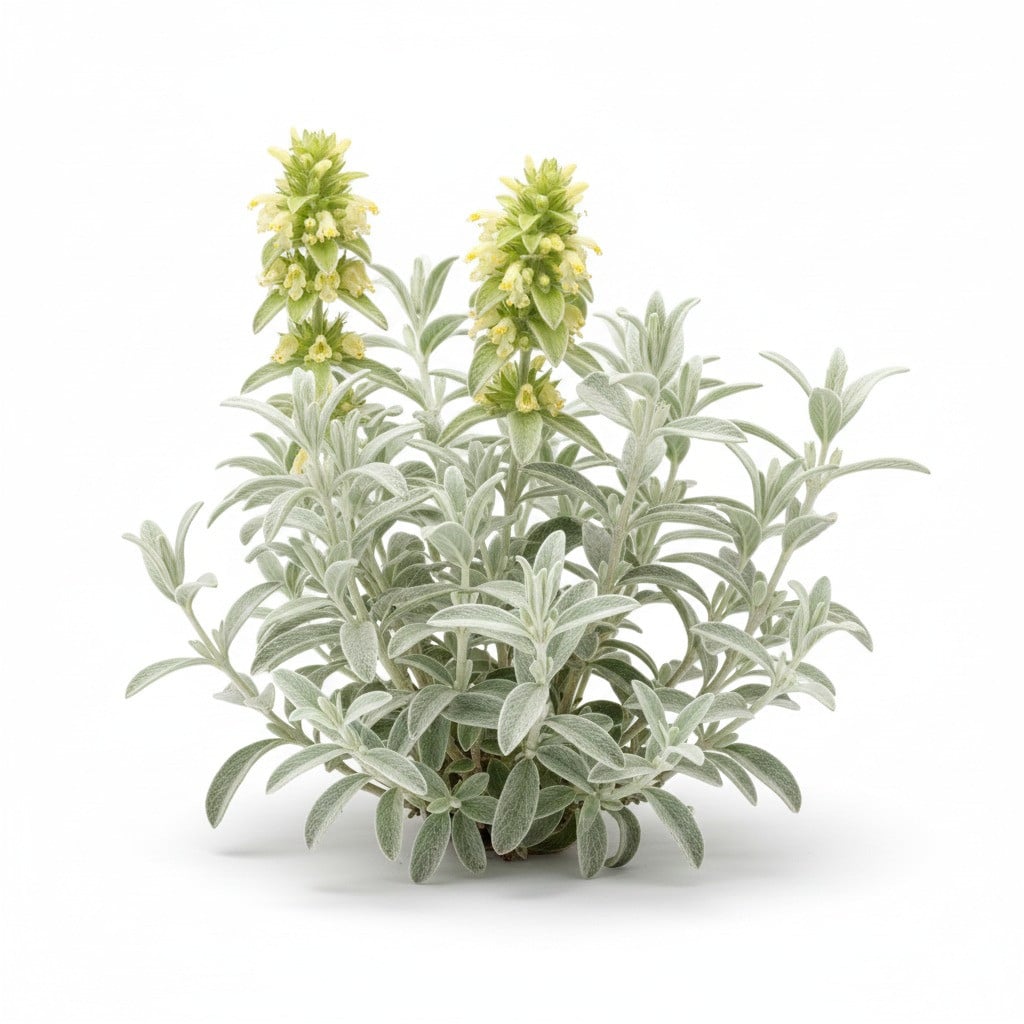
The genus Sideritis (bot. Sideritis) contains herbaceous, perennial plants. Some species are woody and are small shrubs. They are dicotyledonous angiosperms of the group Asterides in the subgroup Euasterides I. They are part of the basic order Eudicotyledons. As a member of the Lamiaceae family, they belong to the Lamiales. Leaf The leaves have a petiole with a leaf blade. The leaf blade is predominantly narrow, linear to lanceolate. Sometimes the leaves are green. They are predominantly densely covered with gray hairs and have a woolly appearance. Flower The flowers are hermaphrodite and the corolla is bilaterally symmetrical (zygomorphic). They are five-petaled and have a double perianth. Five sepals grow together to form a calyx and form a bell-shaped tube. There are five free-standing calyx lobes or calyx teeth. Their special feature is a thorny awn. In some species, the upper tooth is larger than the four lateral ones. Two lips characterize the corolla. Two petals form the upper lip. This is protruding and flat. Sometimes it has a short slit or is entire. Three petals partially fuse and form a three-lobed lower lip. The central lobe protrudes long beyond the two short lateral lobes. The flower has four fertile stamens of different lengths. They are shorter than the corolla tube, which is surmounted by the calyx. Often six flowers, sometimes fewer, form a false whorl. The flowers sit in the leaf axils or are terminal on the stems. The flowers are yellow in most species. Fruit The plant has an ovary at the top and develops clypeus fruits. The fruit splits into sub-fruits (clauses) at the partitions. They each contain one seed. The limb herbs have rounded seeds at the tip. Sometimes there is a smooth surface. Rough to warty surfaces also occur. Growth Some species are annuals. Most are perennials and occasionally grow as shrubs. In mild regions, the plants are evergreen. The plants grow upright, sometimes arching. They form dense bushes or develop a few loose shoots. The above-ground parts of the plant contain essential oil. It is mainly found in the glandular scales on the surface of the leaves. The oil is made up of various components. These include terpenes, flavanoids and phenolic acids.
Origin:
Azores, Madeira, Canary Islands, Cap Verde Islands, Mediterranean region, Russia, Tibet, Western China, Turkey, Central Europe
Growing tips
Location Sideritis species like a warm and sunny location. Dry and gravelly sites are favorable. Mountainous areas, slopes and stony substrates are ideal places to grow. Many species thrive on plains, dry grasslands and rocky steppes. Annuals grow on scree and in vineyards. Some species thrive up to an altitude of 1200 meters. Utilization Sideritis herb is a traditional herbal remedy and is used in various applications. It is widely used as a tea. Several species of sideritis are used in mountain tea from Greece. In other regions, the dried leaves and flowers of the herb produce a tasty, slightly bitter tea for everyday use. Sideritis is an ingredient in herbal mixtures for colds and coughs. The plants used come mainly from wild collections. To date, only a few species are in regular agricultural use. These include the Balkan limb herb. Sideritis is of interest to fragrance manufacturers because of its essential oil components. The limb herbs produce fragrance notes of the green notes, herbs and fougère notes (ferns) group. Sideritis complements or emphasizes the heart note in some green perfumes. Limb herbs have found their place in herb gardens and ornamental gardens. In Germany, they are known as annual plants in the field. Grey-felt, perennial plants add silvery splashes of color to a colorful summer border. Perennial species, such as Balkan limbwort and Syrian limbwort, create interesting effects in patio and balcony plantings. Unusual plantings are possible in a wine-growing climate. A mixture of low and semi-high as well as green and gray-leaved species as ground cover in front of vines and periploca. Beds with different types of sage and limb herbs also develop a spicy mixture of scents and are attractive to bumblebees and butterflies. Plants on the tops of walls and in gaps in walls hide unsightly borders. The silvery limb herbs with their yellow flowers enhance blue-flowering lavender and purple mountain mint. Care/pruning The limb herbs need a warm, sunny location and well-drained soil. A well-drained bed, an embankment or a stony slope are ideal. A loosened area is sufficient for sowing annual species. A heat fleece is helpful for germination. Plants of perennial species find an ideal place in nutrient-rich sandy loam soil. They are usually frost-hardy in mild winter locations. Spruce branches provide reliable winter protection. In less favorable regions, the plants overwinter in a cool room. They tolerate pruning. Perennial species are suitable as container plants.

Companion Plants

Antagonistic Plants

Diseases
Powdery mildews
Root Rot
Pests
Aphids
Spider mites
White fly