Turnip greens - Mizuna

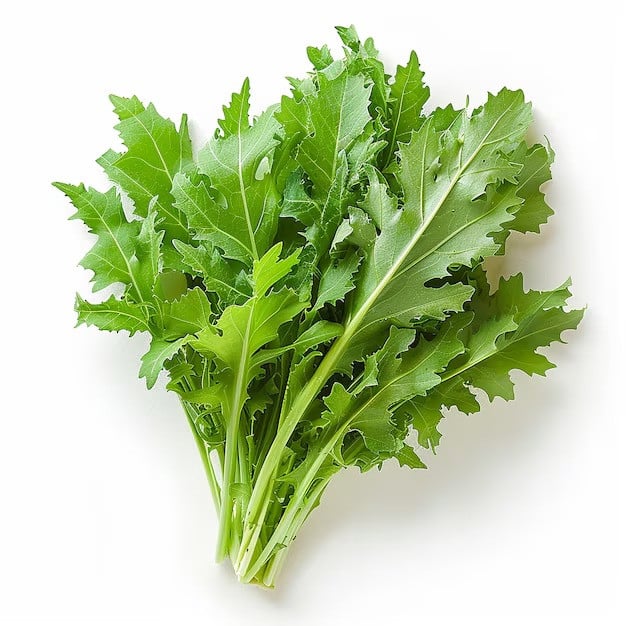
Turnip greens - Mizuna
Brassica rapa subsp. nipposinica / japonica
Plant family
Crucifers (Brassicaceae)
Cultivation Break
4 Years
Season Overview
Propagating
Planting
Harvest
J
F
M
A
M
J
J
A
S
O
N
D
Details


Light requirement
Sunny

Water requirement
Moist

Soil
Medium (loamy)

Nutrient requirement
Medium

Dark germinator

Germination temperature
7 - 23 °C (Degrees Celsius)

Plant distance
10 cm

Row spacing
20 cm

Seeding depth
1 cm
Instructions
Description
Mizuna, whose scientific name is Brassica rapa subsp. Nipposinica or Brassica rapa var. japonica, belongs to the cruciferous family, just like cabbage, broccoli or rocket. It originates from Japan and other Asian regions. It is becoming increasingly popular due to its adaptability and its excellent culinary and nutritional properties. Mizuna is also known as spider mustard, water green, kyona, Japanese leaf mustard or Japanese mustard green. - Taste and texture: Mizuna leaves have a delicate, fresh flavor with just the right amount of spice, similar to arugula but less intense. It offers a crunchy and tender texture, ideal both raw and in cooked dishes. - Shape and growth: its leaves are toothed, fine, with a feathery appearance and can vary in width and thickness of cut depending on the variety: Some varieties grow wider and smoother, others finer and more toothed. - Height and development: At maturity, Mizuna can grow between 30 and 40 cm tall. During flowering, the stems elongate further and produce delicate yellow flowers. - Varieties presented: There are various Mizuna varieties. The thin-leaved, tender varieties are preferred for salads, while the broad-leaved varieties are more suitable for stews and stir-fries. - Nutrients: It is characterized by its content of vitamins C and K, folic acid, calcium, iron and potassium. It is also a source of antioxidants, such as carotenoids and flavonoids, which are very beneficial to health. In the kitchen, it is used in salads, stir-fries, soups, stews and as a side dish with meat or fish. It can be combined with other leafy vegetables, rice, noodles, tofu, chicken or fish, or simply prepared with lemon, olive oil and various seeds. Due to its ease of cultivation, hardiness and versatile flavor, mizuna has become an important crop in the home organic garden.
Origin:
Asia (Japan)
Growing tips
Mizuna is characterized by its ease of cultivation, fast growth and cold tolerance, making it ideal for beginners and experienced gardeners alike. In fact, with careful planting, you can enjoy several harvests in a single year. Planting The Mizuna prefers cool temperatures. It can be cultivated from late summer through fall and into early spring. In temperate climates, protected sowing in winter is even possible. - When grown at temperatures between 7°C and 23°C, growth is optimal and the leaves have a better aroma and texture. - If it is planted in spring and the heat starts early, it can flower quickly, which shortens the harvest time. Soil To obtain tender and lush leaves, it is important to prepare the soil carefully: - Mizuna needs fertile soil, rich in organic matter and well-drained. A pH value between 6.0 and 7.5 is ideal. - Mix in mature compost or worm castings before sowing to improve the structure and provide essential nutrients. - Avoid heavy or waterlogged soils, as these can encourage root diseases. Light Choose a sunny or slightly shaded area. Mizuna grows well in at least 4-6 hours of direct sunlight, but will tolerate some shade, especially in very hot climates where a little protection during the hottest periods will prevent heat stress. Sowing The easiest and quickest way to plant Mizuna is by direct sowing in the open ground or in a pot, although you can also start in seedbeds for transplanting later. - Sow in grooves or holes 1 cm deep. - Spread the seeds evenly. - Cover lightly and ensure that gentle watering after sowing does not wash out the seeds. - You can place 2-3 seeds in each hole to ensure germination and then thin out the weaker seedlings. -If you are interested in harvesting small and tender leaves, you can leave 5-10 cm between the plants. - For larger plants intended for cooking, a distance of 15 to 20 cm between plants is recommended. Watering and care Mizuna needs constant moisture, but without waterlogging. Soil that dries out completely slows growth and hardens the leaves, while excess water favors the appearance of fungi and diseases of the stem and root. - Water 2 to 4 times a week. Adjust the frequency to the climate and soil type. Reduce or eliminate watering during the rainy season if the soil remains naturally moist. - Avoid waterlogging at all costs. Water carefully, preferably using drip irrigation or a fine spray watering can to avoid compacting the soil and splashing the leaves. - With a pot, make sure that the substrate does not dry out completely and that excess water can drain away easily. - Remove weeds to avoid competition for nutrients and water. - Fertilize lightly every 3-4 weeks with a balanced fertilizer when growth slows down or the leaves turn pale. Harvest Mizuna is very fast-growing. After sowing, you can start cutting the young leaves after just 15 to 20 days and after 4 to 6 weeks you will have mature plants ready for a more generous harvest. - It can be harvested leaf by leaf: Harvest the outer leaves so that the plant continues to sprout from the center. - If you need a lot of leaves, you can cut off the entire plant and leave 5 cm of stem. It will sprout again and allow you several successive harvests. - Mizuna responds well to the 'cut and regrow' method: as long as you maintain a good green base, it will continue to produce new leaves. - Under optimal conditions, you can enjoy Mizuna for several months throughout the year with staggered plantings. Flowering and seed formation: If you let Mizuna complete its cycle, it will bloom with clusters of small yellow flowers that are very attractive to pollinating insects such as bees and butterflies. It is an excellent choice if you want to support the biodiversity of your garden. - If you want to prolong the harvest, cut off the flower stems as soon as they start to sprout. - If you want to collect seeds, let some plants flower and form pods: Wait until they have dried before collecting and storing them for the next cycle. - Mizuna flowers are not only pretty, but also exude a pleasant aroma and can also be used as edible decoration in salads. Pests and diseases Although Mizuna is fairly resistant to pests and diseases, especially in relation to other cabbage plants, there are certain dangers to be aware of. The most common pests - Aphids: Small insects that gather on the underside of leaves and stems. They can be controlled with soapy water (potassium soap) or by introducing beneficial insects such as ladybugs. - Earth fleas: They leave small holes in the leaves. You can protect the plants with insect nets or sticky traps. - Slugs: They feed on the most tender leaves, especially in humid environments. Control them with physical barriers, beer traps or ash around the base. - Whitefly: Tiny insects commonly found in protected crops and closed environments. Remove them mechanically or use paint traps. Common diseases - Powdery mildew: Occurs in high humidity and insufficient ventilation. Avoid wet leaves when watering and promote air circulation. - Cabbage hernia: Fungal disease that attacks the roots and leads to wilting and yellowing of the plants. Avoid planting cruciferous plants in the same location for at least three years (crop rotation). In general, good irrigation management, avoiding water logging and implementing crop rotation is important to avoid most plant health problems. Always remember to remove old plant debris and disinfect your tools regularly.

Companion Plants
Artichoke
Aubergine / Eggplant
Bean ((Scarlet) runner bean)
Bean (Broad bean / Faba bean / Field bean)
Bean (Dwarf bean)
Bean (Hyacinth bean / Lablab-bean)
Bean (Lima Bean)
Bean (Runner bean)
Black salsify
Carrots
Celery (Celeriac / Celery root)
Celery (Celery)
Celery (Leaf celery / Chinese celery)
Chamomile
Chili
Coriander / Cilantro
Cucumber / Gherkin
Dill
Leeks
Lettuce (Common chicory)
Lettuce (Endive / Escarole / Erisée)
Lettuce (Lamb's lettuce)
Lettuce (Lettuce)
Lettuce (Puntarelle / Cicoria di catalogna / Cicoria asparago)
Lettuce (Radicchio / Italian chicory)
Lettuce (Sugar loaf)
Parsnip
Pea
Pepper / Paprika
Soybean
Spinach (Summer)
Spinach (Winter)
Tomato (Bush tomato)
Tomato (Cocktail bush tomato)
Tomato (Cocktail Stake Tomato)
Tomato (Stake tomato)

Antagonistic Plants
Abyssinian cabbage / Ethiopian mustard
Broccoli
Broccoli raab / Stem cabbage / Cima di rapa
Brussels sprouts
Brussels sprouts
Cabbage (Cabbage)
Cabbage (Pointed cabbage)
Cabbage (red cabbage)
Cabbage (Savoy cabbage)
Cauliflower
Chinese kale - Kai-lan / Chinese broccoli
Collard greens
Collard greens (Kale)
Collard greens (Tuscan kale / Dinosaur kale / Palm tree kale)
Horseradish
Kohlrabi / German turnip / Turnip cabbage
Lovage
Napa cabbage / Chinese cabbage
Pak Choi
Rapeseed
Rapeseed - Sheer cabbage / Siberian cabbage
Rapini / Broccoli rabe
Rutabaga / Swedish turnip
Sea coal
Turnip
Turnip greens - Choy Sum / Chinese flowering cabbage
Turnip greens - Tatsoi
Turnips - Oilseed turnips
Turnips - Wild turnips
Vegetable cabbage - Forage cabbage
Vegetable cabbage - Ribbed cabbage / Portuguese cabbage
Vegetable cabbage - wild cabbage / ancient cabbage

Diseases
Root Rot
Club root of cabbage
Grey mold
Downy mildew
Powdery mildews

Pests
Land snails
Cabbage white
Cabbage fly
Cabbage heart midge
Cutworms
Flea beetles
Aphids
White fly
Voles