Common marigold

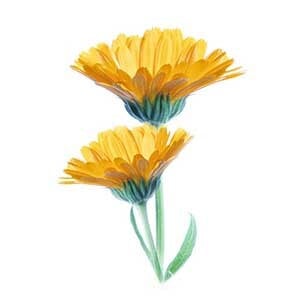
Common marigold
Calendula
Plant family
Daisy family (Asteraceae)
Also known as
Pot marigold, Ruddles, Mary's Gold, Scotch Marigold
Cultivation Break
0 Years
Season Overview
Propagating
Planting
Harvest
J
F
M
A
M
J
J
A
S
O
N
D
Details


Light requirement
Sunny

Water requirement
Dry

Soil
Medium (loamy)
Nutrient requirement
Low

Light germinator

Germination temperature
15 - 20 °C (Degrees Celsius)

Plant distance
25 cm

Row spacing
25 cm

Seeding depth
0.5 cm
Instructions
The season for this plant is over. The following instructions are for the next season.
Beginning of March

Fertilizing
Mid of April

Sowing
Mid of June

Picking
Every week
Description
Marigold is an ornamental and medicinal plant of the composite family. Different varieties differ in flower color (golden yellow to orange), growth period and height. It is cultivated as an annual, is sensitive to frost and attracts many pollinators.
Origin:
Mediterranean
Growing tips
Marigold is sown directly or grown in plant pots. It is a light germinator, so you should not cover the seeds with soil. Since it is sensitive to cold, you should sow or plant it in the bed only after the Ice Saints. Pinching out already wilted flowers will encourage the growth of new flower stalks. The roots emit toxins that reduce nematode infestation of neighboring crops. In addition, the plants are well suited as green manure.

Companion Plants
Abyssinian cabbage / Ethiopian mustard
Artichoke
Arugula / Rocket
Aster
Aubergine / Eggplant
Basil
Bean ((Scarlet) runner bean)
Bean (Broad bean / Faba bean / Field bean)
Bean (Dwarf bean)
Bean (Hyacinth bean / Lablab-bean)
Bean (Lima Bean)
Bean (Runner bean)
Beetroot
Black salsify
Blackberry / Brambles
Blueberry
Broccoli
Broccoli raab / Stem cabbage / Cima di rapa
Brussels sprouts
Brussels sprouts
Cabbage (Cabbage)
Cabbage (Pointed cabbage)
Cabbage (red cabbage)
Cabbage (Savoy cabbage)
Carrots
Cauliflower
Celery (Celeriac / Celery root)
Celery (Celery)
Chamomile
Chard
Chervil
Chili
Chinese kale - Kai-lan / Chinese broccoli
Collard greens
Collard greens (Kale)
Collard greens (Tuscan kale / Dinosaur kale / Palm tree kale)
Coriander / Cilantro
Corn / Maize
Courgette / Zucchini
Cress
Cucumber (Caigua)
Cucumber / Gherkin
Currant
Dill
Dogwood
Garden cosmos / Mexican aster
Garden squash - Patisson / UFO squash
Gooseberry
Hair cucumbers / snake gourds
Hazelnut
Kohlrabi / German turnip / Turnip cabbage
Lavender
Lettuce (Common chicory)
Lettuce (Endive / Escarole / Erisée)
Lettuce (Lamb's lettuce)
Lettuce (Lettuce)
Lettuce (Puntarelle / Cicoria di catalogna / Cicoria asparago)
Lettuce (Radicchio / Italian chicory)
Lettuce (Sugar loaf)
Marjoram
Melissa
Melon (Sugar melon)
Melon (Watermelon)
Miner's lettuce / Indian lettuce / Winter purslane
Mizuna / Japanese mustard greens
Napa cabbage / Chinese cabbage
Nasturtium
Nightshades (Other)
Oregano
Ornamental pumpkin
Pak Choi
Parsley
Parsnip
Pea
Pepper / Paprika
Physalis
Potato
Pumpkin / Squash
Radish
Radishes
Rapeseed
Rapeseed - Sheer cabbage / Siberian cabbage
Rapini / Broccoli rabe
Raspberry
Rhubarb
Rock pear (Amelanchier)
Root parsley
Rosemary
Rutabaga / Swedish turnip
Sage
Savory
Soybean
Spinach (Summer)
Strawberry
Thyme
Tomato (Bush tomato)
Tomato (Cocktail bush tomato)
Tomato (Cocktail Stake Tomato)
Tomato (Stake tomato)
Turnip
Turnip greens - Choy Sum / Chinese flowering cabbage
Turnip greens - Mizuna
Turnip greens - Tatsoi
Turnips - Oilseed turnips
Turnips - Wild turnips
Vegetable cabbage - Forage cabbage
Vegetable cabbage - Ribbed cabbage / Portuguese cabbage
Vegetable cabbage - wild cabbage / ancient cabbage
Yalta tomatoes
Zinnia

Antagonistic Plants

Diseases
Grey mold
Fusarium
Angular leaf spot of cucumber
Black spot of roses
Red spot disease
Powdery mildews
Pests
Caterpillars
Spider mites
Land snails
Aphids