Hair cucumbers / snake gourds

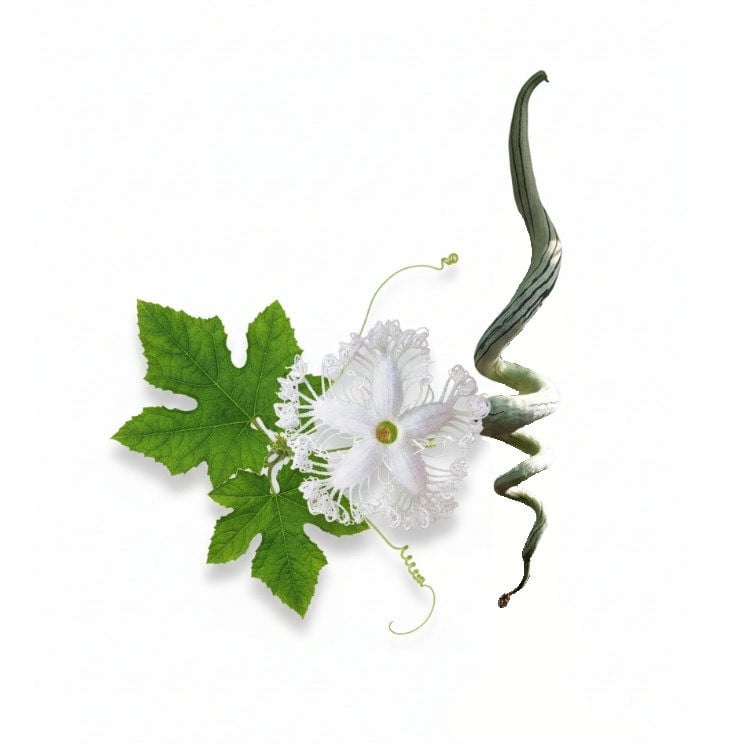
Hair cucumbers / snake gourds
Trichosanthes
Plant family
Curcurbits (Cucurbitaceae)
Cultivation Break
4 Years
Season Overview
Propagating
Planting
Harvest
Harvest
J
F
M
A
M
J
J
A
S
O
N
D
1ST YEAR
FOLLOWING YEARS
Details


Light requirement
Sunny

Water requirement
Moist

Soil
Medium (loamy)

Nutrient requirement
High

Dark germinator

Germination temperature
20 - 30 °C (Degrees Celsius)

Plant distance
100 cm

Row spacing
100 cm

Seeding depth
2 cm
Instructions
Description
Trichosanthes is an Asian genus of the gourd family (Cucurbitaceae). The so-called hairflowers are distributed from Asia via Malesia and Australia to the western Pacific islands. The snakehair cucumber is commercially important. With around 100 species, Trichosanthes is the most species-rich genus of the Cucurbitaceae family. Trichosanthes species are small to large climbing plants, predominantly perennial, rarely annual herbaceous plants. The tendrils are branched with 2 to 5 branches (rarely up to 9 branches, or simple). The leaves are simple, entire, lobed or compound, then with three to five leaf lobes. The leaf margin is scattered with small teeth about 1 millimeter long. The leaves are usually covered with glands. Trichosanthes species are dioecious, more rarely unisexual. The flowers are always unisexual. The petals are usually finely hairy, white to rarely pink or with red veins. The edge of the petals is long fringed and also hairy. In the male inflorescences, the flowers are solitary, but usually in stalked paniculate inflorescences, sometimes together with a single flower in the axils of the foliage leaves. There is a distinct flower stalk. The bracts are usually present and with or without glands. The flower tube is tubular, usually widened at the opening. It is usually hairy on the inside. The five sepals are entire, toothed or lobed. The female flowers are always solitary at the nodes. The perianth corresponds to that of the male flowers. The ovary is spherical to ellipsoidal or elongated and contains many ovules. The style is slender, the stigma deeply three-lobed (up to five-lobed). The hanging berries are 3 to 15 centimeters long, only in Trichosanthes cucumerina var. anguina do they reach lengths of approx. 100 centimeters. They are ovoid, ellipsoid or spherical, more rarely cylindrical. They are fleshy-pulpy on the inside. The skin is leathery to woody and red to green with lighter stripes. The surface is smooth, bare or hairy. The firm outer flesh is white to yellowish, sometimes fibrous. The inner juicy flesh is greenish-black, white or reddish. The numerous seeds are usually densely packed and are very variable in shape: slightly to strongly flattened, or with two inflated sides; usually with an edge, the edge is whole, bitten out or wavy, the surface is not or only slightly textured. How is Trichosanthes used in food? Although the fruits of Trichosanthes resemble cucumber fruits in the early stages of development, the ripe fruits differ from them in shape, color and taste. However, fruits that are completely orange in color are no longer suitable for consumption - they begin to taste bitter and seeds remain. Unripe "cucumbers" are harvested for consumption. Raw, they taste like sweet radish. However, they can not only be eaten raw, but also fried, boiled, steamed and marinated. Trichosanthes is also used in folk medicine. In addition to the snake cucumber, several species are used medicinally, particularly in China. A decoction made from the seeds and stems has a diuretic effect. The roots have a wound-healing effect. The sweet, fleshy skin of the seeds and the seeds themselves are recommended for treating stomach ulcers. Trichosanthes fruits are rich in vitamins and nutrients.
Origin:
South, Southeast and East Asia, Malesia, tropical Australia, Fiji
Growing tips
🌡️ Sowing - Start: mid-April to early May - Germination period: 7-14 days - Warm germinator (optimum: 20-30 °C) - Soak seeds in lukewarm water for 12-24 hours (promotes germination). - Sow in individual pots (8-10 cm) - pumpkin plants do not like transplanting. - Sowing depth: 1-2 cm. - Substrate: loose, nutrient-poor potting compost. - Keep evenly moist, but avoid waterlogging. - Bright location - After emergence, keep slightly cooler (18-20 °C) so that the plants remain compact. - Pricking out is necessary if there are several seeds in one pot. - Otherwise cultivate directly in the final pot or bed. - Place outside for a few hours every day for 7-10 days before planting out. - Avoid draughts and direct midday sun at first. - Direct sowing possible from mid-May (soil temperature: 16-18°C) 🌱 Planting out - After the ice saints (mid-May). - Planting distance: 80-120 cm. ☀️ Location - Sunny and warm - full sun in the garden or on the patio is ideal. - Protected from cold winds, as the plants are of tropical origin. 🌿 Growth & climbing support - Trichosanthes is a vigorous climbing plant that can grow up to 3 m long. - A sturdy climbing support (trellis, fence, pergola) is essential to prevent the long shoots from breaking. 🌱 Soil - Well-drained, humus-rich, fertile. - Avoid waterlogging at all costs → risk of root rot. - In containers: high-quality, loose vegetable or potting soil. 💧 Watering - Keep evenly moist, but avoid waterlogging. - Check daily during hot spells. 🍃 Fertilization - Feed regularly with organic fertilizer or compost. - Heavy feeders - similar to cucumbers or pumpkins. 🌼 Flowering & fruit - White, decorative flowers from June. - Fruits from late summer. - Young fruits are edible (similar to cucumber/zucchini). 🪴 Cultivation in containers - Very well possible - at least 20-30 L volume. - Regular fertilization and climbing support are particularly important. 🛡️ Care & problems - Robust and easy to care for. - Main problem: too much moisture → root rot. - Snails like young plants - protect them! 🌿 Good neighbors - Beans, peas - Dill, fennel, coriander, caraway - Cabbage - Lettuce, lettuce - Corn - Beet - Celery - Sunflowers - Marigold - Nasturtium 🚫 Bad neighbors - Tomatoes, peppers, chili, eggplants - Potatoes - Radishes, radishes - Onions, garlic, leek - Pumpkin 🐛 Common pests - Aphids - Spider mites - thrips - snails 🍄 Common diseases - Fungal infections (fruit wilt) - Powdery mildew - Downy mildew - Gray mold (Botrytis) - Root rot 🍉 Harvest - Harvest unripe continuously (July to October) - Optimal when the skin is still soft. - The younger the fruit, the more tender and milder. - Cut off with a sharp knife or scissors. - Harvest the plant regularly → promotes new fruit formation. - Old, ripe fruit inedible, bitter 🍽️ Use in the kitchen - Prepare like zucchini or cucumber: ◦ roast, steam, deep-fry, stuff ◦ In curries, soups and wok dishes - Taste: mild, slightly sweet, somewhat like radish. - Young fruits can be eaten raw. - In salads or as a snack - No longer suitable as a vegetable when ripe. - In some regions, ripe fruit is used for: ◦ Desserts ◦ Jams ◦ Fermented products 🌿 Medicinal use - Effect of some species: ◦ antibiotic ◦ antineoplastic ◦ Used for lung and stomach problems - The seeds and roots are also used medicinally ⚠️ Important: Medical use should be in the hands of specialists - do not use it yourself. 🌱 Other possible uses - Ornamental plant: The white, fringed night flowers are spectacular. - Climbing plant: Ideal for pergolas, fences, privacy screens. - Seeds: can be dried and stored for the next season.

Companion Plants
Abyssinian cabbage / Ethiopian mustard
Bean ((Scarlet) runner bean)
Bean (Broad bean / Faba bean / Field bean)
Bean (Dwarf bean)
Bean (Hyacinth bean / Lablab-bean)
Bean (Lima Bean)
Bean (Runner bean)
Beetroot
Broccoli
Broccoli raab / Stem cabbage / Cima di rapa
Brussels sprouts
Brussels sprouts
Cabbage (Cabbage)
Cabbage (Pointed cabbage)
Cabbage (red cabbage)
Cabbage (Savoy cabbage)
Caraway / Meridian fennel / Persian cumin
Carrots
Cauliflower
Celery (Celeriac / Celery root)
Celery (Celery)
Celery (Leaf celery / Chinese celery)
Chinese kale - Kai-lan / Chinese broccoli
Collard greens
Collard greens (Kale)
Collard greens (Tuscan kale / Dinosaur kale / Palm tree kale)
Common marigold
Coriander / Cilantro
Corn / Maize
Dill
Fennel
Florence fennel / Finocchio
Kohlrabi / German turnip / Turnip cabbage
Lettuce (Lettuce)
Mizuna / Japanese mustard greens
Napa cabbage / Chinese cabbage
Nasturtium
Pak Choi
Pea
Rapeseed
Rapeseed - Sheer cabbage / Siberian cabbage
Rapini / Broccoli rabe
Rutabaga / Swedish turnip
Soybean
Spinach (Summer)
Spinach (Winter)
Sunflower
Turnip
Turnip greens - Choy Sum / Chinese flowering cabbage
Turnip greens - Mizuna
Turnip greens - Tatsoi
Turnips - Oilseed turnips
Turnips - Wild turnips
Vegetable cabbage - Forage cabbage
Vegetable cabbage - Ribbed cabbage / Portuguese cabbage
Vegetable cabbage - wild cabbage / ancient cabbage

Antagonistic Plants
Aubergine / Eggplant
Chili
Chives
Courgette / Zucchini
Cucumber (African horned cucumber / Kiwano)
Cucumber (Caigua)
Garden squash - Patisson / UFO squash
Garlic
Garlic chives
Leeks
Melon (Sugar melon)
Melon (Watermelon)
Nightshades (Other)
Okra
Onion
Onion (Spring onion)
Ornamental pumpkin
Pepper / Paprika
Potato
Pumpkin / Squash
Radish
Radishes
Sponge gourd / Egyptian cucumber / Vietnamese luffa
Tomato (Bush tomato)
Tomato (Cocktail bush tomato)
Tomato (Cocktail Stake Tomato)
Tomato (Stake tomato)
Wild garlic

Diseases
Root Rot
Grey mold
Downy mildew
Powdery mildews
Pests
Thrips
Spider mites
Land snails
Aphids