Striped Toga

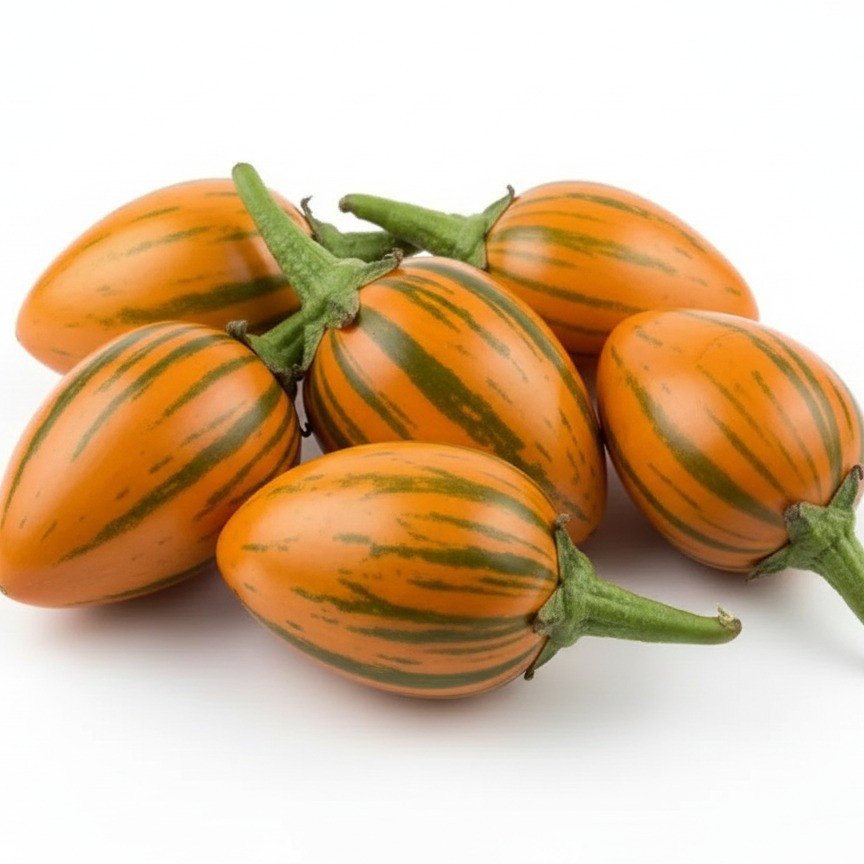
Variety
Striped Toga
created by Alex&Sempi at 27.12.2025
Features
Color
orange
striped
grey-green
glossy
medium green
Flower: white
Blätter: dunkelgrün
Oberfläche: matt
Frucht: grün
Farbe: zweifarbig
Stamm, Stiel: grün
Stamm, Stiel: violett
Wurzel: weiß
Wurzel: cremeweiß
Samen: gelb
Fruchtfleisch: weiß
Wurzel: beige
Behaarung: silbergrau
Behaarung: weiß
Fruchtfleisch: cremeweiß
Samen: beige
Oberfläche: samtig
Taste
mild
bitter
mildly toxic
Essbarkeit: Frucht
Essbarkeit: nur gekocht
Essbarkeit: roh nicht essbar
Konsistenz: fest
Konsistenz: schwammig
Location
planting: bed
planting: greenhouse
planting: outdoor
planting: raised bed
Heat requirement: high
sheltered from the wind
planting: house wall / wall
Soil: permeable soil
soil moisture: no waterlogging
fertilization: high
Fertilization: single dose of compost
Fertilization: nutrient-rich
fertilization: humus-enriched
Soil: Well fertilized
soil moisture: fresh to moist
planting: polytunnel / under protective covers
light: Full sun
soil moisture: well-drained
Water: regularly
Soil: deep
Soil: light to medium-heavy
planting: open balcony or terrace
Soil: sandy to loamy
pH value: acidic to neutral (5,5-7)
planting: covered balcony or terrace
Soil: loosened
fertilization: potassium-rich
Water: Adequate
Planting: pots, tubs, or boxes
Light: Sun
Planting: frost-free
Water: moderately
Fertilization: nitrogen-rich
Fertilization: organic
Düngemittel: Pflanzenjauche
Düngung: flüssig
Düngung: Langzeitdünger
Düngemittel: Hornspäne
Nachbarn schlechte: Schattenpflanzen
Nachbarn schlechte: kalkliebend
Good companions: sun-loving
Nachbarn schlechte: stark wuchernd
Nachbarn schlechte: hoher nährstoffbedarf
Nachbarn gute: mit niedrigen Nährstoffbedarf
Nachbarn schlechte: hochwachsend
Nachbarn gute: niedrigwachsend
Pflanztechnik: Mulchen
Gießen: Olla
Pflanzung: Hügelbeet
Pflanzung: Gewächshaus
Herkunft: Züchtung
Düngemittel: Mist, Dung
Pflanzung: überdacht
Düngung: NPK 5/3/10
Düngung: NPK 7/3/8
Resistances
robust
resistant
drought tolerant
heat tolerant
Fruit shape
egg-shaped
elongated
small
Typ: Schließfrucht - Beere
Growth habit
Pruning: Partially necessary
lifespan: annual
Autumn variety
growth habit: rank
growth habit: compact
harvest: profitable
growth habit: shrubby
root type: taproot
strong leaves
normal growth
warm germination
ornamental plant
growth habit: needs climbing support
growth habit: upright-bushy
panicle-shaped flower
hermaphroditic
growth habit: thorny
simple flower
small flowers
star-shaped flowers
large leaves
slow growth
propagation by seeds
perennial
insect pollination
hand pollination
Summer variety
Blätter: zugespitzt
Geschlechtertyp: einhäusig
Ernte: mittelreifend
Keimung: Lichtkeimer
Blätter: einfach
Leaves: slightly hairy
Seitentriebbildung: mäßig
Blätter: gelappt
Vermehrung: samenfest
height: 50 - 60 cm
wide: 30 - 40 cm
Cultivation Break
4 Years
Season Overview
Propagating
Planting
Harvest
J
F
M
A
M
J
J
A
S
O
N
D
Description
Widely used in African cuisine, this eggplant surprises with its small two-colored fruits, green and orange, which are very decorative. This unusually colored eggplant variety is a real crowd-pleaser. The elongated fruits are approx. 5 - 8 cm long. They are harvested from the end of July to October and can be eaten raw or cooked. They taste more intense than "normal" eggplants. The young leaves can be prepared like spinach. Originally from Africa, this variety is suitable for greenhouse cultivation as well as for outdoor cultivation and is particularly suitable for cultivation in pots. Cultivation under a tunnel or in a greenhouse is recommended. These climbing, upright-growing vegetable plants usually grow 1.4 to 1.8 m tall and 40 to 60 cm wide.
Non hybrid
Not frost resistant
Growing tips
Sowing time - Optimal: February to early April - The earlier, the better - eggplants need a lot of warmth and a long development period 🌡️ Germination conditions - Temperature: constant 24-28 °C - Light: bright, but not directly on the seedlings - Germination time: 7-21 days - Tip: Heating mat or warm window sill above the heater 🌱 Substrate - Fine, loose sowing soil - Optional: 10-20 % perlite for better aeration - Moisten the soil slightly, not wet 🌾 Sowing technique - Plant seeds 0.5-1 cm deep - Press down lightly - Use a mini-greenhouse or transparent cover - Ventilate daily to avoid mold 💧 Watering - Evenly moist, but no waterlogging - It is best to water from below (saucer) - After germination: remove the cap, keep slightly drier ☀️ Light after germination - Very bright, ideal: south-facing or plant lamp - Without additional light, eggplants will quickly become long and thin (become wilted) 🔄 Pricking out - When the seedlings have 2 true leaves - Transplant into nutrient-rich soil - Plant deeper than before, but not as deep as tomatoes 🪴 Further cultivation - Keep warm: at least 18-20 °C - From a height of 20-25 cm: tie up with a stick - From mid-May (frost-free): Harden off and place outdoors or in a tub ☀️ Location - Very sunny, warm and sheltered from the wind - Ideal: south-facing wall, greenhouse, foil tunnel or balcony in full sun - The more warmth, the faster and more abundant the fruiting 🪴 Cultivation in a pot or bed - Works very well in pots - Minimum pot size: 15-20 liters - Climbing/upright growing: 1.4-1.8 m high, 40-60 cm wide 🌱 Soil / substrate - Well-drained, humusy, nutrient-rich - No waterlogging - make sure there is good drainage - Ideal: Tomato/vegetable soil + 20 % perlite or sand 💧 Watering - Low water requirement - Practice: Keep evenly moist, but never wet - Pot: Avoid saucers, water must drain away 🍽️ Fertilization - Heavy feeder → weekly liquid fertilizer or slow-release fertilizer - Particularly important from the start of flowering ❄️ Frost - Not frost-hardy - Only put outside when stable above 10 °C at night - Overwintering possible: bright, 10-15 °C, little watering ✂️ Care - Tie up the main shoot (climbing/upright) - Thin out side shoots only slightly, not as strict as for tomatoes - Mulching keeps moisture stable 🍆 Fruits & harvest - Shiny, striped fruits - Harvest time: August to October - Ripe when the skin is shiny and gives way easily - Young fruits taste milder 🦠 Robustness - Striped Toga is generally easy to care for, but: ◦ Loves warmth ◦ Reacts sensitively to waterlogging ◦ only reliable outdoors in very warm locations
Details


Light requirement
Sunny

Water requirement
Moist

Soil
Medium (loamy)

Nutrient requirement
High

Light germinator

Germination temperature
24 - 28 °C (Degrees Celsius)

Plant distance
40 cm

Row spacing
60 cm

Seeding depth
0.5 cm

Companion Plants
Basil
Bean ((Scarlet) runner bean)
Bean (Broad bean / Faba bean / Field bean)
Bean (Dwarf bean)
Bean (Hyacinth bean / Lablab-bean)
Bean (Lima Bean)
Bean (Runner bean)
Beetroot
Black salsify
Borage
Buddleja / Butterfly Bushes
Carrots
Catnip
Celery (Celeriac / Celery root)
Celery (Celery)
Celery (Leaf celery / Chinese celery)
Chard
Chickpea
Chives
Comfrey
Common marigold
Coneflower (Echinacea)
Coriander / Cilantro
Currant
Daisies
Dill
Garden cosmos / Mexican aster
Garlic
Garlic chives
Gooseberry
Grasses - Other
Lettuce (Common chicory)
Lettuce (Endive / Escarole / Erisée)
Lettuce (Lamb's lettuce)
Lettuce (Lettuce)
Lettuce (Puntarelle / Cicoria di catalogna / Cicoria asparago)
Lettuce (Radicchio / Italian chicory)
Lettuce (Sugar loaf)
Melissa
Onion
Onion (Spring onion)
Oregano
Parsnip
Pea
Phlox, flame flower
Rudbeckia (Coneflower / Black-eyed-susans)
Savory
Soybean
Spinach (Summer)
Spirea
Strawberry
Sunflower
Sweet pea
Tagetes / Marigolds
Thyme
Yarrow

Antagonistic Plants
Abyssinian cabbage / Ethiopian mustard
Aubergine / Eggplant
Begonias
Blueberry
Broccoli
Broccoli raab / Stem cabbage / Cima di rapa
Brussels sprouts
Brussels sprouts
Cabbage (Cabbage)
Cabbage (Pointed cabbage)
Cabbage (red cabbage)
Cabbage (Savoy cabbage)
Cauliflower
Chili
Chinese kale - Kai-lan / Chinese broccoli
Collard greens
Collard greens (Kale)
Collard greens (Tuscan kale / Dinosaur kale / Palm tree kale)
Common mugwort
Corn / Maize
Elderberry
Fennel
Florence fennel / Finocchio
Forsythia
Funk
Geranie/Pelargonie
Grasses - Bamboos
Grasses - reeds, cattails, bulrushes
Hazelnut
Hellebores
horse chestnut
Hydrangea / Hortensia
Ivy
Jerusalem artichoke / Topinambur
Kohlrabi / German turnip / Turnip cabbage
Larkspur
Lavender
Lovage
Lupine / Bluebonnet
Make
Maples
Mizuna / Japanese mustard greens
Napa cabbage / Chinese cabbage
Nightshades (Other)
Pak Choi
Pepper / Paprika
Potato
Privet
Purple bellflower, silver bellflower
Quadriceps
Rapeseed
Rapeseed - Sheer cabbage / Siberian cabbage
Rapini / Broccoli rabe
Raspberry
Rhododendron
Rutabaga / Swedish turnip
Sage
Sea coal
Stem herbs
Succulents
Sweet woodruff / Sweetscented bedstraw
Tomato (Bush tomato)
Tomato (Cocktail bush tomato)
Tomato (Cocktail Stake Tomato)
Tomato (Stake tomato)
Turnip
Turnip greens - Choy Sum / Chinese flowering cabbage
Turnip greens - Mizuna
Turnip greens - Tatsoi
Turnips - Oilseed turnips
Turnips - Wild turnips
Vegetable cabbage - Forage cabbage
Vegetable cabbage - Ribbed cabbage / Portuguese cabbage
Vegetable cabbage - wild cabbage / ancient cabbage
Walnut family
Weigela
Willows
Women's coats
Yalta tomatoes

Diseases
Root Rot
Septoria
Grey mold
Downy mildew
Angular leaf spot of cucumber
Powdery mildews

Pests
Thrips
Spider mites
Land snails
Caterpillars
Leaf-miner flies
Cabbage white
Ten-lined potato beetle
Cutworms
Aphids
White fly