Purple bellflower, silver bellflower

Purple bellflower, silver bellflower
Heuchera
Plant family
Season Overview
Propagating
Planting
Harvest
Harvest
J
F
M
A
M
J
J
A
S
O
N
D
1ST YEAR
FOLLOWING YEARS
Details


Light requirement
Semi-shaded

Water requirement
Moist

Soil
Medium (loamy)

Nutrient requirement
Medium

Light germinator

Germination temperature
15 - 20 °C (Degrees Celsius)

Plant distance
40 cm

Row spacing
40 cm

Seeding depth
0.1 cm
Instructions
Description
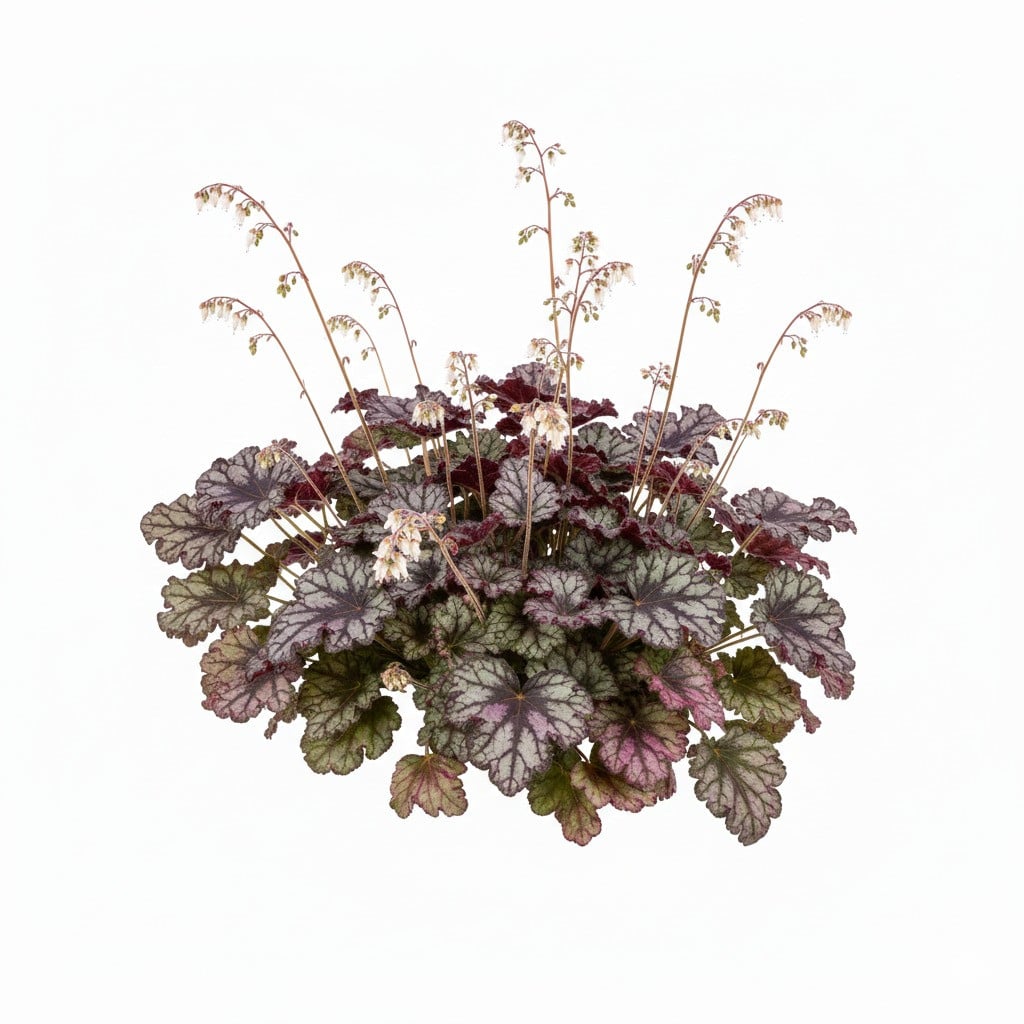
The genus Heuchera belongs to the saxifrage family (Saxifragaceae). The purple bells are mainly native to rock crevices and coastal forests in North America. The various species are mostly winter-green to evergreen perennials that grow in clumps. Purple bellflowers, also known as shade bellflowers, are extremely attractive. Their tiny, funnel-shaped bell-shaped flowers appear in abundance on branched, long-stemmed panicles and seem to float like a cloud above the compact clump. They bloom from May to July and are white, pink or red. In current cultivars - mostly crosses of Heuchera sanguinea and Heuchera americana - the attractive, lobed foliage of the purple bells is the real ornamental value of the plants. Countless varieties are available on the market and new ones are added almost every season. These impress with leaves in vibrant colors ranging from pale to dark green, yellow-orange to dark red, silver, violet and bronze to over-brown. In addition, the leaves are often beautifully patterned, their edges elegantly curled, distinctively lobed or ruffled. The smallest purple bells grow to a height of 15 to 50 centimetres, larger ones to 90 centimetres - measured by the flower stems. Strong-growing varieties form clumps up to 45 centimetres in diameter. They are just as suitable as ground cover in the light shade of trees and shrubs as they are as borders. The garden purple bells (Heuchera brizoides) originated from American wild species.
Growing tips
Heucheras need a semi-shady or sunny location. If they are moist enough, purple bells can also tolerate moderate sunlight. They prefer a fresh to moist, loose, nutrient- and humus-rich soil that should be slightly acidic and not dry out too much in summer.

Companion Plants

Antagonistic Plants

Diseases
Root Rot
Septoria
Angular leaf spot of cucumber
Powdery mildews
Pests
Land snails
Aphids