Ethiopian eggplant

Ethiopian eggplant
Solanum aethiopicum
Plant family
Solanums (Solanaceae)
Cultivation Break
4 Years
Season Overview
Propagating
Planting
Harvest
J
F
M
A
M
J
J
A
S
O
N
D
Details


Light requirement
Sunny

Water requirement
Moist

Soil
Light (sandy)
Nutrient requirement
High

Light germinator

Germination temperature
24 - 28 °C (Degrees Celsius)

Plant distance
35 cm

Row spacing
55 cm

Seeding depth
0.5 cm
Instructions
Description
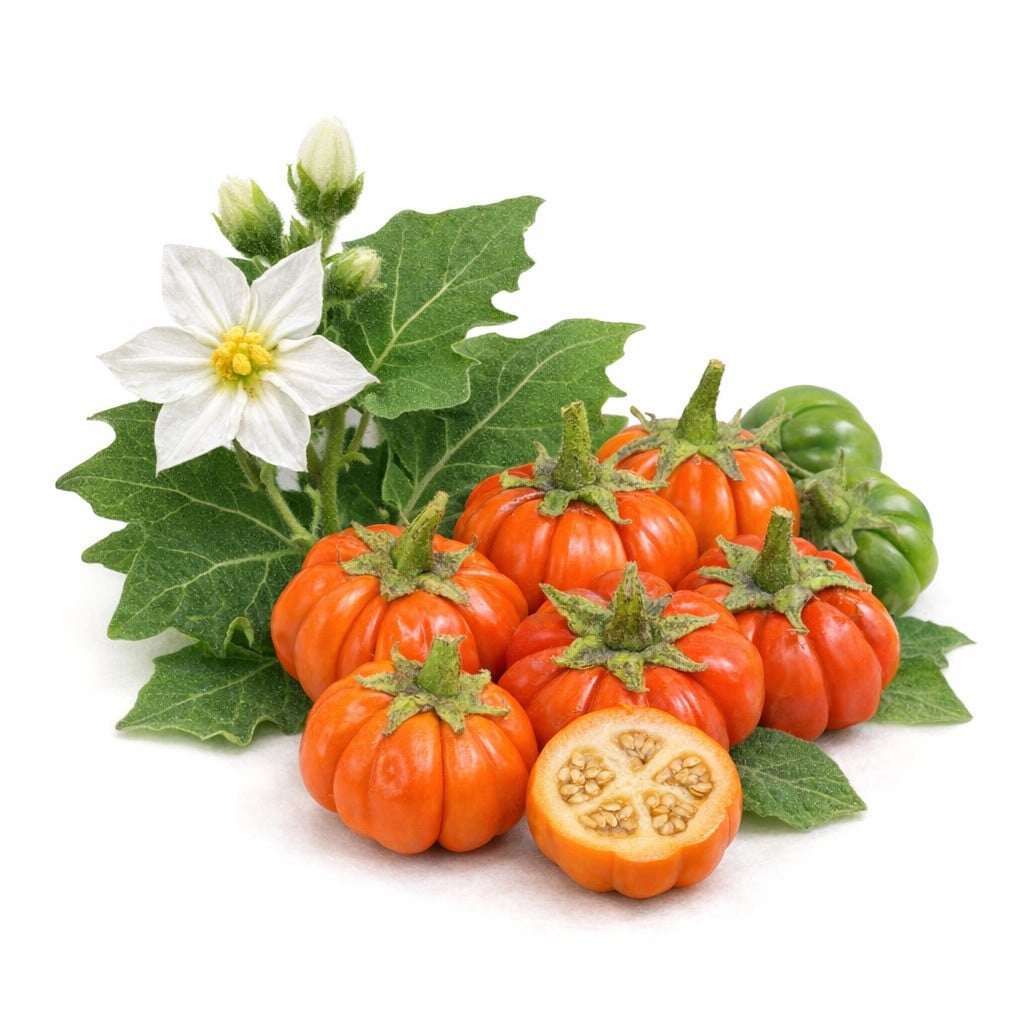
The Ethiopian eggplant (Solanum aethiopicum) is a plant species from the nightshade genus (Solanum) in the nightshade family (Solanaceae). the nightshade family (Solanaceae). Its varieties are grown as fruiting vegetables. Distribution The Ethiopian eggplant or African eggplant occurs naturally in Ethiopia and Eritrea. Through cultivation, however, the species has been introduced to numerous countries in Africa, South Asia and North and South America. Growth The Ethiopian eggplant is an annual, herbaceous plant that can grow up to 70 cm tall. It is hairy with stalked or erect, five to nine-rayed, star-shaped trichomes. The stems are covered with straight or slightly curved spines 2-5 mm long and 1-2 mm wide at the base. Leaf The upper leaves are often in unevenly shaped pairs. The leaf stalk is 2-7 cm long. The leaf blade is ovate to elongated-ovate and reaches a length of 10-20 cm and a width of 6-14 cm. The leaf blade is irregularly wavy and the tip can be pointed or blunt. The underside is covered with simple and star-shaped trichomes, along the leaf veins the pubescence is finely tomentose and consists only of star-shaped trichomes, often there are also awl-shaped spines with a length of 3-7 mm. Flower The inflorescences are outside the leaf axils due to concaulescence. They are racemose, consist of only a few flowers and are borne on a 1-1.5 cm long inflorescence stalk. The flower stalk is 5-12 cm long and covered with 0.2-2 mm long spines. The flowers are usually five-petaled, but can also be six to nine-petaled on cultivated plants. The calyx is bell-shaped, 5-7 mm long and 3-4 mm wide, with slightly irregular, ovate to ovate-lanceolate spikes. The corolla is white or slightly purple in color, star-shaped or star-wheel-shaped. It reaches a diameter of 1.5-2.5 cm, the corolla edge is about 6.5 mm wide. Fruit The fruits are orange to red-colored berries with a diameter of 1.5-3 cm, rarely they grow up to 5 cm in size. They are often furrowed four to six times lengthwise. They contain kidney-shaped seeds with a diameter of 2-3.5 mm. Use The ripe fruits of the Ethiopian eggplant are eaten raw or cooked and are also used as a remedy for colic and flatulence. The leaves are also used as food and are usually cooked before consumption. Studies have shown that the leaves have a mild antispasmodic effect.
Origin:
Äthiopien, Eritrea
Growing tips
🌞 Location & soil - Sunny to full sun, warm location - Protected from the wind, but airy - Ideal: south-facing wall, greenhouse, foil tunnel or balcony in full sun - The more warmth, the faster and more abundant the fruit production - Humus-rich, loose (ideal: tomato/vegetable soil + 20 % perlite or sand) - nutrient-rich soil - well-drained, permeable, no waterlogging 🌱 Sowing & planting - Pre-cultivation: February to early April - The earlier, the better - eggplants need plenty of warmth and a long development period - Germination temperature: 24-28 °C - Germination time: 7-21 days - Sowing depth: 0.5 cm (light germinator) - Substrate: Fine, loose sowing soil (with 10-20% perlite) - moisten slightly - Pricking out: with 1st pair of true leaves, nutrient-rich soil, 18-20°C - From a height of 20-25 cm, tie up with a stick - Planting: mid to end of May - Planting distance: 30-40 cm - Row spacing: 50-60 cm 💧 Care - Watering: little, evenly moist, always close to the ground - Basic fertilization: Compost or well-rotted manure in spring - Fertilization: heavy feeder (weekly liquid fertilizer / slow-release fertilizer) - Tie up the main shoot - Thin out side shoots only slightly - Mulching 🌾 Harvest - Harvest time: August to October - Harvest continuously for new fruit set - Leaves & fruits edible - Ripeness: when the skin is shiny and gives slightly - Young fruits taste milder ❄️ Winter protection - Not frost-hardy - Overwintering possible: bright, 10-15°C, little watering - Avoid waterlogging 🌿 Good neighbors - Basil, marigold, marigolds, borage - Beans, peas, spinach, lettuce, garlic - Echinacea, catmint, phlox, yarrow, ornamental grasses, cosmos, magerites - Oregano, thyme, savory, lemon balm, dill, coriander - Chives, onions, chard, carrots - Parsnips, beet, black salsify, celery - Potentilla, spirea, summer lilac, low roses - Mint (in pots), comfrey, sunflower - Strawberries, gooseberries, currants 🚫 Bad neighbors - Tomatoes, potatoes, peppers, chili, eggplant - Cabbages, pumpkins, turnips, rapeseed, corn, fennel, wormwood, sage - Cranesbill, lady's mantle, larkspur, lavender, limb herbs, lupine - Sedum, houseleek - Woodruff, astilbe, Jerusalem artichoke, ivy, goutweed, lovage - Ferns, funkia, bamboo, reeds, begonia, hellebore, purple bellflower - hazel, elder, privet, forsythia, hydrangea - Walnut, maple, birch, willow, chestnut, rhododendron, weigelie - Raspberries, blueberries 🍂 Diseases - Powdery and downy mildew - Verticillium wilt - Gray mold - Leaf spot diseases - Mosaic viruses (e.g. TMV) - Root rot Pests - Aphids - Whitefly - Caterpillars, cabbage white butterfly - leaf miners - Spider mites - thrips - Colorado potato beetle - snails

Companion Plants
Basil
Bean ((Scarlet) runner bean)
Bean (Broad bean / Faba bean / Field bean)
Bean (Dwarf bean)
Bean (Hyacinth bean / Lablab-bean)
Bean (Lima Bean)
Bean (Runner bean)
Beetroot
Black salsify
Borage
Buddleja / Butterfly Bushes
Carrots
Catnip
Celery (Celeriac / Celery root)
Celery (Celery)
Celery (Leaf celery / Chinese celery)
Chard
Chickpea
Chives
Comfrey
Common marigold
Coneflower (Echinacea)
Coriander / Cilantro
Currant
Daisies
Dill
Garden cosmos / Mexican aster
Garlic
Garlic chives
Gooseberry
Grasses - Other
Lettuce (Common chicory)
Lettuce (Endive / Escarole / Erisée)
Lettuce (Lamb's lettuce)
Lettuce (Lettuce)
Lettuce (Puntarelle / Cicoria di catalogna / Cicoria asparago)
Lettuce (Radicchio / Italian chicory)
Lettuce (Sugar loaf)
Melissa
Onion
Onion (Spring onion)
Oregano
Parsnip
Pea
Phlox, flame flower
Rudbeckia (Coneflower / Black-eyed-susans)
Savory
Soybean
Spinach (Summer)
Spirea
Strawberry
Sunflower
Sweet pea
Tagetes / Marigolds
Thyme
Yarrow

Antagonistic Plants
Abyssinian cabbage / Ethiopian mustard
Aubergine / Eggplant
Begonias
Blueberry
Broccoli
Broccoli raab / Stem cabbage / Cima di rapa
Brussels sprouts
Brussels sprouts
Cabbage (Cabbage)
Cabbage (Pointed cabbage)
Cabbage (red cabbage)
Cabbage (Savoy cabbage)
Cauliflower
Chili
Chinese kale - Kai-lan / Chinese broccoli
Collard greens
Collard greens (Kale)
Collard greens (Tuscan kale / Dinosaur kale / Palm tree kale)
Common mugwort
Corn / Maize
Elderberry
Fennel
Florence fennel / Finocchio
Forsythia
Funk
Geranie/Pelargonie
Grasses - Bamboos
Grasses - reeds, cattails, bulrushes
Hazelnut
Hellebores
horse chestnut
Hydrangea / Hortensia
Ivy
Jerusalem artichoke / Topinambur
Kohlrabi / German turnip / Turnip cabbage
Larkspur
Lavender
Lovage
Lupine / Bluebonnet
Make
Maples
Mizuna / Japanese mustard greens
Napa cabbage / Chinese cabbage
Nightshades (Other)
Pak Choi
Pepper / Paprika
Potato
Privet
Purple bellflower, silver bellflower
Quadriceps
Rapeseed
Rapeseed - Sheer cabbage / Siberian cabbage
Rapini / Broccoli rabe
Raspberry
Rhododendron
Rutabaga / Swedish turnip
Sage
Sea coal
Stem herbs
Succulents
Sweet woodruff / Sweetscented bedstraw
Tomato (Bush tomato)
Tomato (Cocktail bush tomato)
Tomato (Cocktail Stake Tomato)
Tomato (Stake tomato)
Turnip
Turnip greens - Choy Sum / Chinese flowering cabbage
Turnip greens - Mizuna
Turnip greens - Tatsoi
Turnips - Oilseed turnips
Turnips - Wild turnips
Vegetable cabbage - Forage cabbage
Vegetable cabbage - Ribbed cabbage / Portuguese cabbage
Vegetable cabbage - wild cabbage / ancient cabbage
Walnut family
Weigela
Willows
Women's coats
Yalta tomatoes

Diseases
Root Rot
Septoria
Grey mold
Downy mildew
Angular leaf spot of cucumber
Powdery mildews
Pests
Thrips
Spider mites
Land snails
Caterpillars
Leaf-miner flies
Cabbage white
Ten-lined potato beetle
Cutworms
Aphids
White fly