Borretsch

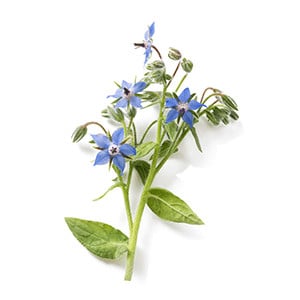
Borretsch
Borago officinalis
Pflanzenfamilie
Raublattgewächse (Boraginaceae)
Auch bekannt als
Gurkenkraut, Boretsch, Kukumerkraut
Anbaupause Fruchtwechsel
0 Jahre
Saisonübersicht
Voranzucht
Pflanzung
Ernte
J
F
M
A
M
J
J
A
S
O
N
D
Details


Lichtbedarf
Halbschattig

Wasserbedarf
Feucht

Boden
Mittelschwer (lehmig)

Nährstoffbedarf
Mittel

Dunkelkeimer

Keimtemperatur
18 - 22 °C (Grad Celsius)

Pflanzabstand
25 cm

Reihenabstand
30 cm

Saattiefe
2 cm
Anleitungen
Anfang April

Vorziehen
Mitte April

pikieren
Ende April

Abhärten
Anfang Mai

Einpflanzen
Beschreibung
Borretsch ist ein einjähriges Kraut aus der Familie der Raublattgewächse. Die haarigen und rauen Blätter schmecken und riechen nach Gurke, daher wird es auch Gurkenkraut genannt. Die blauen Blüten schmecken nussig und eignen sich prima als essbare Garnitur. Bienen mögen die Pflanze ebenfalls sehr. Borretsch wird bis zu 1 m hoch und sät sich selbst aus. Dadurch verbreitet er sich über die Jahre mehr und mehr im Garten. Junge und weiche Blätter können kontinuierlich geerntet und als Salatbeigabe verwendet werden. Ältere Blätter sind hart und rau und nicht sehr genießbar.
Herkunft:
Mittelmeerraum
Anbautipps
Boden: Borretsch mag mittelschweren, lehmigen Boden. Gut durchlässige Erde ist wichtig, um Staunässe zu vermeiden. Standort: Halbschatten ist ideal für Borretsch – weder direkte, pralle Sonne noch tiefster Schatten. Bewässerung: Er ist empfindlich gegenüber Trockenheit. Halte den Boden gleichmäßig feucht, ohne ihn zu überfluten. Pflanzabstand: Pflanze Borretsch in einem Abstand von etwa 25 cm zueinander und 30 cm zwischen den Reihen. Saatgut: Die Samen können leicht geerntet werden, um im nächsten Jahr wieder ausgesät zu werden. Vorteile für den Garten: Borretsch lockert mit seiner Pfahlwurzel den Boden auf und ist eine wertvolle Bienenweide. Seine blauen Blüten sind außerdem essbar und dekorativ. Besonders praktisch: Borretsch ist recht unkompliziert, sät sich oft von selbst aus und braucht keine aufwändige Pflege.

Gute Nachbarn
Bohne (Ackerbohne)
Bohne (Buschbohne)
Bohne (Stangenbohne)
Bohnenkraut
Chili
Dill
Erbse
Erdbeere
Gartenkürbis - Zucchini
Gartensalat
Gemüsekohl - Blumenkohl / Romanesco
Gemüsekohl - Grünkohl / Braunkohl
Gemüsekohl - Kohlrabi
Gemüsekohl - Palmkohl / Schwarzkohl
Gemüsekohl - Rosenkohl
Gemüsekohl - Weißkohl / Weißer Spitzkohl
Gemüsekohl - Wirsing / Butterkohl
Kapuzinerkressen
Kartoffel
Koriander
Kümmel
Neuanlegen 6
Paprika
Ringelblumen
Rosmarinminze
Rübsen - Chinakohl
Rübsen - Pak Choi
Salat (Radicchio)

Schlechte Nachbarn

Krankheiten
Keine Krankheiten vorhanden

Schädlinge
Blattläuse