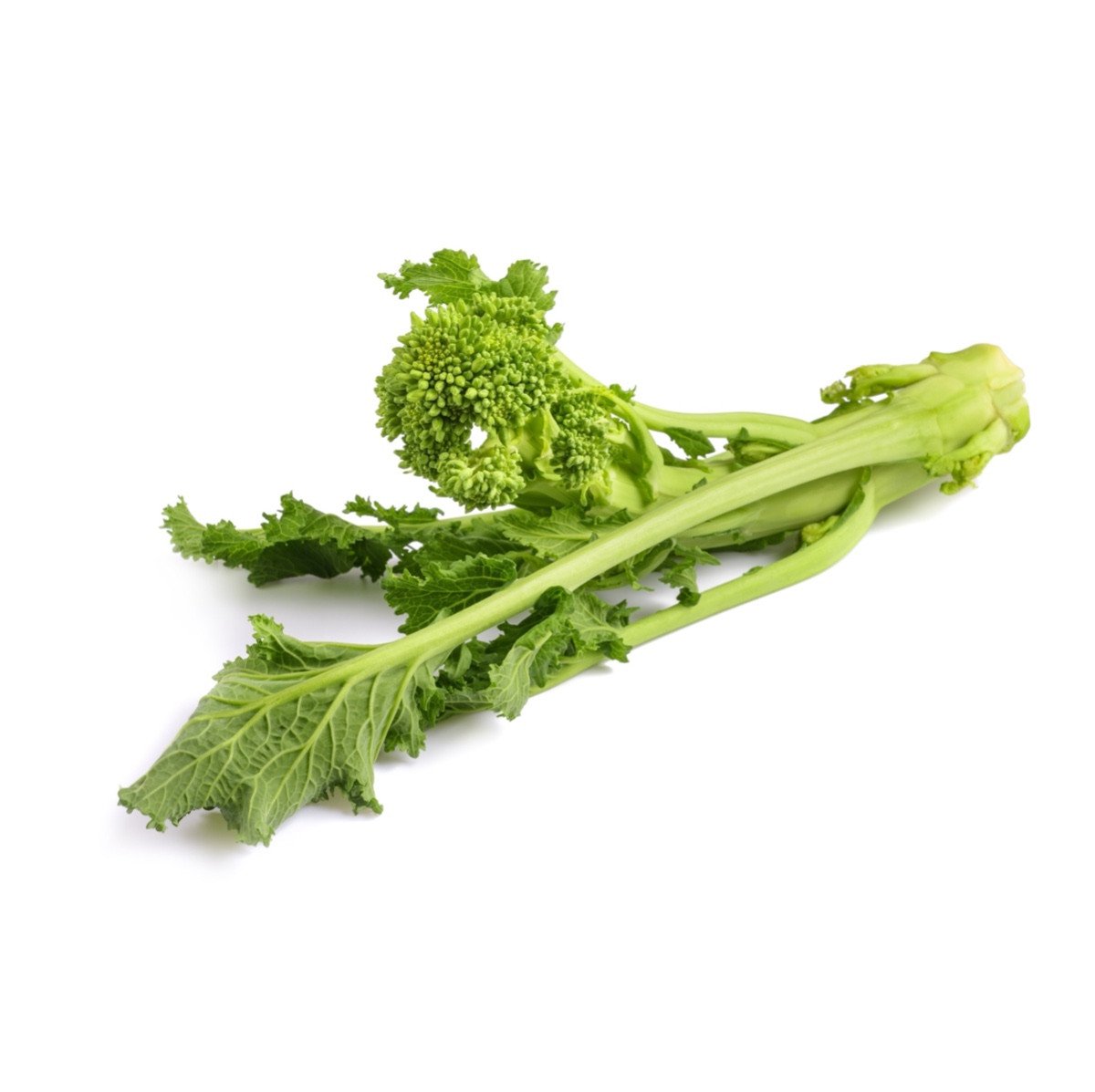
Cima di Rapa (Ursprungsart)

Variety
Cima di Rapa (Ursprungsart)
Approved Data
created by Alex&Sempi at 31.01.2026
Seed packet
Features
Resistances
robust
Location
light: sunny to semi-shady
Light: Sun
Color
medium green
Fruit shape
pod
Growth habit
umbellate flowers
Taste
cabbage flavor
Cultivation Break
4 Years
Season Overview
Sowing
Harvest
J
F
M
A
M
J
J
A
S
O
N
D
Description
Stalk cabbage (Brassica rapa subsp. Cymosa) is a variety of turnip (Brassica rapa) from the cruciferous family (Brassicaceae) that is similar to turnip greens. Depending on the region, stalk cabbage is also known as rappa, cima di rapa, or broccoli raab. Characteristics Stem cabbage is an annual plant that forms delicate, fleshy, upright stems from fine taproots and grows to a total height of about 80 to 100 centimeters. The stems of Cime di Rapa develop soft, light green, steeply angled, curly, and slightly serrated leaves. The plant bolts very quickly and then forms golden yellow clusters of flowers similar to those of rapeseed. The plant is harvested before it actually flowers. Stalk cabbage differs from the genetically closely related turnip, which has strong root formation and few leaves, in that it has many fine roots, more leaves, and bolts quickly. With leaves similar to turnips, radishes, or Chinese cabbage, stem cabbage also differs significantly from the well-known sprouting broccoli with many small individual inflorescences, which later, as broccoli of today's cultivated form, has leaves that are rather leathery and covered with a thick wax layer, similar to cabbage or cauliflower. Origin Like turnips, stem cabbage is derived from wild turnips (Brassica rapa subsp. campestris). Both forms were widely cultivated in the Apulia and Campania regions and spread from there. Significance Stem cabbage is mainly grown commercially in Italy, especially in the southern Italian regions of Campania and Apulia. There is also limited cultivation in Switzerland. In other countries, it is offered as a delicacy for connoisseurs at weekly markets. Stem cabbage is therefore a typical niche crop in vegetable cultivation. Cuisine It is considered a typical winter vegetable in Italy, Portugal, and Galicia. The vegetable smells like cabbage, has a slightly bitter aroma, and tastes milder as long as the flower buds are still closed. However, the taste is significantly more intense than that of many other types of cabbage and is sometimes perceived as strong. When the flowers open, the taste becomes even more broccoli-like, sharper, and slightly more bitter. After that, the intensity of the flavor continues to increase significantly. In Germany, it is only available regionally or occasionally at markets or, for example, at Turkish vegetable stores under the name "rappa." The flower buds are primarily edible, but the leaves and stems are also edible. It is used cooked. To do this, stem cabbage is divided into florets and stems and washed. In Apulia, cima di rapa is cut into pieces and prepared with orecchiette. Other ingredients include chopped anchovy fillets, crushed garlic, salt, and olive oil. In northern Italy, on the other hand, the stem cabbage is blanched, mixed with vinegar and oil, and served as a side dish with "bollito misto." In international cuisine, the vegetable is also blanched, refined with cream, mixed with grated cheese and breadcrumbs, and baked as a gratin. Sprouts from stem cabbage seeds have a pleasantly spicy taste. They are mixed into salads and raw vegetables or used in smoothies.
Non hybrid
Frostproof
Growing tips
🌱 Pre-cultivation - Spring cultivation: from February/March - Fall cultivation: from July - Germination temperature: 12-18 °C - Substrate: loose potting compost - Sowing depth: 1-1.5 cm - Moisten slightly, do not soak - Place in a bright spot, but not in full sun - Germination time: 5-10 days - After emergence, place in a cooler place (10-15 °C) - Keep evenly moist - Separate: As soon as 2-3 true leaves appear - Plant out after 3-4 weeks - Harden off for 7-10 days before planting out: put outside during the day, inside at night - Planting distance: 25-30 cm / row spacing: 30-40 cm - Water well immediately after planting 📅 Direct sowing - Spring sowing: March-May - Autumn sowing: August-September (often more aromatic and less susceptible to bolting) - Sowing depth: approx. 1-1.5 cm - Planting distance: 10-15 cm - Row spacing: 25-30 cm 🌱 Location & soil - Sunny to semi-shady - Loose, humus-rich soil - Evenly moist, but not waterlogged - pH value slightly alkaline to neutral 💧 Care - Water regularly, especially in warm weather - Mulching helps to retain moisture - Weak growers: light fertilization with compost or organic fertilizer - Remove weeds early ✂️ Harvest - As early as 6-8 weeks after sowing - The tender stems with buds are harvested before they blossom - Plant often sprouts again after cutting - Regular harvesting promotes new side shoots 🐛 Pests - Cabbage fly, earth fleas, caterpillars, cabbage white butterfly, cabbage midge, - aphids, snails 🍄 Diseases - Downy mildew, powdery mildew - Cabbage hernia, black rot, root rot - Leaf spot diseases - Mosaic virus 🌿 Good neighbors - Celery - Leeks, onions, garlic, chives, winter onions - Spinach, chard, beet - Salads - Dill, coriander, parsley, basil, thyme, marjoram - Tarragon, lemon balm, chervil - Savory, borage, marigold, chamomile - Potatoes, carrots - Beans, peas - Mint (in a pot) - Lavender, sage, hyssop, catnip, yarrow, comfrey, lady's mantle - Coneflower, goldenrod, St. John's wort, elecampane, woodruff - Fruit trees, elderberries, currants, gooseberries, raspberries - Blackberries, rock pear, cornelian cherry 🚫 Bad neighbors - White cabbage, red cabbage, broccoli, kohlrabi, savoy cabbage, cauliflower - Radishes, radishes, mustard, cress, rocket, rapeseed, turnips - Pumpkin, melons, zucchinis, cucumbers - Fennel, wormwood, horseradish - Peppers, chili - Tomatoes, eggplants, okra - Nasturtium - Walnut, hazelnut - Thuja, cherry laurel, maple
Details

Light requirement
Sunny

Water requirement
Moist

Soil
Medium (loamy)
Nutrient requirement
Low

Dark germinator

Germination temperature
12 - 18 °C (Degrees Celsius)

Plant distance
15 cm

Row spacing
30 cm

Seeding depth
1 cm

Companion Plants
Almond tree
Apple
Apricot
Basil
Bean ((Scarlet) runner bean)
Bean (Broad bean / Faba bean / Field bean)
Bean (Dwarf bean)
Bean (Hyacinth bean / Lablab-bean)
Bean (Lima Bean)
Bean (Runner bean)
Beetroot
Blackberry / Brambles
Borage
Catnip
Celery (Celeriac / Celery root)
Celery (Celery)
Celery (Leaf celery / Chinese celery)
Chamomile
Chard
Chervil
Chives
Chives
Comfrey
Common marigold
Coneflower (Echinacea)
Coriander / Cilantro
Currant
Dill
Dogwood
Elderberry
Garlic
Garlic chives
Gooseberry
Hyssop
Lavender
Leeks
Lettuce (Common chicory)
Lettuce (Endive / Escarole / Erisée)
Lettuce (Lamb's lettuce)
Lettuce (Lettuce)
Lettuce (Puntarelle / Cicoria di catalogna / Cicoria asparago)
Lettuce (Radicchio / Italian chicory)
Lettuce (Sugar loaf)
Melissa
Mint
Onion (Spring onion)
Parsley
Pea
Peach
Pear
Plum
Plum (tree)
Pomegranate
Quince
Raspberry
Rock pear (Amelanchier)
Root parsley
Sage
Savory
Sour cherry / Tart cherry
Soybean
Spinach (Summer)
Spinach (Winter)
St. John's wort
Sweet woodruff / Sweetscented bedstraw
Wild Cherry / Bird Cherry / Sweet Cherry
Wild garlic
Women's coats
Yarrow

Antagonistic Plants
Abyssinian cabbage / Ethiopian mustard
Arugula / Rocket
Aubergine / Eggplant
Broccoli
Brussels sprouts
Brussels sprouts
Cabbage (Cabbage)
Cabbage (Pointed cabbage)
Cabbage (red cabbage)
Cabbage (Savoy cabbage)
Cauliflower
Cherry laurel
Chili
Chinese kale - Kai-lan / Chinese broccoli
Collard greens
Collard greens (Kale)
Collard greens (Tuscan kale / Dinosaur kale / Palm tree kale)
Courgette / Zucchini
Cress
Cucumber (African horned cucumber / Kiwano)
Cucumber (Caigua)
Cucumber (Melothria)
Cucumber / Gherkin
Fennel
Florence fennel / Finocchio
Garden squash - Patisson / UFO squash
Hazelnut
Horseradish
Jerusalem artichoke / Topinambur
Kohlrabi / German turnip / Turnip cabbage
Maples
Melon (Sugar melon)
Melon (Watermelon)
Mizuna / Japanese mustard greens
Mustard
Napa cabbage / Chinese cabbage
Nasturtium
Nightshades (Other)
Oil radish / Fodder radish
Okra
Ornamental pumpkin
Pak Choi
Pepper / Paprika
Pumpkin / Squash
Radish
Radishes
Rapeseed
Rapeseed - Sheer cabbage / Siberian cabbage
Rapini / Broccoli rabe
Rutabaga / Swedish turnip
Sea coal
Sponge gourd / Egyptian cucumber / Vietnamese luffa
Tomato (Bush tomato)
Tomato (Cocktail bush tomato)
Tomato (Cocktail Stake Tomato)
Tomato (Stake tomato)
Tree of Life, Thuja
Turnip
Turnip greens - Choy Sum / Chinese flowering cabbage
Turnip greens - Mizuna
Turnip greens - Tatsoi
Turnips - Oilseed turnips
Turnips - Wild turnips
Vegetable cabbage - Forage cabbage
Vegetable cabbage - Ribbed cabbage / Portuguese cabbage
Vegetable cabbage - wild cabbage / ancient cabbage
Walnut family
Yalta tomatoes
Diseases
Angular leaf spot of cucumber
Downy mildew
Grey mold
Root Rot
Black spot of roses
Powdery mildews
Club root of cabbage
Pests
Caterpillars
Nematodes
Thrips
Land snails
Flea beetles
Aphids
Cabbage heart midge
Cabbage white
Cabbage fly