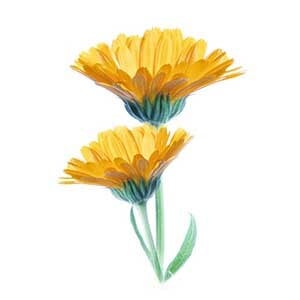
Gewöhnliche Ringelbume / Garten-Ringelblume (Wildform)

Variety
Gewöhnliche Ringelbume / Garten-Ringelblume (Wildform)
Approved Data
Features
Growth habit
lifespan: annual
Game Variety
growth habit: stable
flower: flowering
ornamental plant
growth habit: upright-bushy
self-seeding
height: 50 - 60 cm
flower: reblooming
height: 20 - 30 cm
wide: 20 - 30 cm
height: 40 - 50 cm
height: 30 - 40 cm
simple flower
Spear shaped leaves
propagation by seeds
Summer variety
Blätter: eiförmig
Blätter: mittelgroß
Wuchsform: krautig
Blätter: einfach
Blätter: duftend
Schnitt: nach Blüte
Blütenform: korbblütig
Blütenstand: einzeln, kleine Gruppen
Schnitt: bei Ernte
Vermehrung: samenfest
Stamm, Stiel: behaart
Stamm, Stiel: kantig
lifespan: biennial
harvest: continuously pickable
leaves: loosely leafed
root type: taproot
self-fruiting
fast growth
cross-pollination
flower: continuous bloomer
Fragrant flowers
hermaphroditic
entire leaves
large flowers
strong growth
non-woody
unisexual
perennial
insect pollination
Nutzungsart: Mischkultur
Geschlechtertyp: einhäusig
Keimung: Lichtkeimer
Blätter: weich/zart
Blätter: länglich
Leaves: slightly hairy
Ernteertrag: mittel
Seitentriebbildung: mäßig
Blätter: löffelförmig
Stamm, Stiel: fleischig
Blätter: klebrig
Blätter: fleischig
Location
planting: bed
planting: raised bed
soil moisture: no waterlogging
Fertilization: single dose of compost
Fertilization: nutrient-poor
fertilization: minimal
Soil: slightly loamy
light: Full sun
soil moisture: well-drained
Soil moisture: dry to moderately moist
Soil: sandy to loamy
fertilization: low-nitrogen
Soil: loosened
Light: Sun
Water: moderately
Düngung: kalktolerant
Pflanzung: Bauerngarten
Gartenstil: Naturgarten
Pflanzung: Staudenbeet
Pflanzung: Hügelbeet
Düngung: nicht erforderlich
Soil moisture: not too moist
planting: outdoor
planting: house wall / wall
Soil: permeable soil
Planting: mounds / ridges
fertilization: low-humus
Soil: light to medium-heavy
Wind: windverträglich
Gartenstil: Kräutergarten
Water: Adequate
pH value: neutral to alkaline (7-8)
Planting: rock garden / alpine garden
Planting: frost-free
planting: herb spiral
Heat requirement: moderate
Biotop: Feld
Nachbarn gute: trockenheitsliebende
Nachbarn schlecht: feuchtigkeitsliebend
Nachbarn schlechte: Schattenpflanzen
Good companions: sun-loving
Nachbarn schlechte: stark wuchernd
Nachbarn schlechte: hoher nährstoffbedarf
Nachbarn gute: mit niedrigen Nährstoffbedarf
Nachbarn schlechte: hochwachsend
Nachbarn gute: niedrigwachsend
Pflanzung: Rabatte
Herkunft: Archäophyt
Boden: mittelgründig (30-60)
Garden style: Mediterranean garden
Biotop: Ruderalflächen
Good companions: calcium-loving
Color
light green / pale green
dark yellow
medium green
orange yellow
carmine
Flower yellow
creamy-yellow
orange-red
grey-green
brown
yellow brown
Oberfläche: matt
Stamm, Stiel: grün
Wurzel: cremeweiß
Wurzel: gelb
Blattrippen: grün
Wurzel: beige
Behaarung: weiß
Oberfläche: samtig
Blattrippen: hellgrün
Stamm, Stiel: hellgrün
Frucht: graubraun
Fruit shape
jagged
crescent-shaped
horned
small
Typ: Schließfrucht - Achäne
Oberfläche: trocken
Oberfläche: hart
Resistances
susceptible to late frost
cold tolerant
resistant
robust
drought tolerant
moisture tolerant
Pest-resistant
Little susceptible
frost-sensitive
weatherproof
heat tolerant
hardy down to -5°C
Standorttolerant
Taste
mild
Slightly bitter
Edible
tender
Essbarkeit: Blüten
Toxizität: ungiftig
Konsistenz: weich
Geschmacksrichtung: Würze: leicht
Season Overview
Sowing
Harvest
J
F
M
A
M
J
J
A
S
O
N
D
Description
The flowers of the traditional medicinal plant, besides their beautiful appearance, are edible. In addition, the dried flowers spice up any herbal tea mixture. The flowers also provide a healthy soil and are also suitable for mixed crops with vegetables.
Non hybrid
Frostproof
Growing tips
Aussaat • Voranzucht: möglich ab März, Auspflanzen: Mai • Direktsaat: ab April-August • Saattiefe: 0,5 - 1 cm / Lichtkeimer • Keimdauer: 7–14 Tage • Keimtemperatur: 15-20 °C • feucht halten, nicht staunass • Reihenabstand: 25–30 cm • Pflanzabstand 20–25 cm Standort • Sonnig bis halbschattig • Verträgt karge Böden, wächst kräftiger in humusreicher Erde • Locker, humusreich, durchlässig • Keine Staunässe • pH‑Wert neutral bis leicht alkalisch Pflege • Regelmäßig, aber nicht übermäßig gießen • Düngen: nicht nötig. Allerdings kräftigt ein wenig Kompost die Pflanzen • Blüten laufend schneiden, fördert neue Knospen • Verträgt Trockenheit besser als Dauernässe • Sehr robust gegen Schädlinge Besonderheiten • Lockt viele Nützlinge an • Wirkt bodenverbessernd und wird oft als Gründüngung genutzt • Selbstaussaat sehr stark – einmal im Garten, kommt sie jedes Jahr wieder 🌼 Gute Pflanzpartner • Tomaten, Auberginen • Gurken, Zucchini, Kürbisgewächse, Melonen • Kartoffeln • Bohnen • Salate • Kohlarten • Dill, Basilikum, Petersilie • Tagetes, Kapuzinerkresse, Cosmea • Johannisbeeren, Himbeeren, Brombeeren, Stachelbeeren • Felsenbirne, Zierquitte, Kornelkirsche, Haselnuss, Zierapfel • Perlmuttstrauch 🌱 Schlechte Pflanzpartner • Fenchel • Wermut / Beifuß • Knoblauch & Zwiebeln • Kartoffeln bei starkem Schneckendruck • Forsythie, Flieder, Deutzie, Weigelie, Schneeball, Sommerflieder • Kirschlorbeer, Liguster, Berberitze, Spiere, Rhododendron, Hortensien • Eiben, Stechpalmen, Walnuss 🌿 Neutral • Paprika • Rote Bete • Möhren • Spinat • Erbsen Häufige Krankheiten • Alternaria-Blattflecken • Entyloma-Blattflecken • Echter Mehltau • Fusarium-Welke • Rost (Puccinia) • Graufäule (Botrytis) • Chlorosen Häufige Schädlinge • Blattläuse • Spinnmilben • Raupen verschiedener Schmetterlingsarten • Trauermücken (v. a. bei Topfkultur) • Schnecken (Jungpflanzen)
Details


Light requirement
Sunny

Water requirement
Dry

Soil
Medium (loamy)
Nutrient requirement
Low

Light germinator

Germination temperature
15 - 20 °C (Degrees Celsius)

Plant distance
25 cm

Row spacing
25 cm

Seeding depth
1 cm

Companion Plants
Abyssinian cabbage / Ethiopian mustard
Artichoke
Arugula / Rocket
Aster
Aubergine / Eggplant
Basil
Bean ((Scarlet) runner bean)
Bean (Broad bean / Faba bean / Field bean)
Bean (Dwarf bean)
Bean (Hyacinth bean / Lablab-bean)
Bean (Lima Bean)
Bean (Runner bean)
Beetroot
Black salsify
Blackberry / Brambles
Blueberry
Broccoli
Broccoli raab / Stem cabbage / Cima di rapa
Brussels sprouts
Brussels sprouts
Cabbage (Cabbage)
Cabbage (Pointed cabbage)
Cabbage (red cabbage)
Cabbage (Savoy cabbage)
Carrots
Cauliflower
Celery (Celeriac / Celery root)
Celery (Celery)
Chamomile
Chard
Chervil
Chili
Chinese kale - Kai-lan / Chinese broccoli
Collard greens
Collard greens (Kale)
Collard greens (Tuscan kale / Dinosaur kale / Palm tree kale)
Coriander / Cilantro
Corn / Maize
Courgette / Zucchini
Cress
Cucumber (Caigua)
Cucumber / Gherkin
Currant
Dill
Dogwood
Garden cosmos / Mexican aster
Garden squash - Patisson / UFO squash
Gooseberry
Hair cucumbers / snake gourds
Hazelnut
Kohlrabi / German turnip / Turnip cabbage
Lavender
Lettuce (Common chicory)
Lettuce (Endive / Escarole / Erisée)
Lettuce (Lamb's lettuce)
Lettuce (Lettuce)
Lettuce (Puntarelle / Cicoria di catalogna / Cicoria asparago)
Lettuce (Radicchio / Italian chicory)
Lettuce (Sugar loaf)
Marjoram
Melissa
Melon (Sugar melon)
Melon (Watermelon)
Miner's lettuce / Indian lettuce / Winter purslane
Mizuna / Japanese mustard greens
Napa cabbage / Chinese cabbage
Nasturtium
Nightshades (Other)
Oregano
Ornamental pumpkin
Pak Choi
Parsley
Parsnip
Pea
Pepper / Paprika
Physalis
Potato
Pumpkin / Squash
Radish
Radishes
Rapeseed
Rapeseed - Sheer cabbage / Siberian cabbage
Rapini / Broccoli rabe
Raspberry
Rhubarb
Rock pear (Amelanchier)
Root parsley
Rosemary
Rutabaga / Swedish turnip
Sage
Savory
Soybean
Spinach (Summer)
Strawberry
Thyme
Tomato (Bush tomato)
Tomato (Cocktail bush tomato)
Tomato (Cocktail Stake Tomato)
Tomato (Stake tomato)
Turnip
Turnip greens - Choy Sum / Chinese flowering cabbage
Turnip greens - Mizuna
Turnip greens - Tatsoi
Turnips - Oilseed turnips
Turnips - Wild turnips
Vegetable cabbage - Forage cabbage
Vegetable cabbage - Ribbed cabbage / Portuguese cabbage
Vegetable cabbage - wild cabbage / ancient cabbage
Yalta tomatoes
Zinnia

Antagonistic Plants

Diseases
Grey mold
Fusarium
Angular leaf spot of cucumber
Black spot of roses
Red spot disease
Powdery mildews
Pests
Caterpillars
Spider mites
Land snails
Aphids