Alpenveilchen / Zyklamen

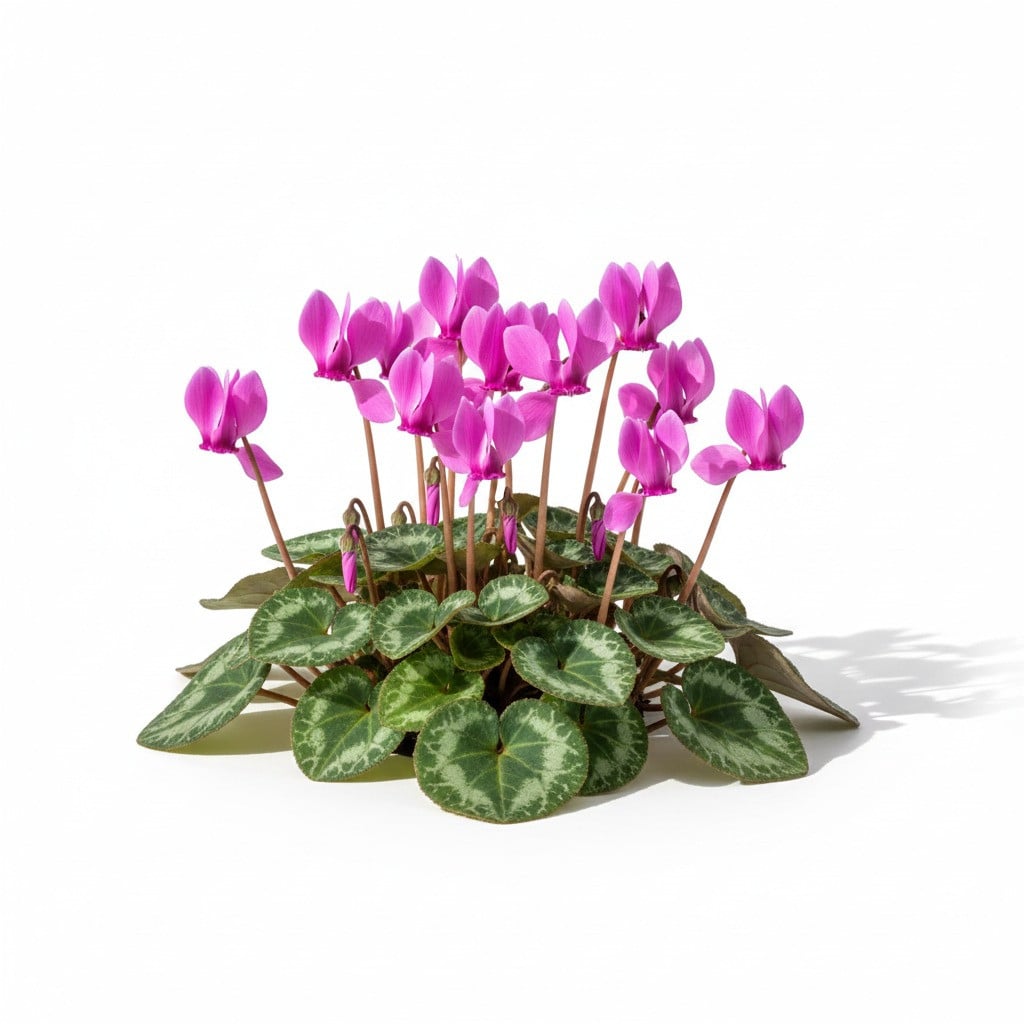
Variety
Alpenveilchen / Zyklamen
Approved Data
created by Alex&Sempi at 12.01.2026
Features
Growth habit
Winter variety
Autumn variety
lifespan: perennial
growth habit: compact
growth habit: ground cover
flower: flowering
broadleaf
root type: shallow-rooted
self-fruiting
leaves: Deciduous
strong leaves
warm germination
growth habit: rosette-shaped
cross-pollination
leaves: densely leafed
ornamental plant
self-seeding
weak growth
flower: continuous bloomer
growth habit: broad-rounded crown
serrated leaves
height: 20 - 30 cm
propagation by cuttings
leaves: leafy
wide: 20 - 30 cm
height: 40 - 50 cm
height: 30 - 40 cm
growth habit: cushion-shaped
round leaves
hermaphroditic
height: 10 - 20 cm
wide: 10-20 cm
growth habit: upright flower stems
root type: bulb, tuber
entire leaves
small flowers
star-shaped flowers
non-woody
slow growth
no lateral shoot development
propagation by seeds
propagation by division
perennial
ground cover
insect pollination
Blätter: herzförmig
leaves: leathery, tough
Summer variety
Blüte: mittelgroß
Blätter: gerillt
Blätter: mittelgroß
Geschlechtertyp: einhäusig
Keimung: Dunkelkeimer
Blüte: hängend
Wuchsform: krautig
Wuchs: nicht invasiv
Blätter: einfach
Blätter: halbimmergrün
Schnitt: nicht erforderlich
Schnitt: nicht möglich
Blütenstand: einzeln, kleine Gruppen
Blätter: gekräuselt
Vermehrung: samenfest
Blüte: zweites Standjahr
Stamm, Stiel: rund
Stamm, Stiel: fleischig
Blüte: fünfzählig
Color
brown
marbled
glossy
Flower: white
Flower: crimson
Flower: red
Flower: pink
Stem and leaf veins red
netted
Stamm, Stiel: purpur
Blätter: dunkelgrün
Blätter: silbergrau
Frucht: grün
Farbe: zweifarbig
Stamm, Stiel: grün
Wurzel: weiß
Wurzel: cremeweiß
Wurzel: braun
Blattrippen: grün
Samen: gelb
Blätter: Austrieb hellgrün
Samen: beige
Blätter: silbergrün
Resistances
robust
disease resistant
drought tolerant
Little susceptible
frost-sensitive
winter-hardy
heat tolerant
hardy down to -20°C
Location
Soil: permeable soil
soil moisture: no waterlogging
biotope: mountain area
fertilization: humus-enriched
light: light shade.
soil moisture: fresh to moist
planting: hanging basket / dish
soil moisture: well-drained
biotope: forest
soil moisture: not too dry
Planting: pots, tubs, or boxes
Light: Partial Shade to Shade
Heat requirement: cool
Boden: kalkhaltig
Düngung: kalktolerant
Pflanztechnik: Mulchen
Herkunft: Neophyt
Biotop: Felsen, Mauer
Biotop: Savanne / Buschland
planting: outdoor
planting: house wall / wall
planting: rain-protected
Planting: windowsill / indoor space
Fertilization: single dose of compost
fertilization: minimal
Fertilization: moderately nutrient-rich
Soil: gravelly to sandy
Water: regularly
planting: heat protected
wind: airy
Soil: light to medium-heavy
Planting: winter garden
Soil: sandy to loamy
Wind: windverträglich
fertilization: low-nitrogen
planting: covered balcony or terrace
Soil: loosened
Water: Adequate
pH value: neutral to alkaline (7-8)
Planting: rock garden / alpine garden
Planting: edge of wooded areas or beneath trees
Water: moderately
Fertilization: organic
fertilization: no peat
Düngemittel: Pflanzenjauche
Düngung: flüssig
Good companions: moisture-loving
Nachbarn schlecht: trockenheitsliebend
Good companions: shade tolerant
Good companions: calcium-loving
Nachbarn schlechte: sonnenliebend
Nachbarn schlechte: stark wuchernd
Nachbarn schlechte: hoher nährstoffbedarf
Nachbarn gute: mit niedrigen Nährstoffbedarf
Nachbarn gute: hochwachsend
Nachbarn gute: niedrigwachsend
Gartenstil: Naturgarten
Pflanzung: Staudenbeet
Boden: flachgründig (0-30)
Pflanzung: Waldbeet
Gartenstil: Waldgarten
Fruit shape
smooth, sleek
egg-shaped
capsule
small
globular
Oberfläche: trocken
Oberfläche: schleimig
Taste
not edible
Toxizität: stark giftig
Season Overview
Propagating
Planting
Harvest
J
F
M
A
M
J
J
A
S
O
N
D
1ST YEAR
FOLLOWING YEARS
Description
Cyclamen (bot. Cyclamen) are a genus of plants in the subfamily Myrsineae, which belongs to the primrose family. The genus comprises 22 species, most of which grow in the Mediterranean climate of the Mediterranean region. Only one species, the European cyclamen, is truly native to the Alps. The German name for cyclamen, known worldwide as Zyklamen, is therefore based on a species native to the Alpine region. The best-known cyclamen, popular as a houseplant, originally comes from Asia Minor. It came to Europe from there in the 17th century and is valued here as a houseplant. Cyclamen grow in abundance and in many varieties, especially around the Mediterranean region, due to the optimal conditions there. Many species have names specific to their country of origin, for which there are several synonyms. Plants of this genus are popular because of their long flowering period and their large, stylish, and colorful blooms. Leaves The leaves of the cyclamen are long-stemmed and simple. Many species have light markings on the upper side of the leaves, giving the foliage an attractive two-tone appearance. The leaves are round to heart-shaped, with smooth to slightly noticeable serrated edges. In some cultivated and bred varieties, the leaf edges are visibly serrated or ruffled. The two-tone appearance of the leaves accentuates the dark green veins, as they are mostly located under the darker colored parts of the foliage. Depending on the species and size, the foliage of the Cyclamen genus appears disc-shaped to plate-shaped and is extremely large in relation to the flower. Flower The flowers of all cyclamen species are terminal on long stems. Cyclamen form single flowers with a smooth surface. Even though the flowers often hang down, the petals stand upright and curve upwards. The edges of the petals are wavy to smooth, with only special cultivars exhibiting strong ripples or serrations. In nature, cyclamen bloom in white, pale pink to pink, or red to purple. The popular indoor cyclamen are available in two-tone shades, some with strongly accentuated edges. Depending on the species, the upward-curving petals reach a length of between three and ten centimeters. As indoor plants, cyclamen bloom from September to April. Fruit Cyclamen have capsule-shaped fruits. During growth, the stem curves inwards and sinks the capsule fruit into the ground. All cyclamen species form fruits that only open after sinking and thus underground. The fruits are inconspicuous and often unrecognizable due to their growth in the soil. The fruit stalk deforms into a spiral shape during the ripening period. Growth The Cyclamen plant genus grows herbaceous, is perennial, and forms disc-shaped tubers as survival organs. Cyclamen differ in terms of growth height and width, as well as in the size of their leaves and flowers. A striking feature of all species of the genus Cyclamen are the large leaves that grow above the ground on short stems. The significantly longer flower stems clearly tower above the foliage. The height depends on the species, location, and environmental conditions. Most species reach an average height of 30 to 50 centimeters. Dwarf species reach a maximum height of ten to twelve centimeters. Use Some species, such as the spring-flowering early spring cyclamen (Cyclamen coum) and the autumn-flowering ivy-leaved cyclamen (Cyclamen hederifolium), are winter-hardy in Central Europe and are planted in shady spots in gardens. The most well-known are the cultivated varieties of Cyclamen persicum hybrids. They cannot tolerate frost and are kept as houseplants in cool rooms. The leaves and tubers are poisonous due to their content of cyclamine, a saponin. The plant also has medicinal uses.
Non hybrid
Growing tips
🌼 Pre-cultivation - Best time: late winter to spring - Cyclamen germinate slowly (at least 4 to 6 weeks). - Fresh seeds germinate best. - Optional: Soak in lukewarm water for 12-24 hours - Use a fine, loose, humus-rich substrate. - Dark germination: indoor cyclamen 0.5 cm (seeds) Garden alpine violets 2-3 cm (tubers) - Moisten substrate well, avoid waterlogging. - Temperature: 15-18 °C. - Location: bright, no direct sunlight. - Moisture: evenly slightly moist. - Cover (foil/hood) possible, ventilate daily. - Prick out as soon as the seedlings have 2-3 true leaves - Keep cool and bright. - Slowly acclimatize young plants to normal room air. - Only fertilize when they are well rooted. - First flowering after 12-18 months, depending on the species. 🌱 Location & soil - Light: Indoor alpine violets: bright, no direct sunlight (east or north window). Garden alpine violets: Partial shade-shady, no direct sun (edge of shrubbery). - Temperature: cool! 12-16 °C ideal. Garden alpine violets hardy to -10°C / -20°C - Soil: rich in humus, slightly loamy, calcareous, well drained. - Moisture: keep rather dry during the dormant phase. - Planting distance: 15-25 cm depending on species 💧 Watering - Always water indoor cyclamen from below to prevent the bulb from rotting. - Keep the soil slightly moist, avoid waterlogging. - During the dormant period (summer after flowering): significantly less water. 🌸 Flowering & care - Flowering time depending on species: fall to spring. - Remove faded flowers and yellow leaves, do not cut. - Fertilize lightly every 2 weeks during the flowering period. ❄️ Overwintering - Indoor alpine violets: keep in a cool place, water little. - Hardy species (e.g. Cyclamen coum, Cyclamen hederifolium): ◦ Hardy in the garden, but need well-drained soil and possibly leaf mulch. - Many hybrids are not hardy and are only suitable for summer outdoors. 🌿 Good neighbors - Ferns, purple bells, Christmas rose, primrose, Waldsteinia, fairy flower, funkia, bergenia - Wild garlic, woodruff, mint (pot) - Rhubarb, chard, chives, lettuce - Hazel, rhododendron, azalea, cornelian cherry, dogwood, rock pear, elderberry ❌ Bad neighbors - Ivy, periwinkle, forest stonecrop, geranium, ysander, sunflower, coneflower - Thyme, rosemary, sage, oregano, lavender, olive herb, limb herbs, hyssop - Tomatoes, peppers, chili, eggplant, potato, pumpkin, zucchini, melon, beans, peas, cabbage, rape, turnips - Bamboo, cherry laurel, thuja, privet, maple, cypress, walnut 🦠 Diseases - Gray mold (Botrytis) - Powdery mildew - Fusarium wilt - Burning spot disease (Cryptocline) - Viral diseases (mosaic) - Root rot 🦟 Pests - Cyclamen mite - Aphids - thrips - spider mites - weevil - fungus gnats 🧪 Frequent problems - Yellow leaves: too warm or too wet. - Rotting: waterlogging or watering over the bulb.
Details


Light requirement
Semi-shaded

Water requirement
Moist

Soil
Medium (loamy)
Nutrient requirement
Medium

Dark germinator

Germination temperature
15 - 18 °C (Degrees Celsius)

Plant distance
20 cm

Row spacing
20 cm

Seeding depth
2.5 cm

Companion Plants
Anemone
Bergenias
Chard
Chives
Dogwood
Elderberry
Funk
Grasses - Sedges
Hazelnut
Hellebores
Lettuce (Lettuce)
Lung herbs
Make
Primula
Purple bellflower, silver bellflower
Rhododendron
Rhubarb
Rock pear (Amelanchier)
Spinach (Summer)
Spinach (Winter)
Sweet woodruff / Sweetscented bedstraw
Violets
White sausages
Wild garlic

Antagonistic Plants
Abyssinian cabbage / Ethiopian mustard
Aubergine / Eggplant
Bean ((Scarlet) runner bean)
Bean (Broad bean / Faba bean / Field bean)
Bean (Dwarf bean)
Bean (Hyacinth bean / Lablab-bean)
Bean (Lima Bean)
Bean (Runner bean)
Beetroot
Broccoli
Broccoli raab / Stem cabbage / Cima di rapa
Brussels sprouts
Brussels sprouts
Cabbage (Cabbage)
Cabbage (Pointed cabbage)
Cabbage (red cabbage)
Cabbage (Savoy cabbage)
Cauliflower
Cherry laurel
Chickpea
Chili
Chinese kale - Kai-lan / Chinese broccoli
Collard greens
Collard greens (Kale)
Collard greens (Tuscan kale / Dinosaur kale / Palm tree kale)
Coneflower (Echinacea)
Courgette / Zucchini
Cucumber (African horned cucumber / Kiwano)
Cucumber (Caigua)
Cucumber (Melothria)
Cucumber / Gherkin
Evergreen
False cypresses
Garden squash - Patisson / UFO squash
Geranie/Pelargonie
Grasses - Bamboos
Grasses - feather-bristled grasses, lamp-cleaning grasses
Grasses - Pampas grass
Grasses - reeds, cattails, bulrushes
Green lavender cotton
Hair cucumbers / snake gourds
Hyssop
Ivy
Kohlrabi / German turnip / Turnip cabbage
Lavender
Maples
Melon (Sugar melon)
Melon (Watermelon)
Mint
Mizuna / Japanese mustard greens
Napa cabbage / Chinese cabbage
Nightshades (Other)
Okra
Oregano
Ornamental pumpkin
Pak Choi
Pea
Pepper / Paprika
Potato
Privet
Pumpkin / Squash
Rapeseed
Rapeseed - Sheer cabbage / Siberian cabbage
Rapini / Broccoli rabe
Rosemary
Rudbeckia (Coneflower / Black-eyed-susans)
Rutabaga / Swedish turnip
Sage
Sea coal
Soybean
Sponge gourd / Egyptian cucumber / Vietnamese luffa
Stem herbs
Sunflower
Sweet pea
Sweet potato
Thyme
Tomato (Bush tomato)
Tomato (Cocktail bush tomato)
Tomato (Cocktail Stake Tomato)
Tomato (Stake tomato)
Tree of Life, Thuja
Turnip
Turnip greens - Choy Sum / Chinese flowering cabbage
Turnip greens - Mizuna
Turnip greens - Tatsoi
Turnip-rooted chervil
Turnips - Oilseed turnips
Turnips - Wild turnips
Vegetable cabbage - Forage cabbage
Vegetable cabbage - Ribbed cabbage / Portuguese cabbage
Vegetable cabbage - wild cabbage / ancient cabbage
Walnut family
Yalta tomatoes
Diseases
Root Rot
Grey mold
Fusarium
Powdery mildews
Ascochyta blight
Pests
Thrips
Spider mites
Aphids