Herkules

Variety
Herkules
Approved Data
created by Alex&Sempi at 24.01.2026
Seed packet
Features
Resistances
robust
cold tolerant
resistant
drought tolerant
Little susceptible
frost-sensitive
weatherproof
heat tolerant
krankheitstolerant
Location
planting: outdoor
planting: bed
planting: raised bed
planting: house wall / wall
Soil: permeable soil
soil moisture: no waterlogging
Fertilization: single dose of compost
Fertilization: nutrient-poor
Soil: slightly sandy
light: Full sun
soil moisture: well-drained
Soil moisture: dry to moderately moist
fertilization: low-humus
Water: regularly
wind: airy
Soil: light to medium-heavy
fertilization: low-nitrogen
Gartenstil: Kräutergarten
Soil: rocky, stony
Soil: loosened
Water: Adequate
Water: sparingly
pH value: neutral to alkaline (7-8)
Planting: pots, tubs, or boxes
Light: Sun
Planting: frost-free
Fertilization: organic
biotope: steppe / grassland
Heat requirement: moderate
Boden: kalkhaltig
Düngung: kalktolerant
Biotop: Feld
Pflanzung: Bauerngarten
Nachbarn gute: trockenheitsliebende
Nachbarn schlecht: feuchtigkeitsliebend
Nachbarn schlechte: Schattenpflanzen
Good companions: calcium-loving
Good companions: sun-loving
Nachbarn schlechte: stark wuchernd
Nachbarn gute: hoher nährstoffbedarf
Nachbarn gute: mit niedrigen Nährstoffbedarf
Nachbarn schlechte: hochwachsend
Nachbarn gute: niedrigwachsend
Gartenstil: Naturgarten
Biotop: Magerrasen, Trockenwiese
Pflanztechnik: Mulchen
Gießen: Olla
Gartenstil: Präriegarten
Pflanzung: Hügelbeet
Boden: mittelgründig (30-60)
Boden: karg
Herkunft: Züchtung
Düngung: nicht erforderlich
Gartenstil: Duftgarten
Taste
Slightly savory
mild
aromatic
sweetish
Slightly bitter
intensive
crunchy
savory
raw edible
Edible
juicy
crispy
tender
Essbarkeit: Blüten
Essbarkeit: Blätter
Essbarkeit: Wurzel
Essbarkeit: Stiel
Essbarkeit: Samen
Toxizität: ungiftig
Konsistenz: weich
Konsistenz: ölhaltig
Geschmacksrichtung: frisch
Growth habit
insect pollination
lifespan: annual
growth habit: compact
growth habit: high
harvest: profitable
harvest: continuously pickable
growth habit: stable
flower: flowering
root type: taproot
fast growth
harvest: early-ripening
warm germination
leaves: densely leafed
growth habit: upright slender
growth habit: upright-bushy
self-seeding
Fragrant flowers
heigth: 100 - 120 cm
height: 80 - 100 cm
wide: 30 - 40 cm
leaves: leafy
late-flowering
hermaphroditic
feathered leaves
growth habit: upright flower stems
wide: 40 - 50 cm
small flowers
umbellate flowers
star-shaped flowers
large leaves
strong growth
non-woody
propagation by seeds
herbs
Summer variety
Geschlechtertyp: einhäusig
Keimung: Lichtkeimer
Blätter: weich/zart
Wuchsform: krautig
Wuchs: nicht invasiv
Blätter: duftend
Ernte: vor Blüte
Seitentriebbildung: mäßig
Schnitt: bei Ernte
Vermehrung: samenfest
Stamm, Stiel: hohl
Stamm, Stiel: rund
Blüte: fünfzählig
Stamm, Stiel: gerillt
Fruit shape
Typ: Schließfrucht - Achäne
ribbed
smooth, sleek
egg-shaped
small
slightly flattened
slightly curved
Oberfläche: trocken
Color
Blätter: blaugrün
brown
Flower yellow
Blätter: dunkelgrün
Oberfläche: matt
Stamm, Stiel: grün
Oberfläche: schimmernd
Wurzel: cremeweiß
Samen: braun
Wurzel: beige
Stamm, Stiel: blaugrün
Cultivation Break
4 Years
Season Overview
Sowing
Harvest
J
F
M
A
M
J
J
A
S
O
N
D
Description
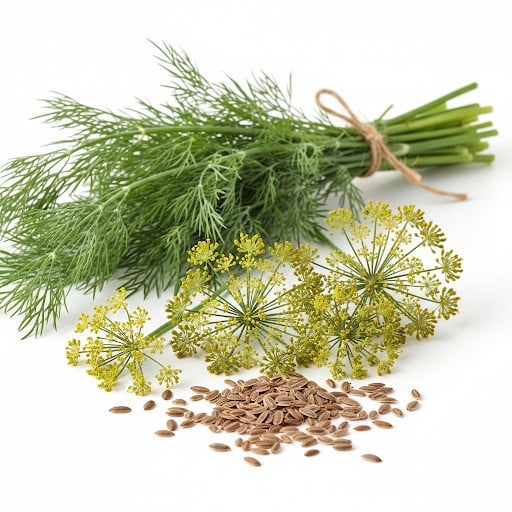
Dill, also known as dill weed or cucumber herb, is a plant species of the genus Anethum within the umbellifer family (Apiaceae). It originates from the Near East, but is now cultivated worldwide. It is the only representative of the genus Dill (Anethum). The popularity of dill as a spice plant has made the monotypic genus widely known. Hardly any other spice plant is more popular in beds and pots in German-speaking countries than dill. Even in the garden, it releases an aromatic scent caused by fats and oils. The various cultivated varieties offer something for everyone, whether you want an intense aroma, a high yield, or late flowering. Dill is also an attractive crop visually. Dill belongs to the umbellifer family and has the familiar appearance of an umbel inflorescence, which attracts numerous insects. Distribution Dill is native to the Near East. As a popular herb, dill has made its way from there to gardens all over the world. In Central Europe and Germany, wild populations can be found. Leaves Like the stems, the leaves are light green to blue-green in color. The leaves are finely pinnate and have no stipules. The leaves growing higher up on the plant are less branched and remain smaller overall than the lower leaves. Flowers The flowers grow in large, conspicuous umbels with almost 30 rays. These umbels reach diameters of up to 15 centimeters and are composed of 10 to 25 individual umbels, which in turn bear 15 to 25 flowers. The individual flowers are circularly symmetrical and have five fused petals. These are yellow and curled. The flowering period extends from May to August. Fruit The split fruits that develop from July to September are brown and about five millimeters long. When they disintegrate, they form two partial fruits. These are narrowly winged and spread by the wind. Growth Dill is a hairless plant that grows annually and reaches heights of over one meter. The non-woody, hollow stem grows upright and branches in the upper areas. Use The ancient Egyptians valued dill as a spice and medicinal plant. As early as 3,000 BC, this useful plant found its way to the Alpine region. As a culinary spice, dill refines salads, yogurt, quark, and butter. The shoot tips are a valued addition to fish and pickled gherkins. In natural medicine, all parts of the fresh plant are important, as are the dried seed heads. Dill water is said to cure digestive problems and stomach cramps, and chewing it is said to eliminate bad breath.
Non hybrid
Not frost resistant
Growing tips
🌱 Location & soil - Full sun, warm and sheltered from the wind - Loose, humus-rich soil - No waterlogging, evenly moist 🌾 Sowing - Dill does not like transplanting - always sow directly - April to August directly in the bed or in large pots - Sowing depth: approx. 0.5-1 cm - Row spacing: 20-30 cm - Planting distance: 10-15 cm - Germination time: 10-20 days - Germination temperature: 15-20 °C - Tip: Dill germinates better in slightly moist, cool soil 💧 Care - Water regularly - Lightly mulch the soil - Do not fertilize heavily - too much fertilizer makes dill unstable - Remove weeds early, as dill is tender at first 🌼 Avoid flowering (if you want to harvest leaves) - Sow as late as possible (May/June) - Keep evenly moist - Varieties such as 'Dukat' or 'Fernleaf' flower later ✂️ Harvest - Cut young shoots as soon as the plants are 20-30 cm high - For seeds: Allow plants to mature completely and dry cones 🪴 Dill in a pot - Large pot (at least 20 cm deep) - Good drainage - Water regularly, as pots dry out more quickly 🌿 Good neighbors - Basil, borage - Broccoli & other types of cabbage - Beets, turnips, rapeseed, sweet potato - Allium plants (onions, chives) - Lettuce, spinach, chard - Beans, peas, corn, Jerusalem artichokes - Cucumbers, zucchinis, pumpkins, melons - Asparagus, okra - Marigolds, nasturtium - Berry bushes (currants, raspberries) - Perennials with loose growth (echinacea, phlox, sunflowers) 🚫 Bad neighbors - Tomatoes, eggplants, potatoes - Carrots, celery, parsnip, fennel, bulbous celery - Peppers, chili & other nightshade plants - Lavender - Coriander, parsley, aniseed, caraway, chervil, lovage Crop rotation Dill belongs to the umbellifer family (Apiaceae). This also includes: carrot, parsnip, parsley, celery, fennel, coriander, caraway, aniseed. These should only be replanted in the same area every 3-4 years. 🌿 Common diseases - Powdery mildew - Downy mildew - Dill blight - Root rot 🐛 Typical pests - Aphids - Dill leaf wasp - Spider mites - snails
Details


Light requirement
Sunny

Water requirement
Dry

Soil
Light (sandy)
Nutrient requirement
Medium

Light germinator

Germination temperature
15 - 20 °C (Degrees Celsius)

Plant distance
10 cm

Row spacing
30 cm

Seeding depth
0.5 cm

Companion Plants
Abyssinian cabbage / Ethiopian mustard
Asparagus
Basil
Bean ((Scarlet) runner bean)
Bean (Broad bean / Faba bean / Field bean)
Bean (Dwarf bean)
Bean (Hyacinth bean / Lablab-bean)
Bean (Lima Bean)
Bean (Runner bean)
Beetroot
Borage
Broccoli
Broccoli raab / Stem cabbage / Cima di rapa
Brussels sprouts
Brussels sprouts
Cabbage (Cabbage)
Cabbage (Pointed cabbage)
Cabbage (red cabbage)
Cabbage (Savoy cabbage)
Cauliflower
Chard
Chinese kale - Kai-lan / Chinese broccoli
Chives
Chives
Collard greens
Collard greens (Kale)
Collard greens (Tuscan kale / Dinosaur kale / Palm tree kale)
Common marigold
Coneflower (Echinacea)
Corn / Maize
Courgette / Zucchini
Cucumber (African horned cucumber / Kiwano)
Cucumber (Caigua)
Cucumber (Melothria)
Cucumber / Gherkin
Currant
Garden squash - Patisson / UFO squash
Garlic
Garlic chives
Gooseberry
Hair cucumbers / snake gourds
Kohlrabi / German turnip / Turnip cabbage
Leeks
Lettuce (Common chicory)
Lettuce (Endive / Escarole / Erisée)
Lettuce (Lamb's lettuce)
Lettuce (Lettuce)
Lettuce (Puntarelle / Cicoria di catalogna / Cicoria asparago)
Lettuce (Radicchio / Italian chicory)
Lettuce (Sugar loaf)
Melon (Sugar melon)
Melon (Watermelon)
Mizuna / Japanese mustard greens
Napa cabbage / Chinese cabbage
Nasturtium
Okra
Onion
Onion (Spring onion)
Ornamental alliums
Pak Choi
Pea
Phlox, flame flower
Rapeseed
Rapeseed - Sheer cabbage / Siberian cabbage
Rapini / Broccoli rabe
Raspberry
Rudbeckia (Coneflower / Black-eyed-susans)
Rutabaga / Swedish turnip
Soybean
Spinach (Summer)
Spinach (Winter)
Sponge gourd / Egyptian cucumber / Vietnamese luffa
Sunflower
Sweet potato
Turnip
Turnip greens - Choy Sum / Chinese flowering cabbage
Turnip greens - Mizuna
Turnip greens - Tatsoi
Turnips - Oilseed turnips
Turnips - Wild turnips
Vegetable cabbage - Forage cabbage
Vegetable cabbage - Ribbed cabbage / Portuguese cabbage
Vegetable cabbage - wild cabbage / ancient cabbage
Wild garlic

Antagonistic Plants
Aubergine / Eggplant
Caraway / Meridian fennel / Persian cumin
Celery (Celeriac / Celery root)
Celery (Celery)
Celery (Leaf celery / Chinese celery)
Chili
Coriander / Cilantro
Cress
Fennel
Florence fennel / Finocchio
Lavender
Lovage
Nightshades (Other)
Parsley
Pimpinella
Root parsley
Rosemary
Sage
Stem herbs
Thyme
Tomato (Bush tomato)
Tomato (Cocktail bush tomato)
Tomato (Cocktail Stake Tomato)
Tomato (Stake tomato)
Tuberous zizyphus
Turnip-rooted chervil
Diseases
Root Rot
Downy mildew
Powdery mildews
Pests
Land snails
Spider mites
Aphids
Root knot nematodes
Nematodes