Koralle

Variety
Koralle
Approved Data
created by Alex&Sempi at 05.03.2026
Features
Resistances
robust
hardy down to -20°C
Color
Flower: light pink
Flower: white
Blätter: dunkelgrün
Frucht: dunkelscharlachrot
Frucht: scharlachrot
Fruchtfleisch: weiß
Taste
Edible
Essbarkeit: Frucht
Growth habit
leaves: evermoist
insect pollination
Location
biotope: swamp / moor
Fruit shape
Typ: Schließfrucht - Beere
Season Overview
Propagating
Planting
Harvest
Harvest
J
F
M
A
M
J
J
A
S
O
N
D
1ST YEAR
FOLLOWING YEARS
Description
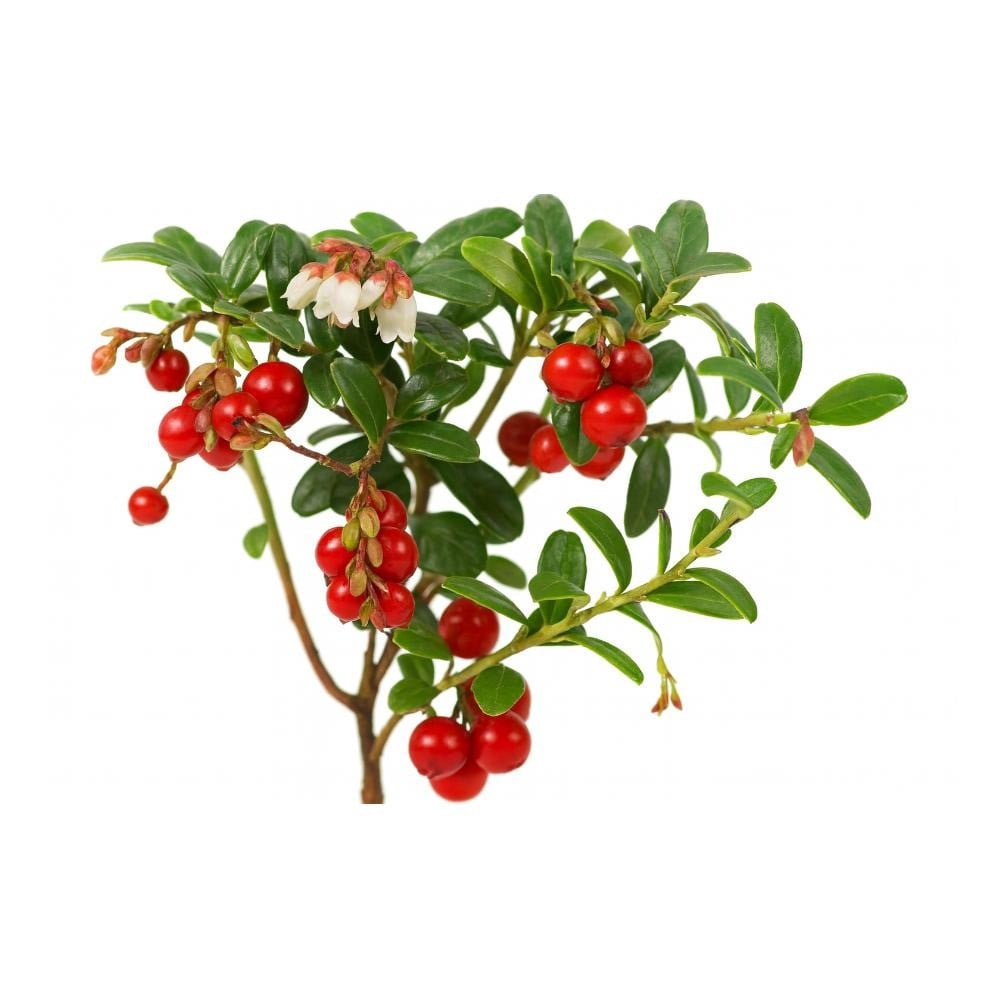
The 'Koralle' lingonberry is a magnificent ground cover plant that adorns the garden with its evergreen foliage, graceful flowers, and delicious fruits. It is easy to care for and hardy. Vaccinium vitis-idaea 'Koralle' is a low, creeping dwarf shrub. It reaches a height of between 20-30 cm and a width of 30-80 cm. Its annual growth is 5-15 cm. From May to June, the 'Koralle' lingonberry forms its graceful clusters of pure white flowers. Some of the flowers are tinged with a delicate, light pink. The individual flowers are bell-shaped and form a dazzling contrast to the dark green leaves. They develop into pea-sized berries that are ready to be picked in September. With their bright scarlet color, they form countless splashes of color on the dark green carpet of leaves. Cranberry bushes have small, leathery, oval leaves. They display their lush, glossy green color all year round. With its dense, low growth, the 'Coral' cranberry is a magnificent ground cover. It adorns large areas at the edge of woodlands and between trees. It is ideal for natural gardens. Here, in the company of blueberries and royal ferns, it brings a forest atmosphere to the garden. Vaccinium vitis-idaea 'Koralle' is a classic plant for bog beds. Accompanied by arnica, bog carnation, summer heath, or cotton grass, it adds variety and color to bog beds. It thrives in pots and window boxes on balconies or terraces. Its edible berries are characterized by their distinctive tart, sweet-sour taste. They contain valuable ingredients such as vitamin A, vitamin C, tannins, and tannic acids. Alternative medicine uses them as a remedy for conditions such as cystitis and colds. The fruits of the 'Koralle' lingonberry taste delicious with game dishes and Camembert. They are an ingredient in many cake recipes. They can also be made into jam and other delicacies. The lingonberry (Vaccinium vitis-idaea) is a plant species from the blueberry genus (Vaccinium). It is widespread in Eurasia and North America (where it is called lingonberry). The name lingonberry (also known as Preißelbeere, Preuselbeere, Prasselbeere) comes from Slavic, derived from brusina, brusnice: brown-red, after the color of the berries, or from Old Czech bruslina from Church Slavonic (o)brusiti: (ab)streifen, because the berry is easy to strip off. The Ida Mountains are the source of the Latin name Vaccinium vitis-idaea. Lingonberries are found worldwide from the temperate northern latitudes to the Arctic. Accordingly, they also have many names: lingonberries are known as crown berries, reef berries, fox berries, or the plant as wild boxwood. Lingonberries are mainly collected as wild berries in the great outdoors. The lingonberries available in stores are selected cultivated varieties that are characterized by larger fruits and a richer fruit set than the wild varieties. Similar to cranberries, lingonberries contain many vitamins, especially vitamin C. They also contain tannins, or more precisely, proanthocyanidins, which prevent many bacteria from settling and multiplying. Lingonberries are therefore also considered a medicinal plant and are used, among other things, as a natural treatment for gastrointestinal problems and bladder infections. Growth Lingonberries are frost-resistant, evergreen, compact, and upright to creeping dwarf shrubs whose shoots do not become completely woody. The above-ground parts of the plant are downy. It roots up to one meter deep. The plants spread through underground runners and grow to a height of about 20 to 40 centimeters. Their average growth width is 40 to 80 centimeters. The branches bear leathery, obovate, dark green glossy leaves with slightly downward-curling leaf margins. The downy leaf stalk is about one millimeter long. Flowering Cranberries usually flower twice a year, first from May to June and then again from July to August. They then form attractive pitcher-shaped bell flowers. The whitish to pink flowers are arranged in a dense, terminal and hanging cluster in all forms. However, the fruit set of the first flowering is usually significantly lower than that of the second. Up to eight flowers are grouped together in terminal, 1-1.5 cm long, downy, pendulous, racemose inflorescences. The quickly perishing, downy bracts are about one millimeter long, broad-ovoid, and there are also bracteoles. Fruit Five to six weeks after fertilization, the initially white, later bright red, spherical to slightly elongated berries ripen from late August to early September. Cultivated varieties also ripen a second time in September and October under good conditions. Under favorable climatic conditions (Netherlands), ripe cranberries can be found as early as the end of June. The four-chambered, multi-seeded berries have a diameter of 5-10 mm and a sour, tart aromatic or slightly bitter taste. The flesh is white and contains many seeds. Ecology It has the ecological characteristics typical of (almost) all species of the heath family (Ericaceae): obligatory symbiosis with root fungi (mycorrhiza) and lime intolerance. It prefers to grow on acidic and low-base soils (sandy soils, sandy-stony loam soils, acidic moor soils) with an acidic raw humus cover, where it can root to a depth of one meter and spread with its creeping shoots. In calcareous areas, it is restricted to special locations that are free of lime. In Central Europe, it prefers sunny locations in moors, mountain heaths, and alpine dwarf shrub scrub, but as a semi-shade plant, it can also thrive in acidic spruce and pine forests. It grows on soils with a fresh to moderately dry (alternately fresh) water balance. It relies on insects (bumblebees, bees) for pollination. The seeds are dispersed by birds that eat the red berries. In addition to its wide distribution and generative reproduction by seeds, vegetative reproduction occurs through creeping shoots in the immediate vicinity. Although cranberries often grow in close proximity to blueberries, hybrids between the two species, known as hybrid blueberries (Vaccinium × intermedium), are rare.
F1 Hybrid
Frostproof
Growing tips
The delicious cranberry prefers a sunny to semi-shady location. It also develops satisfactorily in the shade. The ideal soil contains a high proportion of humus and an acidic pH value. A peaty soil is ideal. Lingonberry 'Koralle' does not tolerate chalky soil. Watering is only necessary during longer periods without rain. 🌞 Location & soil - Sunny - semi-shady, cool location - Protected from the wind, but airy - Humus-rich, loose, sandy, acidic soil (pH 4-5) - Organic soil, coniferous litter, bark humus, boggy soil - Rather nutrient-poor soil - well-drained, permeable, alternately fresh, no waterlogging 🌱 Sowing & planting - Stratify: 4-6 weeks - Sowing depth: 0.2 cm (light germinator) - Germination temperature: 18-22 °C - Germination time: several weeks to months - Planting time: March - May (alternatively September - October) - Planting distance: 40-80 cm - Row spacing: 40-80 cm - Keep evenly slightly moist 💧 Care - Watering: regularly, never dry out, no waterlogging, no tap water - Fertilization: not required - No fresh compost, calcareous fertilizer and strong mineral universal fertilizer - Mulching: Coniferous litter (pine, spruce), bark mulch, leaves (oak, beech) in the fall 🌾 Pruning & harvesting - Pruning not required - Harvest time: July/August - October (depending on variety) - Frequency: regular harvest / ripen gradually - Pick fully ripe berries individually in dry weather or with berry comb ❄️ Winter protection - Thick layer of mulch (bark mulch, needle litter, leaves) around the root area - Keep the soil loose, avoid waterlogging - Additionally cover young plants with brushwood - Lightly mound up heavy soil if necessary or use a raised bed - Must not dry out, water occasionally 🌿 Good neighbors - Cranberry, blueberry, allackberry - Currant, gooseberry - Rhododendron, azalea, erica, calluna, ferns - Alders, spruces, pines at a distance 🚫 Bad neighbors - Heavy eaters (cabbage, pumpkin, nightshade plants) - Maple, birch, willow, hazelnut, walnut - Strawberries, raspberries, blackberries - Mediterranean herbs, sedum - Lawns, lime-loving perennials 🍂 Diseases - Gray mold - Fruit rot - Leaf spot diseases - Shoot dieback - Root rot 🐌 Pests - Aphids - frost moth - Caterpillars - Cherry vinegar fly - gall midges - scale insects - spider mites
Details


Light requirement
Semi-shaded

Water requirement
Moist

Soil
Light (sandy)
Nutrient requirement
Low

Light germinator

Germination temperature
18 - 22 °C (Degrees Celsius)

Plant distance
60 cm

Row spacing
60 cm

Seeding depth
0.2 cm

Companion Plants

Antagonistic Plants
Abyssinian cabbage / Ethiopian mustard
Anemone
Aubergine / Eggplant
Beetroot
Blackberry / Brambles
Broccoli
Broccoli raab / Stem cabbage / Cima di rapa
Brussels sprouts
Brussels sprouts
Cabbage (Cabbage)
Cabbage (Pointed cabbage)
Cabbage (red cabbage)
Cabbage (Savoy cabbage)
Cauliflower
Chili
Chinese kale - Kai-lan / Chinese broccoli
Clematis
Collard greens
Collard greens (Kale)
Collard greens (Tuscan kale / Dinosaur kale / Palm tree kale)
Courgette / Zucchini
Cucumber (African horned cucumber / Kiwano)
Cucumber (Caigua)
Cucumber (Melothria)
Cucumber / Gherkin
Garden squash - Patisson / UFO squash
Grasses - feather-bristled grasses, lamp-cleaning grasses
Grasses - Fescue
Grasses - Pampas grass
Grasses - Reedgrass
Green lavender cotton
Hair cucumbers / snake gourds
Hazelnut
Hellebores
Horsetail
Ivy
Kohlrabi / German turnip / Turnip cabbage
Lavender
Lily of the valley
Maples
Mizuna / Japanese mustard greens
Napa cabbage / Chinese cabbage
Nightshades (Other)
Okra
Oregano
Ornamental pumpkin
Pak Choi
Pepper / Paprika
Phlox, flame flower
Potato
Pumpkin / Squash
Rapeseed
Rapeseed - Sheer cabbage / Siberian cabbage
Rapini / Broccoli rabe
Raspberry
Rose
Rosemary
Rutabaga / Swedish turnip
Sage
Sea coal
Sponge gourd / Egyptian cucumber / Vietnamese luffa
Stem herbs
Stinging nettle
Strawberry
Succulents
Sweet woodruff / Sweetscented bedstraw
Thyme
Tomato (Bush tomato)
Tomato (Cocktail bush tomato)
Tomato (Cocktail Stake Tomato)
Tomato (Stake tomato)
Turnip
Turnip greens - Choy Sum / Chinese flowering cabbage
Turnip greens - Mizuna
Turnip greens - Tatsoi
Turnips - Oilseed turnips
Turnips - Wild turnips
Vegetable cabbage - Forage cabbage
Vegetable cabbage - Ribbed cabbage / Portuguese cabbage
Vegetable cabbage - wild cabbage / ancient cabbage
Walnut family
Wild garlic
Willows
Yalta tomatoes

Diseases
Root Rot
Septoria
Grey mold
Pests
Aphids
Spider mites
Schildläuse
Caterpillars
Spotted wing drosophila
Gall midges
Common winter moth