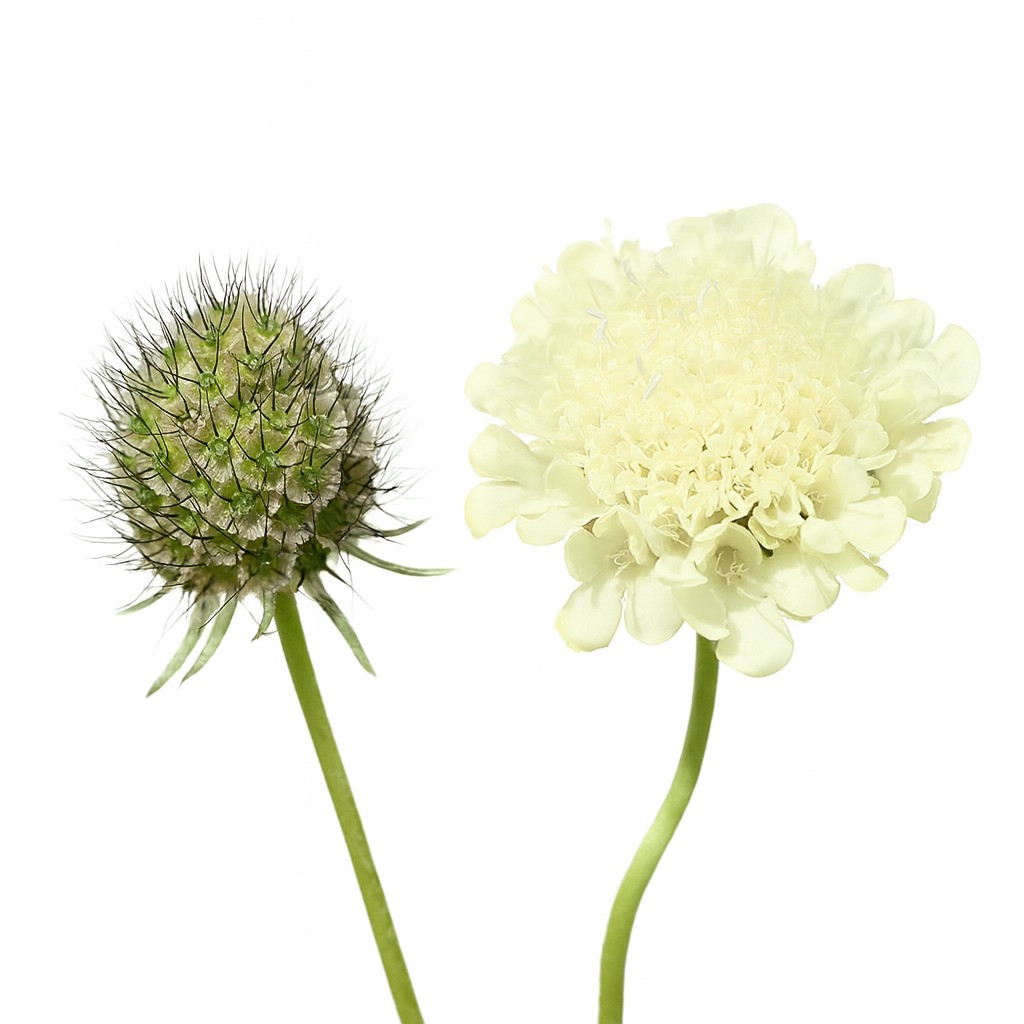
Gelbe Skabiose

Variety
Gelbe Skabiose
Approved Data
created by Alex&Sempi at 01.02.2026
Features
Resistances
robust
cold tolerant
resistant
drought tolerant
heat resistant
Pest-resistant
Winter hardy
Little susceptible
hardy down to -20°C
krankheitstolerant
Location
biotope: mountain area
Biotop: Magerrasen, Trockenwiese
planting: bed
planting: outdoor
Heat requirement: high
planting: house wall / wall
Soil: permeable soil
soil moisture: no waterlogging
Planting: mounds / ridges
Fertilization: nutrient-poor
light: Full sun
soil moisture: well-drained
Soil: light
Soil: gravelly to sandy
fertilization: low-humus
Soil: sandy
Soil: deep
wind: airy
Soil: light to medium-heavy
Wind: windverträglich
Soil: rocky, stony
Water: sparingly
pH value: neutral to alkaline (7-8)
Planting: rock garden / alpine garden
Light: Sun
Water: Let the substrate dry in between
Soil moisture: dry
biotope: steppe / grassland
Heat requirement: moderate
Düngung: kalktolerant
Pflanzung: Trockenmauer
Biotop: Feld
Pflanzung: Bauerngarten
Nachbarn gute: trockenheitsliebende
Nachbarn schlecht: feuchtigkeitsliebend
Nachbarn schlechte: Schattenpflanzen
Good companions: calcium-loving
Good companions: sun-loving
Nachbarn schlechte: stark wuchernd
Nachbarn schlechte: hoher nährstoffbedarf
Nachbarn gute: mit niedrigen Nährstoffbedarf
Nachbarn schlechte: hochwachsend
Nachbarn gute: niedrigwachsend
Gartenstil: Naturgarten
Pflanzung: Rabatte
Pflanzung: Dachbegrünung
Pflanzung: Mauerkrone
Pflanzung: Treppenrand
Pflanzung: Staudenbeet
Gartenstil: Präriegarten
Herkunft: einheimisch, indigen
Pflanzung: Hügelbeet
Boden: karg
Düngung: nicht erforderlich
Soil moisture: not too moist
Taste
not edible
Toxizität: ungiftig
Color
creamy-yellow
brown
medium green
yellow brown
pale yellow
Blätter: dunkelgrün
Frucht: goldgelb
Blüte: hellgelb
Farbe: einfarbig
Stamm, Stiel: grün
Wurzel: braun
Samen: braun
Wurzel: beige
Behaarung: silbergrau
Behaarung: weiß
Samen: beige
Oberfläche: rau
Stamm, Stiel: hellgrün
Growth habit
insect pollination
lifespan: perennial
Game Variety
tubular flower
growth habit: stable
leaves: loosely leafed
flower: flowering
root type: taproot
self-fruiting
warm germination
growth habit: rosette-shaped
cross-pollination
growth habit: upright slender
ornamental plant
self-seeding
flower: continuous bloomer
height: 50 - 60 cm
height: 20 - 30 cm
wide: 20 - 30 cm
height: 40 - 50 cm
height: 30 - 40 cm
late-flowering
hermaphroditic
feathered leaves
growth habit: upright flower stems
growth habit: Long Stalks
lobed leaves
star-shaped flowers
non-woody
Spear shaped leaves
propagation by seeds
dies back in late autumn
Blüte: scheibenförmig
leaves slim
perennial
Summer variety
Blätter: eiförmig
Blüte: mittelgroß
Blätter: mittelgroß
Geschlechtertyp: einhäusig
Keimung: Lichtkeimer
Blüte: duftend schwach
Wuchsform: krautig
Schnitt: nach Blüte
Schnitt: Spätwinter
Wuchsform: verzweigt
Leaves: slightly hairy
Seitentriebbildung: mäßig
Blütenstand: einzeln, kleine Gruppen
Life cycle: sprouts in spring
Vermehrung: samenfest
Stamm, Stiel: behaart
Blüte: filigran
Stamm, Stiel: rund
Stamm, Stiel: fleischig
Stamm, Stiel: gerillt
Fruit shape
Typ: Schließfrucht - Achäne
elongated
ribbed
triangular
egg-shaped
small
Shape: tapered
Oberfläche: trocken
Season Overview
Propagating
Planting
Harvest
J
F
M
A
M
J
J
A
S
O
N
D
1ST YEAR
Description
The yellow scabious or yellow scabious (Scabiosa ochroleuca) is a plant species from the genus Scabiosa. The original distribution area of the yellow scabious extends from Germany to Mongolia. It is a neophyte in Great Britain and France, among other places. In Germany, the yellow scabious occurs in the eastern low mountain range and in the eastern part of the North German lowlands. It is considered endangered in Germany. It does not occur in western Austria, but is common in the Pannonian region. Yellow scabious thrives in Central Europe in dry grasslands, dry meadows, embankments, railway embankments, and even on slag heaps. It is somewhat calcareous and grows from the colline to the montane altitude zone. It is a biennial to perennial herbaceous plant that reaches heights of 20 to 60 centimeters. The stem is usually branched and often heavily hairy. The basal leaves are usually simple pinnate with an ovate-lanceolate terminal leaflet, hairy on the underside at the veins. The opposite, middle stem leaves are simple to doubly pinnate, with short, curly hairs. The terminal lobes are barely wider than the lateral lobes. The capitate inflorescence has a diameter of 1.5 to 3.5 centimeters and is surrounded by bracts. The flowers are hermaphroditic with an outer calyx. The marginal flowers are radiant. The calyx has five striking fox-red (later brownish) calyx bristles. The pale to light yellow, fused-leaved corolla is five-lobed. Yellow scabious blooms from July to November and fruits from July to December. The fruit is a nut (achene). Pollination is mainly carried out by bees, bumblebees, and hoverflies, but to a lesser extent also by other insects. The dispersal of the diaspores is carried out by the wind.
Non hybrid
Frostproof
Growing tips
🌱 Pre-cultivation - From the beginning/mid-March - From April in an unheated cold frame - Fine, well-drained sowing soil - No heavily fertilized soil (scabiosas like it rather lean) - Only press seeds down lightly (light germinator) - Germination temperature: 18-20 °C - Germination time: 7-14 (21) days - Evenly slightly moist, never wet. - Keep cooler after germination (approx. 12-15 °C) - Plenty of light - Prick out when 2-3 true leaves are present - Harden off: end of April/beginning of May - Plant in the bed after the last frosts - Planting distance: 25-35 cm 🌼 Direct sowing - Direct sowing: from April/May - Press seeds only lightly (light germinator) - Planting distance: 25-35 cm, depending on variety 🌞 Location - Full sun - the more sun, the more flowers - Airy, but not draughty - Ideal for flower beds, natural gardens, dry beds and as a cut flower 🌱 Soil - Well-drained, rather poor to normally nutrient-rich - Slightly moist, no waterlogging - Work in sand or fine gravel 💧 Care - Water moderately - Allow the top layer to dry out between waterings - Remove faded leaves regularly - Lightly fertilize in early summer 🌾 Overwintering - Annual varieties die back - Perennial species (e.g. Scabiosa caucasica) are usually hardy: ◦ light winter protection from leaves or brushwood ◦ good drainage in winter 🐝 Insect magnet Scabiosas are extremely popular with bees, butterflies and hoverflies - perfect for natural gardens. 🌼 Good neighbors - Yarrow, catnip, lavender, sage - Magnificent candle, echinacea, girl's eye - Feather grass, love grass, blue fescue - Verbena, oregano, thyme - Tomatoes, peppers & chili, zucchini & pumpkin - Beans, peas - Garlic & onions - Carrots, beet - Summer lilac, dog rose, wild roses - Sea buckthorn, rock pear, currants & gooseberries 🚫 Bad neighbors - Astilbe, funkia, ferns, ragwort - Phlox, delphinium, mint, goldenrod - Woodruff, fairy flower, heuchera - Salads, cabbages, celery, spinach & chard, cucumbers - Hydrangeas, rhododendrons & azaleas, privet - Willows, dogwood 🦠 Common diseases - Powdery mildew - Root rot - Leaf spot diseases 🐛 Typical pests - Aphids - snails - thrips - Caterpillars
Details


Light requirement
Sunny

Water requirement
Dry

Soil
Medium (loamy)
Nutrient requirement
Low

Light germinator

Germination temperature
15 - 20 °C (Degrees Celsius)

Plant distance
30 cm

Row spacing
30 cm

Seeding depth
0.2 cm

Companion Plants
Bean ((Scarlet) runner bean)
Bean (Broad bean / Faba bean / Field bean)
Bean (Dwarf bean)
Bean (Hyacinth bean / Lablab-bean)
Bean (Lima Bean)
Bean (Runner bean)
Beetroot
Buddleja / Butterfly Bushes
Calliopsis / Tickseed
Carrots
Catnip
Chili
Coneflower (Echinacea)
Courgette / Zucchini
Currant
Garden squash - Patisson / UFO squash
Garlic
Garlic chives
Gooseberry
Grasses - Feather grasses
Grasses - Fescue
Grasses - Other
Lavender
Onion
Onion (Spring onion)
Oregano
Ornamental pumpkin
Pea
Pepper / Paprika
Pumpkin / Squash
Rock pear (Amelanchier)
Rose
Sage
Sea buckthorn
Soybean
Thyme
Tomato (Bush tomato)
Tomato (Cocktail bush tomato)
Tomato (Cocktail Stake Tomato)
Tomato (Stake tomato)
Verbena, ironweed
Yalta tomatoes
Yarrow

Antagonistic Plants
Abyssinian cabbage / Ethiopian mustard
Broccoli
Broccoli raab / Stem cabbage / Cima di rapa
Brussels sprouts
Brussels sprouts
Cabbage (Cabbage)
Cabbage (Pointed cabbage)
Cabbage (red cabbage)
Cabbage (Savoy cabbage)
Cauliflower
Celery (Celeriac / Celery root)
Celery (Celery)
Celery (Leaf celery / Chinese celery)
Chard
Chinese kale - Kai-lan / Chinese broccoli
Collard greens
Collard greens (Kale)
Collard greens (Tuscan kale / Dinosaur kale / Palm tree kale)
Cucumber / Gherkin
Dogwood
Funk
Hydrangea / Hortensia
Kohlrabi / German turnip / Turnip cabbage
Larkspur
Lettuce (Common chicory)
Lettuce (Endive / Escarole / Erisée)
Lettuce (Lamb's lettuce)
Lettuce (Lettuce)
Lettuce (Puntarelle / Cicoria di catalogna / Cicoria asparago)
Lettuce (Radicchio / Italian chicory)
Lettuce (Sugar loaf)
Make
Mint
Mizuna / Japanese mustard greens
Napa cabbage / Chinese cabbage
Pak Choi
Phlox, flame flower
Privet
Purple bellflower, silver bellflower
Quadriceps
Rapeseed
Rapeseed - Sheer cabbage / Siberian cabbage
Rapini / Broccoli rabe
Rhododendron
Spinach (Summer)
Spinach (Winter)
Sponge gourd / Egyptian cucumber / Vietnamese luffa
Sweet woodruff / Sweetscented bedstraw
Turnip
Turnip greens - Choy Sum / Chinese flowering cabbage
Turnip greens - Mizuna
Turnip greens - Tatsoi
Turnips - Oilseed turnips
Turnips - Wild turnips
Vegetable cabbage - Forage cabbage
Vegetable cabbage - Ribbed cabbage / Portuguese cabbage
Vegetable cabbage - wild cabbage / ancient cabbage
Willows
Diseases
Angular leaf spot of cucumber
Powdery mildews
Root Rot
Pests
Thrips
Land snails
Caterpillars
Aphids