Kriechende Jaltomate

Variety
Kriechende Jaltomate
Approved Data
created by Alex&Sempi at 03.01.2026
Features
Resistances
robust
resistant
drought tolerant
Little susceptible
frost-sensitive
heat tolerant
Location
light: sunny to semi-shady
Light: Sun
planting: greenhouse
planting: bed
planting: outdoor
planting: raised bed
Heat requirement: high
planting: house wall / wall
planting: rain-protected
Soil: permeable soil
soil moisture: no waterlogging
biotope: mountain area
Fertilization: single dose of compost
fertilization: humus-enriched
soil moisture: fresh to moist
planting: polytunnel / under protective covers
Fertilization: moderately nutrient-rich
light: Full sun
soil moisture: well-drained
biotope: forest
Soil: gravelly to sandy
Soil moisture: dry to moderately moist
Water: regularly
Soil: light to medium-heavy
planting: open balcony or terrace
Planting: winter garden
Soil: sandy to loamy
Wind: windverträglich
fertilization: low-nitrogen
planting: covered balcony or terrace
Soil: rocky, stony
Soil: loosened
fertilization: potassium-rich
Water: Adequate
Planting: frost-protected
Planting: pots, tubs, or boxes
Planting: frost-free
Fertilization: moderate
fertilization: sufficient
Soil: mineral
pH value: neutral (7)
Water: moderately
Fertilization: organic
Düngemittel: Pflanzenjauche
Pflanzung: Bauerngarten
Düngung: flüssig
Düngung: Langzeitdünger
Good companions: moisture-loving
Nachbarn schlecht: trockenheitsliebend
Nachbarn schlechte: Schattenpflanzen
Nachbarn schlechte: kalkliebend
Good companions: sun-loving
Nachbarn schlechte: stark wuchernd
Nachbarn schlechte: hoher nährstoffbedarf
Nachbarn gute: mit niedrigen Nährstoffbedarf
Nachbarn schlechte: hochwachsend
Nachbarn gute: niedrigwachsend
Gartenstil: Naturgarten
Pflanztechnik: Mulchen
Gießen: Olla
Gartenstil: Präriegarten
Herkunft: Neophyt
Boden: mittelgründig (30-60)
Pflanzung: Gewächshaus
Biotop: Felsen, Mauer
Biotop: Savanne / Buschland
Pflanzung: überdacht
Growth habit
self-fruiting
lifespan: perennial
Game Variety
harvest: profitable
growth habit: shrubby
flower: flowering
fast growth
growth habit: multi-stem cultivatable
strong lateral shoot development
harvest: early-ripening
warm germination
growth habit: sprawling
cross-pollination
subshrub
leaves: densely leafed
No pruning necessary
growth habit: prostrate
root type: heart-shaped root system
growth habit: needs climbing support
growth habit: upright-bushy
self-seeding
serrated leaves
heigth: 100 - 120 cm
height: 160 - 180 cm
height: 140 - 160 cm
propagation by cuttings
height: 180 - 200 cm
leaves: leafy
height: 120 - 140 cm
hermaphroditic
entire leaves
simple flower
small flowers
umbellate flowers
star-shaped flowers
small leaves
strong growth
propagation by seeds
insect pollination
leaves: slightly wavy
Blätter: eiförmig
Blätter: zugespitzt
Blätter: mittelgroß
Geschlechtertyp: einhäusig
Keimung: Lichtkeimer
Blätter: weich/zart
Wuchsform: krautig
Blätter: einfach
Blätter: duftend
Schnitt: Auslichtung
Schnitt: nicht erforderlich
Leaves: slightly hairy
Blütenstand: einzeln, kleine Gruppen
Vermehrung: samenfest
Stamm, Stiel: behaart
Stamm, Stiel: hohl
Stamm, Stiel: kantig
Taste
almond aroma
mild
aromatic
fruity
sweet
Melon aroma
refreshing
slightly sour
raw edible
Edible
delicious, pleasant taste
juicy
thin skin
edible skin
Essbarkeit: Frucht
Essbarkeit: Samen
Toxizität: giftig
Konsistenz: kernreich
Konsistenz: weich
Essbarkeit: nur reif
Konsistenz: schleimig
Aroma: Kiwi
Fruit shape
Typ: Schließfrucht - Beere
smooth, sleek
small
slightly flattened
globular
Color
Behaarung: weiß
glossy
yellow-green
Blätter: gelbgrün
Frucht: schwarz
Blüte: grün
Farbe: einfarbig
Frucht: schwarzviolett/violettschwarz
Oberfläche: schimmernd
Wurzel: weiß
Wurzel: cremeweiß
Samen: braun
Fruchtfleisch: weiß
Stamm, Stiel: gelbgrün
Fruchtfleisch: farblos
Cultivation Break
4 Years
Season Overview
Propagating
Planting
Harvest
Harvest
J
F
M
A
M
J
J
A
S
O
N
D
1ST YEAR
FOLLOWING YEARS
Description
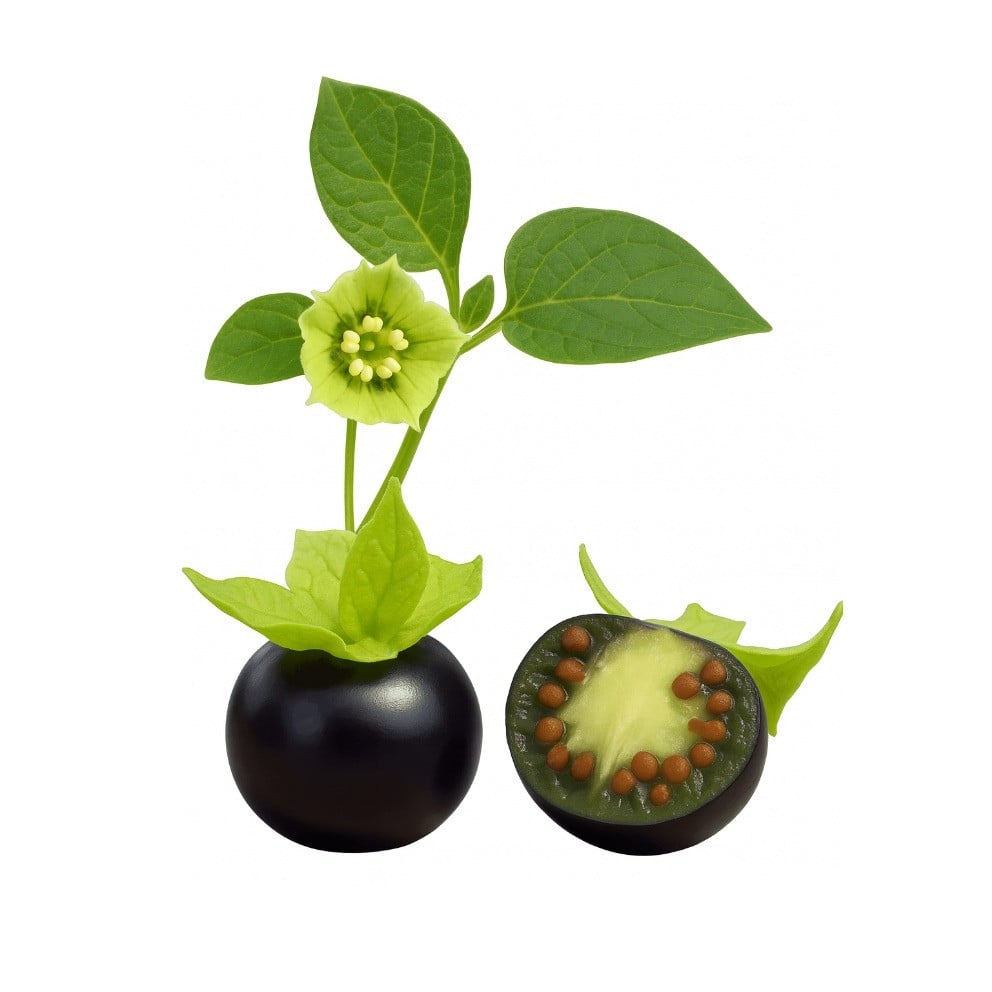
The creeping nightshade tomato or creeping nightshade berry (Jaltomata procumbens) is a plant species from the genus Jaltomata in the nightshade family (Solanaceae). The fruits of Jaltomata procumbens are occasionally used as fruit. It is perennial but not hardy (up to max. +5 degrees Celsius). The species is widespread in Mexico and Central America up to the Andes. It often grows on slopes, on arable land, in scrubland and in subtropical to temperate mountain regions. The habitats are at altitudes between 1000 and 2900 meters in open, sunny to semi-shady places. Jaltomata procumbens are up to 2 m tall, herbaceous, broadly spreading plants with a hollow, green and hairless to tomentose stem. When the trichomes dry out, they turn white. The yellow-green leaves are ovate, with entire margins or slightly wavy-toothed. They are pointed at the tip, the base is blunt or narrowed. The upper side of the leaves is hairless, with only a few trichomes on the veins. The leaf stalks are up to 5 cm long, often winged due to the narrow leaf base. The corymbose inflorescences are borne on a slightly hairy, unbranched inflorescence stalk. The flowers are usually bent backwards. The yellow to greenish-white corolla often has greenish dots and measures 10 to 15 mm in diameter. The petals are fused to about half their length and the resulting corolla lobes are triangular or blunt. On the first day of flowering the anthers are closed, they only open on the second day, at the same time the stamens also elongate (pre-feminine). The flowering period is from May to October. The edible fruit is a mucilaginous berry, black when ripe, with a diameter of 8 to 10 mm. The fruit contains many depressed, lentil-shaped seeds about 1 mm in size. The black berries, about the size of a cherry stone, taste sweet and juicy and have an aftertaste reminiscent of marzipan. Fully ripe berries taste a little like kiwi or physalis. The unripe berries and all other parts of the plant are poisonous.
Non hybrid
Not frost resistant
Growing tips
🌡️ Sowing - Possible all year round, ideal February-May - No pre-treatment necessary - Germination temperature: 20-26 °C - Germination period: 7-30 days (depending on species) - Light: germination independent of light, but brighter conditions promote strong seedlings - Substrate: fine, loose, slightly moist - Depth: cover only 0.2-0.5 cm (very fine seeds) - Always slightly moist, never wet 💧 Young plant phase - Light requirement: high, similar to tomato or physalis - Temperature: 18-24 °C - Growth: fast, soft stems → support early - Pricking out: as soon as 2-3 true leaves are present - Fertilization: very sparingly, only after 3-4 weeks 🪴 Planting - Planting out: after the ice saints - 20-200 cm high, broadly spreading - often semi-recumbent growth - Planting distance: ◦ creeping species: 40-60 cm ◦ Upright species: 60-80 cm ◦ shrubby species: 80-120 cm - Pot culture: very well possible ◦ Pot size: 5-20 L depending on species ◦ Drainage important ☀️ Location - Sun to partial shade - Warm, sheltered from wind - Can be grown outdoors, in containers or greenhouses (similar to tomatoes) - Soil: humusy, loose, slightly moist - pH: slightly acidic to neutral 🌼 Care - Watering: evenly moist, but not wet - Fertilizing: moderate, every 2-3 weeks with organic liquid fertilizer - Support: useful for upright species - Pinching out: not necessary (unlike tomatoes) - Mulching: retains moisture and promotes fruit set 🍇 Flowering & fruit - Flowering time: from June-July, depending on the species - Pollination: self-fertile, insects improve yield - Fruit set: abundant, often in clusters - Ripening time: 60-90 days after flowering - Signs of ripeness: Color (green → yellow/orange/red/black/purple), soft consistency - Taste: mildly sweet - neutral, very juicy, low acidity, aromatic, fruity ⚠️ Important - Unripe fruits and plant parts are poisonous - Risk of confusion with belladonna (Atropa belladonna) ❄️ Overwintering - Jaltomata is not frost hardy. - Possibilities: Cultivate as an annual (easiest) ◦ Overwinter frost-free as a container plant (10-15 °C, light) ◦ Take cuttings in the fall (very easy!) 🦠 Diseases - Powdery mildew - Downy mildew - Gray mold - Root rot - Virus diseases (rare) 🐛 3. pests - Aphids - Whiteflies - Spider mites - Thrips - snails - Miner flies - Caterpillars 🟢 Good neighbors - Basil, parsley, dill, coriander, mint (pot) - Marigold, marigold, nasturtium, phacelia - Lettuce, spinach, chard, bush beans - Carrots, beet, radishes 🔴 Bad neighbors - Tomato, pepper/chilli, eggplant, potato, other nightshades - Cabbage plants (broccoli, kohlrabi, white cabbage) - Zucchini / pumpkin / melon - maize - Jerusalem artichoke, sunflower - Mint (in the ground!) - Horseradish, radishes - celery - cucumbers - okra - Rice or marsh plants
Details


Light requirement
Sunny

Water requirement
Moist

Soil
Medium (loamy)

Nutrient requirement
Medium

Light germinator

Germination temperature
20 - 26 °C (Degrees Celsius)

Plant distance
80 cm

Row spacing
100 cm

Seeding depth
0.2 cm

Companion Plants
Basil
Bean (Dwarf bean)
Beetroot
Carrots
Chard
Common marigold
Coriander / Cilantro
Dill
Lettuce (Common chicory)
Lettuce (Endive / Escarole / Erisée)
Lettuce (Lamb's lettuce)
Lettuce (Lettuce)
Lettuce (Radicchio / Italian chicory)
Lettuce (Sugar loaf)
Nasturtium
Parsley
Phacelia / Scorpionweed / Heliotrope
Radishes
Root parsley
Spinach (Summer)
Spinach (Winter)
Tagetes / Marigolds

Antagonistic Plants
Abyssinian cabbage / Ethiopian mustard
Aubergine / Eggplant
Broccoli
Broccoli raab / Stem cabbage / Cima di rapa
Brussels sprouts
Brussels sprouts
Cabbage (Cabbage)
Cabbage (Pointed cabbage)
Cabbage (red cabbage)
Cabbage (Savoy cabbage)
Cauliflower
Celery (Celeriac / Celery root)
Celery (Celery)
Celery (Leaf celery / Chinese celery)
Chili
Chinese kale - Kai-lan / Chinese broccoli
Collard greens
Collard greens (Kale)
Collard greens (Tuscan kale / Dinosaur kale / Palm tree kale)
Corn / Maize
Courgette / Zucchini
Cucumber (Caigua)
Cucumber / Gherkin
Garden squash - Patisson / UFO squash
Grasses - reeds, cattails, bulrushes
Grasses - Sedges, Rushes
Hair cucumbers / snake gourds
Horseradish
Jerusalem artichoke / Topinambur
Kohlrabi / German turnip / Turnip cabbage
Melon (Sugar melon)
Melon (Watermelon)
Mint
Mizuna / Japanese mustard greens
Napa cabbage / Chinese cabbage
Nightshades (Other)
Oil radish / Fodder radish
Okra
Ornamental pumpkin
Pak Choi
Pepper / Paprika
Potato
Pumpkin / Squash
Radish
Rapeseed
Rapeseed - Sheer cabbage / Siberian cabbage
Rapini / Broccoli rabe
Rutabaga / Swedish turnip
Sea coal
Sunflower
Tomato (Bush tomato)
Tomato (Cocktail bush tomato)
Tomato (Cocktail Stake Tomato)
Tomato (Stake tomato)
Turnip
Turnip greens - Choy Sum / Chinese flowering cabbage
Turnip greens - Mizuna
Turnip greens - Tatsoi
Turnips - Oilseed turnips
Turnips - Wild turnips
Vegetable cabbage - Forage cabbage
Vegetable cabbage - Ribbed cabbage / Portuguese cabbage
Vegetable cabbage - wild cabbage / ancient cabbage

Diseases
Root Rot
Grey mold
Downy mildew
Powdery mildews
Pests
Thrips
Spider mites
Land snails
Caterpillars
Leaf-miner flies
Aphids
White fly