Jaune Panaché de Vert

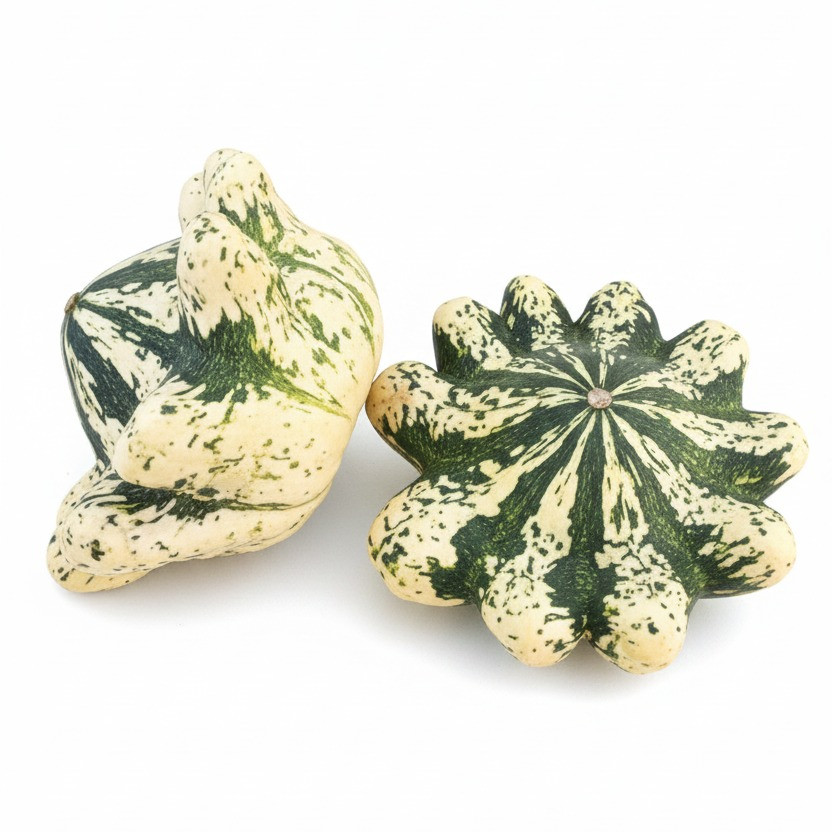
Variety
Jaune Panaché de Vert
Approved Data
created by Alex&Sempi at 27.12.2025
Features
Taste
aromatic
mild
creamy
intensive
buttery
raw edible
Edible
delicious, pleasant taste
juicy
tender
A little floury
thin skin
Essbarkeit: Blüten
edible skin
soft skin
Essbarkeit: Frucht
Toxizität: ungiftig
Konsistenz: weich
Essbarkeit: eingelegt
Konsistenz: festfleischig
Resistances
robust
resistant
drought tolerant
heat tolerant
Fruit shape
ufo-shaped
ribbed
wavy
star-shaped
slightly hairy
medium-sized
Location
light: Full sun
planting: greenhouse
planting: bed
planting: outdoor
Heat requirement: high
sheltered from the wind
planting: house wall / wall
Soil: permeable soil
soil moisture: no waterlogging
Planting: mounds / ridges
fertilization: high
Fertilization: single dose of compost
Fertilization: nutrient-rich
fertilization: humus-enriched
Soil: Well fertilized
soil moisture: moist
soil moisture: well-drained
Water: regularly
Soil: deep
wind: airy
Soil: light to medium-heavy
Soil: sandy to loamy
Soil: loosened
fertilization: potassium-rich
Water: Adequate
Light: Sun
Planting: frost-free
pH value: neutral (7)
Water: moderately
Fertilization: nitrogen-rich
Fertilization: organic
Düngemittel: Pflanzenjauche
Biotop: Feld
Pflanzung: Bauerngarten
Düngung: flüssig
Düngung: Langzeitdünger
Düngemittel: Hornspäne
Good companions: moisture-loving
Nachbarn schlecht: trockenheitsliebend
Nachbarn schlechte: Schattenpflanzen
Nachbarn schlechte: kalkliebend
Good companions: sun-loving
Nachbarn schlechte: stark wuchernd
Nachbarn schlechte: hoher nährstoffbedarf
Nachbarn gute: mit niedrigen Nährstoffbedarf
Nachbarn gute: hochwachsend
Nachbarn gute: niedrigwachsend
Pflanztechnik: Mulchen
Gießen: Olla
Pflanzung: Hügelbeet
Pflanzung: Gewächshaus
Herkunft: Züchtung
Düngemittel: Mist, Dung
Düngung: NPK 5/3/10
Düngung: NPK 7/3/8
Growth habit
insect pollination
lifespan: annual
Autumn variety
growth habit: compact
growth habit: bushy
harvest: profitable
harvest: continuously pickable
growth habit: shrubby
growth habit: ground cover
flower: flowering
broadleaf
root type: taproot
strong leaves
fast growth
strong lateral shoot development
harvest: early-ripening
growth habit: broad
warm germination
Nutzungsart: Ur-/Alte Sorte
growth habit: prostrate
root type: heart-shaped root system
ornamental plant
growth habit: needs climbing support
heigth: 100 - 120 cm
height: 80 - 100 cm
leaves: leafy
wide: 90 - 100 cm
wide: 80 - 90 cm
wide: 100 - 150 cm
growth habit: well-branched
funnel-shaped
simple flower
large flowers
large leaves
strong growth
propagation by seeds
limited growth
perennial
hand pollination
Summer variety
Geschlechtertyp: einhäusig
Keimung: Dunkelkeimer
Blüte: duftend schwach
Blätter: einfach
Leaves: slightly hairy
Blüte: kurzlebig
Blütenstand: einzeln, kleine Gruppen
Blätter: gelappt
Schnitt: bei Ernte
Vermehrung: samenfest
Geschlecht: getrenntgeschlechtlich
Wurzeltyp: Adventivwurzeln
Color
Frucht: cremegelb
striped
speckled
dark green
medium green
Flower yellow
Frucht: blassgelb
Frucht: creme
Stem, trunk: greenish-grey
Stamm, Stiel: grün
Pattern: variegated
Wurzel: weiß
Wurzel: cremeweiß
Seeds: white/cream
Fruchtfleisch: gelb
Wurzel: beige
Behaarung: silbergrau
Behaarung: weiß
Fruchtfleisch: cremeweiß
Oberfläche: glatt
Samen: beige
Oberfläche: samtig
Blattrippen: hellgrün
Stamm, Stiel: gelbgrün
Cultivation Break
3 Years
Season Overview
Propagating
Planting
Harvest
J
F
M
A
M
J
J
A
S
O
N
D
Description
This pretty patisson is a French variety by Bruno Defay from 1885, now quite rare. The plant has a shrubby, semi-climbing habit and is robust. They are slightly smaller than other patisson squashes and are also characterized by a much thinner skin than yellow or white varieties and firm, slightly floury, white flesh. Panaché Jaune de Vert is a creamy white to pale yellow patisson with beautiful, plump, disc-shaped fruits with dark green stripes and a beautifully wavy edge. The stripes usually only appear later during the ripening process. The cream-colored skin is accentuated by the vivid, dark green stripes, a real eye-catcher! The flesh is tasty and tender. The variety is very fruitful. Young fruits are about the size of a palm and do not yet have any stripes. Young, raw, grated fruits have a mild artichoke aroma. They can be used in various recipes in different ways. For example, in salads, as a dip, in lasagna, as a soup or in savory cakes. You can even preserve them. Harvest the baby fruits (with a diameter of 5 - 7 cm) immediately before you want to use them. Because the skin is still soft, they are very delicate and do not keep for long. Cut open the mature, hard fruit in the fall (approx. 20 cm in diameter) and bake whole with filling in the oven. Very good. For the filling, simply use whatever is available (also good as leftovers) and bake in the oven at 180°C for about 20 minutes. Scoop out the pumpkin flesh together with the filling. Would you prefer to use them as ornamental fruit? Then leave them to ripen completely. The skin is then harder and you can use them as decoration for a few months.
Non hybrid
Not frost resistant
Growing tips
🌞 1. location - Full sun, warm, sheltered from the wind - Ideal: south-facing, 6-10 hours of sunshine - Soil: humus-rich, deep, nutrient-rich - pH: slightly acidic to neutral (6.2-7.0) 🌱 2. sowing & planting Sowing - Pre-cultivation: from mid-April - Direct sowing: from mid-May (frost-free) - Sowing depth: 2-3 cm - Germination temperature: 20-24 °C - Germination time: 5-10 days Planting distance - 80-100 cm between the plants - 120-150 cm between the rows - The variety can grow semi-climbing → allow a little more space or direct it to a small trellis. 💧 3. care Watering - Keep evenly moist - Water in the morning - No waterlogging - Mulching (straw, grass clippings) retains moisture and protects fruit Fertilization - Heavy feeders - Before planting: compost + horn shavings - During the season: top up with organic fertilizer every 2-3 weeks Climbing behavior - The variety is sometimes semi-climbing - Advantage: fruits stay clean, fewer snails - You can guide them to a small trellis or 3-4 bamboo poles 🍽️ 4th harvest - Harvest time: approx. 50 days after planting - Young (10-15 cm): mild artichoke flavor - Ripe: ideal for stuffing, very good shelf life Harvesting tips - Cut with a sharp knife - Leave the stem attached → better storage - Store ripe fruit in a cool, dry place (2-3 months possible) 🐛 5. diseases & pests - Mildew: prevent by keeping in an airy position, do not water over the leaves - Snails: especially on young plants - Pumpkin fly (rare): Yellowing tablets + early covering 🌼 6. special features of this variety - Disc-shaped, plump fruits with yellow-green speckling - Thinner skin than other patisson varieties - Firm, slightly floury, white flesh - Very good shelf life when fully ripe
Details


Light requirement
Sunny

Water requirement
Moist

Soil
Medium (loamy)
Nutrient requirement
High

Dark germinator

Germination temperature
20 - 24 °C (Degrees Celsius)

Plant distance
90 cm

Row spacing
130 cm

Seeding depth
2.5 cm

Companion Plants
Bean ((Scarlet) runner bean)
Bean (Broad bean / Faba bean / Field bean)
Bean (Dwarf bean)
Bean (Hyacinth bean / Lablab-bean)
Bean (Lima Bean)
Bean (Runner bean)
Beetroot
Borage
Chickpea
Chives
Common marigold
Corn / Maize
Dill
Garlic
Garlic chives
Leeks
Lettuce (Common chicory)
Lettuce (Endive / Escarole / Erisée)
Lettuce (Lamb's lettuce)
Lettuce (Lettuce)
Lettuce (Radicchio / Italian chicory)
Lettuce (Sugar loaf)
Mint
Nasturtium
Onion
Onion (Spring onion)
Pea
Radishes
Soybean
Spinach (Summer)
Spinach (Winter)
Sweet pea
Wild garlic

Antagonistic Plants
Abyssinian cabbage / Ethiopian mustard
Aubergine / Eggplant
Broccoli
Broccoli raab / Stem cabbage / Cima di rapa
Brussels sprouts
Cabbage (Cabbage)
Cabbage (Pointed cabbage)
Cabbage (red cabbage)
Cabbage (Savoy cabbage)
Cauliflower
Chili
Chinese kale - Kai-lan / Chinese broccoli
Collard greens
Collard greens (Kale)
Collard greens (Tuscan kale / Dinosaur kale / Palm tree kale)
Courgette / Zucchini
Cucumber (African horned cucumber / Kiwano)
Cucumber (Caigua)
Cucumber (Melothria)
Cucumber / Gherkin
Fennel
Florence fennel / Finocchio
Kohlrabi / German turnip / Turnip cabbage
Melon (Sugar melon)
Melon (Watermelon)
Mizuna / Japanese mustard greens
Napa cabbage / Chinese cabbage
Okra
Ornamental pumpkin
Pak Choi
Pepper / Paprika
Potato
Pumpkin / Squash
Rapeseed
Rapeseed - Sheer cabbage / Siberian cabbage
Rapini / Broccoli rabe
Rutabaga / Swedish turnip
Sea coal
Sponge gourd / Egyptian cucumber / Vietnamese luffa
Tomato (Bush tomato)
Tomato (Cocktail bush tomato)
Tomato (Cocktail Stake Tomato)
Tomato (Stake tomato)
Turnip
Turnip greens - Choy Sum / Chinese flowering cabbage
Turnip greens - Mizuna
Turnip greens - Tatsoi
Turnips - Oilseed turnips
Turnips - Wild turnips
Vegetable cabbage - Forage cabbage
Vegetable cabbage - Ribbed cabbage / Portuguese cabbage
Vegetable cabbage - wild cabbage / ancient cabbage

Diseases
Root Rot
Septoria
Fusarium
Downy mildew
Powdery mildews
Pests
Spider mites
Land snails
Flea beetles
Leaf bugs
Aphids