Duftsalbei ‚Shangri-La‘

Variety
Duftsalbei ‚Shangri-La‘
Approved Data
created by Alex&Sempi at 30.12.2025
Features
Taste
aromatic
mild
Slightly bitter
refreshing
raw edible
Edible
resinous
characteristic
Essbarkeit: Blüten
Essbarkeit: Blätter
Toxizität: ungiftig
Konsistenz: weich
Geschmacksrichtung: mediterran
Konsistenz: ölhaltig
Geschmacksrichtung: Würze: leicht
Resistances
resistant
robust
drought tolerant
heat resistant
Little susceptible
hardy down to -20°C
Growth habit
growth habit: herbaceous
flower: flowering
strong leaves
flower: continuous bloomer
Fragrant flowers
panicle-shaped flower
height: 80 - 100 cm
height: 70 - 90 cm
lobed leaves
Hairy leaves
large leaves
perennial
Blüte: mittelgroß
Blätter: duftend
Blütenform: lippenförmig
Blätter: gewellt
lifespan: perennial
harvest: continuously pickable
leaves: rosulate
fast growth
growth habit: broad
cross-pollination
ornamental plant
growth habit: upright-bushy
root type: deep-rooted
seed-fixed: no
serrated leaves
propagation by cuttings
leaves: leafy
hermaphroditic
growth habit: upright flower stems
wide: 40 - 50 cm
growth habit: Long Stalks
strong growth
non-woody
dies back in late autumn
insect pollination
Blätter: eiförmig
Blätter: runzelig
Geschlechtertyp: einhäusig
Keimung: Lichtkeimer
Wuchs: nicht invasiv
Blätter: einfach
Schnitt: zeitiges Frühjahr
Blätter: länglich
Ernteertrag: mittel
Seitentriebbildung: mäßig
Schnitt: bei Ernte
Blütenform: zygomorph (spiegelbildlich)
Life cycle: sprouts in spring
Blüte: zweites Standjahr
Stamm, Stiel: behaart
Blätter: samtig/pelzig
Blütenstand: quirlförmig
Location
light: Full sun
Light: Sun
Herkunft: Züchtung
planting: bed
planting: outdoor
planting: house wall / wall
Soil: permeable soil
soil moisture: no waterlogging
Planting: mounds / ridges
Fertilization: nutrient-poor
fertilization: minimal
soil moisture: well-drained
Soil: gravelly to sandy
fertilization: low-humus
Soil: light to medium-heavy
planting: open balcony or terrace
Soil: sandy to loamy
Wind: windverträglich
fertilization: low-nitrogen
planting: covered balcony or terrace
Gartenstil: Kräutergarten
Soil: loosened
Water: Adequate
Water: sparingly
pH value: neutral to alkaline (7-8)
Soil moisture: moderately dry to fresh
Planting: rock garden / alpine garden
Planting: pots, tubs, or boxes
Soil: mineral
planting: herb spiral
Heat requirement: moderate
Düngung: kalktolerant
Pflanzung: Trockenmauer
Düngung: Langzeitdünger
Nachbarn gute: trockenheitsliebende
Nachbarn schlecht: feuchtigkeitsliebend
Nachbarn schlechte: Schattenpflanzen
Good companions: calcium-loving
Good companions: sun-loving
Nachbarn schlechte: stark wuchernd
Nachbarn schlechte: hoher nährstoffbedarf
Nachbarn gute: mit niedrigen Nährstoffbedarf
Nachbarn schlechte: hochwachsend
Nachbarn gute: niedrigwachsend
Pflanzung: Treppenrand
Pflanztechnik: Permakultur
Gießen: Olla
Gartenstil: Präriegarten
Boden: mittelgründig (30-60)
Boden: karg
Fruit shape
small
smooth, sleek
Typ: Zerfallsfrucht - Klausen
Color
Flower: light-violet
green
brown
dark brown
medium green
Flower: white
lavender
Stamm, Stiel: purpur
Blattrippen: weiß
Oberfläche: matt
Musterung: verlaufend
Stamm, Stiel: grün
Wurzel: weiß
Wurzel: braun
Samen: braun
Behaarung: silbergrau
Behaarung: weiß
Herbstfärbung: keine
Musterung: gepunktet
Oberfläche: samtig
Blattrippen: hellgrün
Wurzel: grau
Season Overview
Propagating
Planting
Harvest
J
F
M
A
M
J
J
A
S
O
N
D
1ST YEAR
Description
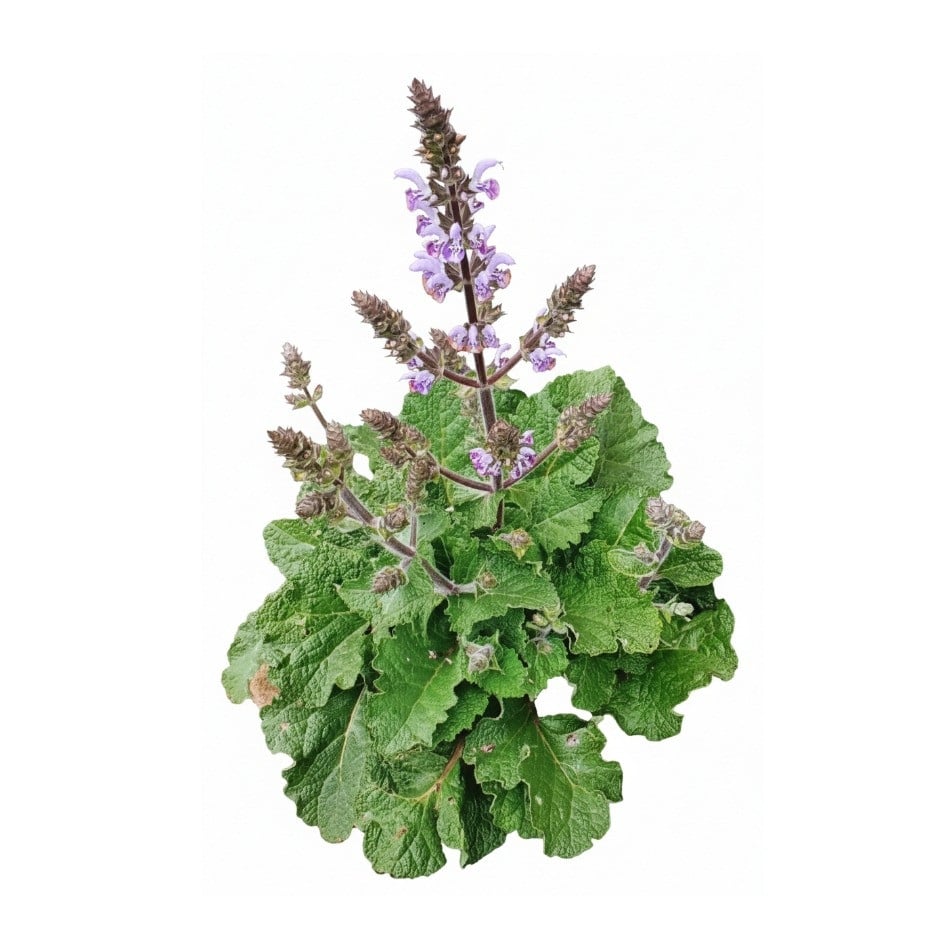
A herbaceous fragrant sage that blooms for months with long, light purple, finely marked flowers from late spring to summer. In terms of growth and aroma, this sage is reminiscent of clary sage. In appearance alone, it is a plant that fits perfectly into the Mediterranean herb garden. This chance cross between Salvia indica and Salvia moorcroftiana has only been around for a few years, and it is possible that this aromatic sage also has medicinal properties - but this is not known at present. However, the large lipped flowers are definitely a magnet for bees, butterflies and insects. Very robust and resistant to drought and heat. Sage plants are popular as medicinal herbs. In the kitchen, they are used as a spice for many dishes. In the garden, the plants are real eye-catchers, as the delicate flowers with their striking flower shapes create colorful accents. The perennial belongs in every herb garden. It harmonizes perfectly with many planting partners. Bumblebees, bees and butterflies are welcome guests at the inflorescences. Sage plants are beautiful and elegant splashes of color in natural gardens and bee pastures. The ease of cultivation makes every gardener's heart beat faster. Sage plants cut a fine figure in the border. They also brighten up terraces and balconies in containers. Distribution The species of the genus Salvia are found all over the world. Their range extends from the tropical to the temperate zones. The majority of all species in this genus are found in Central and South America. This is followed by the Mediterranean region, which extends as far as Central Asia. Leaf The leaves of the sage species are opposite. Their leaf stalk is very short. Depending on the species, the simple leaf blade has a differently shaped leaf margin. There are representatives with smooth, notched or toothed leaf edges. Some species develop pinnately lobed or deeply lobed leaves. The veins on the leaf blades are reticulate. Stipules are not present. In some species, the leaves exude an aromatic scent when rubbed. Flower The individual flowers are hermaphrodite and have the typical lip shape. They stand on the side of the stem axis and form a dense pseudo-whorl. Sage species bear racemose, paniculate or spike-shaped inflorescences. They develop bracts, which take on a decorative note in some species. Depending on the species, the shape of the bracts may be similar to the foliage leaves or differ significantly. The flowers have a five-petaled structure. The sepals are fused together. They are green or purple in color. Some species have hairs in the throat inside the calyx tube. The calyx tube ends with an upper and a lower lip. The corolla has a two-lipped structure. In many species the lower lip is not fully developed. The lips have different shapes depending on the species. In the lower part, the petals are fused into a tube and come in a wide variety of colors. The colors range from violet and blue to red and pink to white and yellow. Species with differently colored upper and lower lips are particularly decorative. Some species have a joint at the base of the flower. Each flower turns independently in a different direction. Such species are pollinated by bees and bumblebees. The joint enables the flowers to turn towards the insects. Species without this joint mechanism are predominantly bird-pollinated. There are numerous transitions between these forms. Fruit The species of the genus Salvia form clawed fruits after flowering. These are decaying fruits that split into four sub-fruits. The whole sub-fruits are glabrous. Their shape is ellipsoid to spherical or elongated to ovoid. The individual sub-fruits (clusters) have one seed. When moist, a slimy layer forms on the brown surface of the clusters. Growth The majority of species are perennial herbaceous plants. There are species that grow as semi-shrubs and shrubs. A few species are annual or biennial. There are simple hairs on the above-ground parts of the plant. Some species have glandular hairs. The plants grow upright and have a square stem.
F1 Hybrid
Frostproof
Growing tips
🌱 1. pre-cultivation - March-April on the windowsill. - Alternatively: direct sowing in the bed from April, but beware: pigeons like to eat sage seeds, so pre-cultivation is often better. - Use potting compost (low in nutrients, loose). - Small pots or multi-pot trays work well. - Place the seeds 0-0.5 cm deep in the soil (light germinators to weak dark germinators). - Press the soil down lightly. - Cover the pot with foil or a hood to retain moisture. - 18-22 °C is ideal for germination. - Semi-shaded location (not full sun behind glass). - Germination time: 7-21 days. - Keep substrate evenly slightly moist, but never wet. - As soon as the seedlings appear: ◦ Remove cover ◦ Place in a brighter location ◦ Water less (sage likes it dry) - When the plants have 2-3 true leaves → prick out. - Harden off for 7-10 days before planting out: ◦ Put outside during the day ◦ Bring in at night ◦ Slowly acclimatize to sun and wind ☀️ 2nd location - From mid-May after the ice saints. - Planting distance: 40 × 40 cm according to Samenbau Nordost. - Location: full sun, dry, well-drained. - Full sun, warm, preferably sheltered from the wind. - Sage loves sun and warmth. - Ideal for steppe beds, herb beds, raised beds or dry locations. - 🌱 2. soil - Well-drained, rather dry, calcareous or neutral. - Avoid waterlogging at all costs. - Sandy or gravelly soils are perfect. 💧 3 Watering - Water very sparingly. - Better too dry than too wet - Mediterranean species are extremely drought tolerant. ✂️ 4. Pruning - Regular pruning promotes compact growth and prevents lignification. - Cut back lightly after flowering and more severely in spring. 🌸 5 Flowering & benefits - Many species attract wild bees and bumblebees. - Garden sage (Salvia officinalis) is both a culinary and medicinal herb. 🌿 6 Planting in a pot - Possible, but: ◦ Very well-drained substrate (herb soil + sand). ◦ Install a drainage layer. ◦ Do not choose a pot that is too small. 🌱 7. propagation - Possible by cuttings, division or sowing. - Cuttings in early summer root most reliably. 🛡️ 8. Diseases & pests - Mostly robust. - Problems are almost always caused by moisture → root rot, fungi. - Powdery mildew - Downy mildew - Aphids - Cicadas ✅ 9. good neighbors These plants benefit from sage or actively support it: Cabbage plants (repels the cabbage white butterfly) Carrots (helps against carrot fly) Rosemary, thyme, oregano, lavender Strawberries (reduces gray mold) Tomatoes Eggplants ❌ 10. bad neighbors Cucumbers & zucchini Basil Mint, lemon balm Parsley Chives Beans, peas Fennel, coriander Cress
Details


Light requirement
Sunny

Water requirement
Dry

Soil
Light (sandy)
Nutrient requirement
Low

Light germinator

Germination temperature
18 - 22 °C (Degrees Celsius)

Plant distance
50 cm

Row spacing
50 cm

Seeding depth
0.5 cm

Companion Plants
Abyssinian cabbage / Ethiopian mustard
Aubergine / Eggplant
Broccoli
Broccoli raab / Stem cabbage / Cima di rapa
Brussels sprouts
Brussels sprouts
Cabbage (Cabbage)
Cabbage (Pointed cabbage)
Cabbage (red cabbage)
Cabbage (Savoy cabbage)
Carrots
Cauliflower
Chinese kale - Kai-lan / Chinese broccoli
Collard greens
Collard greens (Kale)
Collard greens (Tuscan kale / Dinosaur kale / Palm tree kale)
Common marigold
Kohlrabi / German turnip / Turnip cabbage
Lavender
Melon (Sugar melon)
Melon (Watermelon)
Mizuna / Japanese mustard greens
Napa cabbage / Chinese cabbage
Oregano
Pak Choi
Rapeseed
Rapeseed - Sheer cabbage / Siberian cabbage
Rapini / Broccoli rabe
Rosemary
Rutabaga / Swedish turnip
Savory
Stem herbs
Strawberry
Thyme
Tomato (Bush tomato)
Tomato (Cocktail bush tomato)
Tomato (Cocktail Stake Tomato)
Tomato (Stake tomato)
Turnip
Turnip greens - Choy Sum / Chinese flowering cabbage
Turnip greens - Mizuna
Turnip greens - Tatsoi
Turnips - Oilseed turnips
Turnips - Wild turnips
Vegetable cabbage - Forage cabbage
Vegetable cabbage - Ribbed cabbage / Portuguese cabbage
Vegetable cabbage - wild cabbage / ancient cabbage

Antagonistic Plants
Basil
Bean ((Scarlet) runner bean)
Bean (Broad bean / Faba bean / Field bean)
Bean (Hyacinth bean / Lablab-bean)
Bean (Lima Bean)
Chives
Chives
Courgette / Zucchini
Cucumber (Caigua)
Cucumber / Gherkin
Dill
Garden squash - Patisson / UFO squash
Garlic
Garlic chives
Gooseberry
Jerusalem artichoke / Topinambur
Leeks
Lettuce (Lettuce)
Lovage
Mint
Onion
Onion (Spring onion)
Ornamental pumpkin
Parsley
Pumpkin / Squash
Root parsley
Soybean
Wild garlic

Diseases
Root Rot
Downy mildew
Powdery mildews
Pests
Aphids
Cicadas