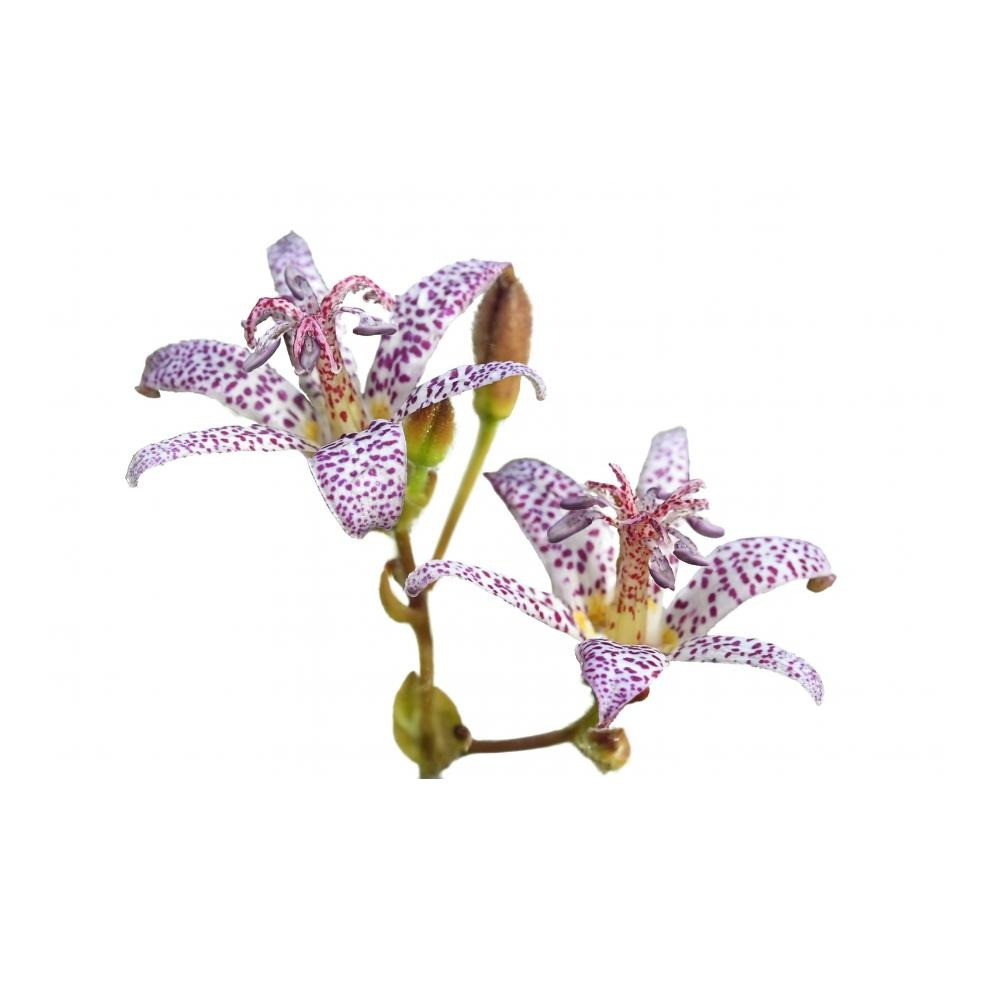
Japanische Krötenlilie / Tigerstern (Wildform)

Variety
Japanische Krötenlilie / Tigerstern (Wildform)
Approved Data
created by Alex&Sempi at 22.02.2026
Features
Growth habit
lifespan: perennial
growth habit: bushy
Game Variety
growth habit: horst-forming
leaves: loosely leafed
self-fruiting
Cold germination
normal growth
cross-pollination
growth habit: upright slender
ornamental plant
self-seeding
root type: rhizome
panicle-shaped flower
height: 50 - 60 cm
wide: 30 - 40 cm
late-flowering
growth habit: well-branched
hermaphroditic
funnel-shaped
growth habit: upright flower stems
wide: 40 - 50 cm
entire leaves
small flowers
star-shaped flowers
Scentless flowers
non-woody
Spear shaped leaves
propagation by seeds
propagation by division
perennial
insect pollination
Blätter: herzförmig
Blätter: zugespitzt
Blätter: mittelgroß
Geschlechtertyp: einhäusig
Keimung: Lichtkeimer
Blätter: weich/zart
Wuchsform: krautig
Blätter: einfach
Schnitt: nach Blüte
Schnitt: zeitiges Frühjahr
Schnitt: nicht erforderlich
Leaves: slightly hairy
Seitentriebbildung: mäßig
Wuchs: mittel
Lebenszyklus: zieht im Herbst ein
Life cycle: sprouts in spring
Vermehrung: samenfest
Stamm, Stiel: behaart
Stamm, Stiel: rund
Stamm, Stiel: fleischig
Fruit shape
elongated
smooth, sleek
capsule
small
Form: langoval, zylindrisch
Oberfläche: trocken
Form: aufrecht wachsend
Form: spindelförmig
Color
brown
light brown
glossy
Flower: white
Flower: crimson
Blätter: dunkelgrün
Frucht: grün
Farbe: zweifarbig
Stamm, Stiel: grün
Wurzel: braun
Blattrippen: grün
Samen: braun
Wurzel: beige
Behaarung: silbergrau
Blätter: Austrieb rot
Behaarung: weiß
Musterung: gepunktet
Wurzelfleisch: weiß
Wurzelfleisch: creme
Resistances
robust
Little susceptible
fully hardy
susceptible to late frost
hardy down to -20°C
Location
planting: outdoor
sheltered from the wind
Soil: permeable soil
soil moisture: no waterlogging
biotope: mountain area
Planting: mounds / ridges
Fertilization: single dose of compost
fertilization: minimal
Fertilization: nutrient-rich
fertilization: humus-enriched
light: light shade.
Soil: Well fertilized
soil moisture: moist
soil moisture: well-drained
biotope: forest
Soil moisture: dry to moderately moist
Water: regularly
soil moisture: not too dry
wind: airy
Soil: light to medium-heavy
planting: open balcony or terrace
pH value: acidic to neutral (5,5-7)
planting: covered balcony or terrace
Soil: loosened
Planting: rock garden / alpine garden
Planting: edge of wooded areas or beneath trees
Planting: pots, tubs, or boxes
Light: Partial Shade to Shade
Water: moderately
Fertilization: organic
Planting: pond / pond's edge
biotope: stream / pond / shoreline
fertilization: no peat
Heat requirement: cool
Düngemittel: Pflanzenjauche
Licht: vor Mittagssonne geschützt
Düngemittel: Hornspäne
Good companions: moisture-loving
Nachbarn schlecht: trockenheitsliebend
Good companions: shade tolerant
Nachbarn schlechte: kalkliebend
Nachbarn schlechte: sonnenliebend
Nachbarn schlechte: stark wuchernd
Nachbarn schlechte: hoher nährstoffbedarf
Nachbarn gute: mit niedrigen Nährstoffbedarf
Nachbarn gute: hochwachsend
Nachbarn gute: niedrigwachsend
Gartenstil: Naturgarten
Pflanztechnik: Mulchen
Pflanzung: Staudenbeet
Pflanzung: Hügelbeet
Boden: flachgründig (0-30)
Biotop: Felsen, Mauer
Pflanzung: Waldbeet
Garden shape: Japanese garden
Gartenstil: Waldgarten
Pflanzung: Schattenbeet
Taste
not edible
mildly toxic
Season Overview
Propagating
Planting
Harvest
Harvest
J
F
M
A
M
J
J
A
S
O
N
D
1ST YEAR
FOLLOWING YEARS
Description
As a plant genus, toad lilies (bot. Tricyrtis) belong to the lily family (bot. Liliaceae). There are 23 known species of this genus worldwide. Many of these plant species are extremely rare and can only be found in small, isolated areas. Plants of the Tricyrtis genus are shade plants that appear delicate and resemble orchids in appearance. These attractive flowering plants are often referred to as garden orchids. The name of the Tricyrtis plant genus comes from the Greek terms tri for three and kyrtos for convex. It is derived from the three sepals on the plants. The species of the genus toad lily impress with their long flowering period. The flowers are abundant and appear late in the year. Depending on the plant species, Tricyrtis plants begin to flower between June and August. The flowering period lasts until the first frosty days in October. Distribution The plants of the toad lily genus are native to East Asia. Their distribution ranges from the Himalayas to the People's Republic of China to Taiwan and Japan. One plant species is native to the Philippines. Growth The species of the Tricyrtis genus thrive as perennial herbaceous plants. They form rhizomes as survival organs. These are creeping, often short and only occasionally longer. The average growth height of the plants is about 80 centimeters. Under ideal conditions at their location, plants of this genus reach heights of up to 150 centimeters. Tricyrtis species form upright or ascending stems. They are simple. Depending on the species, the stems branch in the upper area. Leaves Toad lilies are notable for their numerous medium green leaves. They are distributed alternately on the stems of the plants. Leaf stalks are short or barely present, so that the leaves almost sit on the stems. The leaf blades are thin and simple. Their shape ranges from ovate to elliptical. The upper ends of the blades appear pointed to sharp. The base of the blade partially or completely encompasses the stems of the plants. The leaf veins run parallel. There are numerous leaf veins. Flower The striking flowers of the toad lilies grow individually on the plants. They rarely form racemose inflorescences. They are hermaphroditic, trifoliate, and trumpet- to bell-shaped. When cut through the axis, the flowers form congruent halves. For this reason, botanists describe the flowers as radially symmetrical. The six bracts of the flowers are free and unequal. They usually appear bent back or widely spread at their upper ends. The petals are often not durable. Three bracts form the outer perianth; they are short-spurred or sac-shaped. Many purple spots appear on the white or yellow leaves of the perianth. Three stamens form two circles. The slightly flattened filaments are located at the base of the perianth. In the upper area, these filaments converge to form a short tube. The three carpels form a superior ovary with three chambers. Each chamber contains numerous ovules. The style of the flowers is columnar. Fruit Plants of the genus Krötenlilien form capsule fruits. These are triangular and broadly cylindrical. As scatter fruits, they open at the lines marked on the ovary. This releases the seeds. Use Toad lilies are suitable as ornamental plants in borders and garden beds. They look decorative in pots on balconies and terraces. They provide long-lasting decoration as cut flowers in a vase.
Non hybrid
Frostproof
Growing tips
🌞 Location & soil - Semi-shady to shady, light-flooded shade under woody plants - Protected from hot midday sun - Cool location - Protected from the wind, but airy - Humus-rich, loose - Slightly acidic to neutral - Nutrient-rich - well drained, permeable 🌱 Sowing & planting - Pre-cultivation: February/March - Substrate: fine, humus-rich sowing soil - Direct sowing: Autumn after seed maturity (cold germinator) - Germination temperature: 15-20 °C - Germination period: 21- 84 days - Sowing depth: 0.5 cm (light germinator) - Planting time: Spring or fall (mid/end of May) - Planting distance: 30-40 cm - Row spacing: 35-50 cm - Water, keep evenly and constantly moist 💧 Care - Watering: evenly moist, no waterlogging, mulch layer, Water regularly during dry periods, do not allow to dry out - Basic fertilization: Compost or well-rotted manure in spring - Fertilization: little (plant manure), do not overfertilize - Withered plants can be removed regularly - Slug protection recommended 🌾 Pruning - No pruning necessary during the season - Withered plants can be removed, but not necessary - Do not cut the plant back immediately after flowering - Foliage may naturally retract → strengthens the rhizome - Only cut when the foliage has completely yellowed - Remove old, dry stems close to the ground in late winter or early spring ❄️ Winter protection - Cover the root area with leaves, straw or brushwood - Additional fleece if winter is very cold - Keep potted plants frost-free or well protected over winter - Avoid waterlogging 🌿 Good neighbors - Ferns, funcias, astilbes, Solomon's seal, fairy flowers, purple bells - Caucasian forget-me-not, lungwort, honeysuckle, woodruff, blueberries - Japanese maple, Asian dogwood, rhododendron, azaleas, rock pear - Waldsteinia, hazelroot, ysander, helichrysum, hellebore, hydrangea, rhododendron - Lettuce, spinach 🚫 Bad neighbors - Thyme, sage, lavender, limb herbs, sedum, stonecrop, yucca - Bamboo, goutweed, ivy, fast-growing grasses, bamboo, reeds - Roses, coneflower (Echinacea), cockades - Catmint, phlox, yarrow, marigold, cosmos, begonia - Oregano, thyme, sage, savory, lemon balm, dill, coriander, wormwood - Chives, onions, garlic, chard, carrots, bush beans - Parsnips, beet, black salsify - Potentilla, spirea, summer lilac, low roses, currants - Ornamental cherry, hawthorn, apple tree, pear tree - Runner beans, field beans, maize, turnips, rape, celery - Lovage, tomatoes, cucumbers, pumpkin, zucchinis, cabbage - Hazelnut, elderberry, privet, forsythia - Walnut, maple, birch, willow, chestnut, weigelie - Strawberries, raspberries, gooseberries - Mint, comfrey, sunflower, Jerusalem artichoke 🍂 Diseases - Powdery mildew - Leaf spot diseases - Root rot 🐌 Pests - Aphids - Largemouth weevil - spider mites - Caterpillars - snails
Details


Light requirement
Semi-shaded

Water requirement
Moist

Soil
Medium (loamy)

Nutrient requirement
Medium

Light germinator

Germination temperature
15 - 20 °C (Degrees Celsius)

Plant distance
35 cm

Row spacing
40 cm

Seeding depth
0.5 cm

Companion Plants

Antagonistic Plants
Apple
Bean (Broad bean / Faba bean / Field bean)
Bean (Dwarf bean)
Bean (Runner bean)
Beetroot
Begonias
Black salsify
Broccoli
Buddleja / Butterfly Bushes
Carrots
Catnip
Celery (Celeriac / Celery root)
Chard
Chives
Comfrey
Common marigold
Coneflower (Echinacea)
Coriander / Cilantro
Corn / Maize
Cucumber / Gherkin
Currant
Dill
Elderberry
Forsythia
Garden cosmos / Mexican aster
Garlic
Gooseberry
Grasses - Bamboos
Grasses - reeds, cattails, bulrushes
Hazelnut
horse chestnut
Ivy
Jerusalem artichoke / Topinambur
Lavender
Lovage
Maples
Melissa
Mint
Onion
Onion (Spring onion)
Oregano
Parsnip
Pear
Phlox, flame flower
Privet
Pumpkin / Squash
Rapeseed
Raspberry
Rose
Sage
Savory
Spirea
Stem herbs
Strawberry
Succulents
Sunflower
Thyme
Tomato (Bush tomato)
Turnips - Wild turnips
Walnut family
Weigela
Willows
Yarrow

Diseases
Root Rot
Angular leaf spot of cucumber
Powdery mildews
Pests
Spider mites
Land snails
Caterpillars
Aphids