Between the Lines

Variety
Between the Lines
Approved Data
created by Alex&Sempi at 10.01.2026
Features
Color
striped
multicolor
marbled
Pattern: variegated
yellow
orange
light green / pale green
pale green
dark purple
Fruit: yellow-green
crimson
Blätter: violett
Frucht: bordeaux
Frucht: goldgelb
Frucht: violett
Frucht: schwarzviolett/violettschwarz
Blätter: cremeweiß
Resistances
robust
resistant
Taste
sweet
crunchy
fruity
raw edible
Edible
pleasant
juicy
edible skin
Essbarkeit: Frucht
Essbarkeit: Samen
Toxizität: ungiftig
Konsistenz: festfleischig
Growth habit
self-fruiting
growth habit: compact
ornamental plant
height: 60 - 80 cm
Ernte: mittelreifend
Ernteertrag: mittel
Location
Planting: pots, tubs, or boxes
planting: greenhouse
planting: bed
planting: outdoor
planting: raised bed
Pflanzung: Gewächshaus
Fruit shape
Typ: Schließfrucht - Beere
conical
smooth, sleek
Cultivation Break
4 Years
Season Overview
Propagating
Planting
Harvest
J
F
M
A
M
J
J
A
S
O
N
D
Description
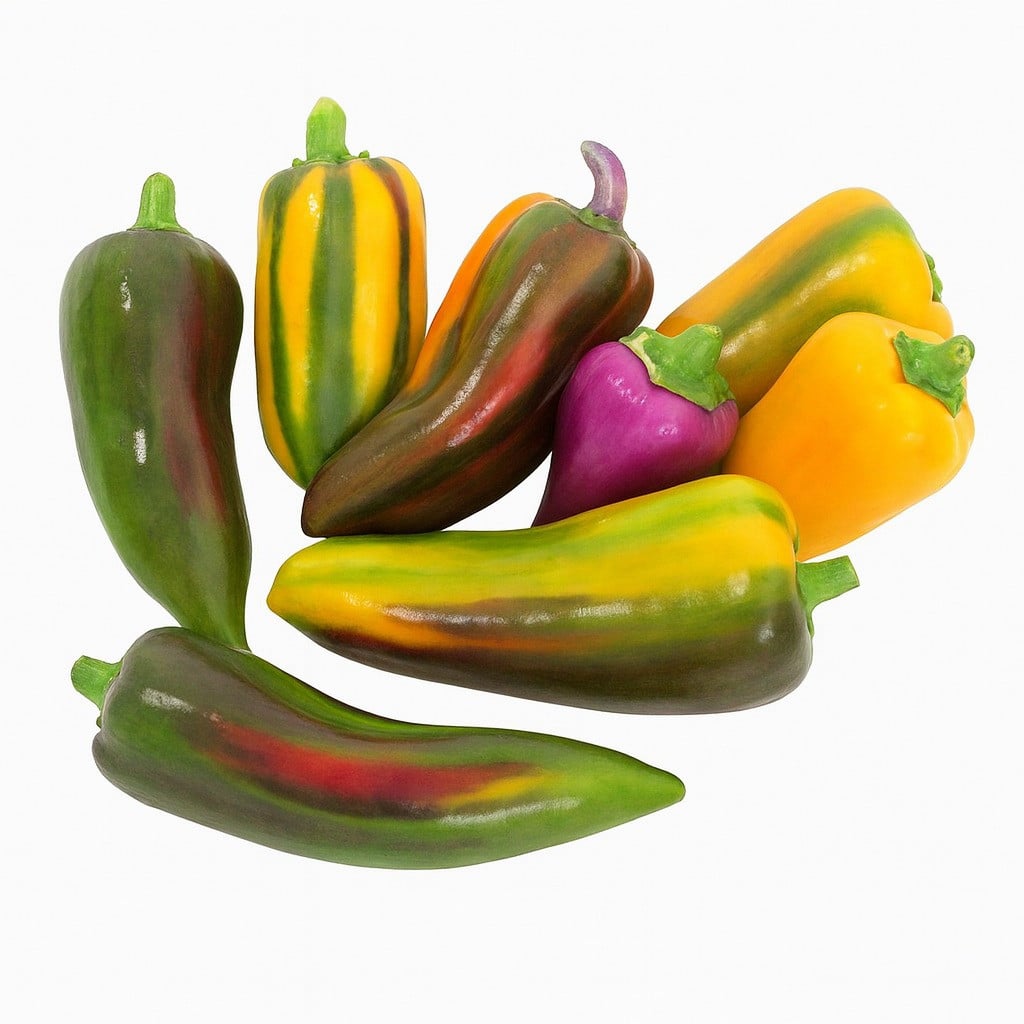
Between the Lines was bred by the seed project Fruition Seeds. It is a stunning pepper variety, colorfully striped in a never-before-seen color combination. Dark green, lime green to apple green, yellow, plum, violet, purple, orange, and burgundy red. All spread across the fruit like a rainbow. In addition to green, cream, and yellow, the colorful swirling foliage features a leaf color that is unique among peppers: purple. Beautiful to look at. The plants remain rather small (60-80 cm high) and produce a respectable number of small, 7-9 cm long, conical fruits. It is a medium-early maturing, robust, and high-yielding variety. The taste is sweet and the flesh is crisp. The variety is particularly well suited to growing in pots. However, it may not yet be completely stable, as there are always variations. In any case, Between the Lines is one of the most beautiful bell pepper varieties.
Non hybrid
Not frost resistant
Growing tips
🌱 Sowing - Peppers are light germinators / low-light germinators - Sowing depth: 0.5-1 cm - Peppers take a long time to germinate (14-21 days) - Optimal start: end of February to mid-March - Germination temperature: 22-25 °C (warmest place in the house) - Light: As soon as germinated, very bright, otherwise they will go to seed 🪴 Planting - Planting time outdoors: after the ice saints - Soil: loose, rich in humus, permeable, well drained - pH 6.0 - 6.8 - Planting distance: 40-50 cm - Do not plant peppers deeper than in pots (unlike tomatoes) - Location: full sun, sheltered from the wind - Peppers love constantly warm conditions - Optimal: ◦ 22-28 °C during the day ◦ Not below 16 °C at night - Outdoors only in very warm, sheltered locations - Peppers react sensitively to cold temperatures → Blossom shedding - Professional tip: Mulching (straw, grass) keeps the root area warm - Greenhouse or foil tunnel brings significantly higher yields 💧 Watering - Evenly moist, but no waterlogging - Water in the morning, warm water preferred - Soil that is too wet → root rot - Soil that is too dry → Flower shedding 🍽️ Fertilize - Peppers are heavy feeders - Before planting: compost + slow-release organic fertilizer - During the season: top up with liquid fertilizer every 2 weeks (e.g. tomato fertilizer) ✂️ Pinching out - Unlike tomatoes, do not pinch out completely - Only remove the lowest shoots close to the ground to allow air to circulate 🪢 Supports - Large varieties need stakes so that the fruit does not break off the shoots 🌼 Blossoms & fruit set - Break out the king bloom for better growth and higher yields - Lightly shaking the plant promotes pollination 🧺 Harvesting - Peppers can be harvested green, but they taste sweeter when fully ripe (red/yellow/orange) - Ripening time is long → warm locations produce significantly more color - Harvest time: July to October (slightly later outdoors) 🌿 Good neighbors - Lettuce, spinach, carrots, cucumbers, cabbage, onions / leeks, beans - Radish, radish, celery, okra - Basil, parsley, dill, marigolds, nasturtium - Lavender, thyme, rosemary, borage - Tomatoes only work with sufficient spacing, otherwise they compete for light and nutrients. 🚫 Bad neighbors - Fennel, beet, peas, eggplants, pumpkins, turnips, - turnips, rapeseed - Other nightshade plants too dense (tomatoes, potatoes, chili) → Risk of diseases increases (e.g. verticillium, leaf spot). 🦠 Diseases - Gray mold (Botrytis) - Powdery mildew - Root rot - Alternaria leaf spot disease - Viral diseases (mosaic virus) 🐛 Pests on peppers - Spider mites / red spider mite - Aphids - Thrips - Whitefly - Snails
Details

Light requirement
Sunny

Water requirement
Moist

Soil
Medium (loamy)
Nutrient requirement
High

Light germinator

Germination temperature
22 - 25 °C (Degrees Celsius)

Plant distance
40 cm

Row spacing
50 cm

Seeding depth
0.5 cm

Companion Plants
Basil
Bean ((Scarlet) runner bean)
Bean (Broad bean / Faba bean / Field bean)
Bean (Dwarf bean)
Bean (Lima Bean)
Bean (Runner bean)
Borage
Broccoli
Brussels sprouts
Brussels sprouts
Cabbage (Cabbage)
Cabbage (Pointed cabbage)
Cabbage (red cabbage)
Cabbage (Savoy cabbage)
Carrots
Cauliflower
Celery (Leaf celery / Chinese celery)
Chinese kale - Kai-lan / Chinese broccoli
Chives
Collard greens (Kale)
Collard greens (Tuscan kale / Dinosaur kale / Palm tree kale)
Common marigold
Cucumber / Gherkin
Dill
Garlic
Garlic chives
Kohlrabi / German turnip / Turnip cabbage
Lavender
Leeks
Lettuce (Common chicory)
Lettuce (Endive / Escarole / Erisée)
Lettuce (Lamb's lettuce)
Lettuce (Lettuce)
Lettuce (Puntarelle / Cicoria di catalogna / Cicoria asparago)
Lettuce (Radicchio / Italian chicory)
Lettuce (Sugar loaf)
Nasturtium
Onion
Onion (Spring onion)
Ornamental alliums
Parsley
Radish
Radishes
Rosemary
Savory
Spinach (Summer)
Spinach (Winter)
Thyme
Vegetable cabbage - Forage cabbage

Antagonistic Plants
Aubergine / Eggplant
Beetroot
Broccoli raab / Stem cabbage / Cima di rapa
Chili
Courgette / Zucchini
Cucumber (Caigua)
Fennel
Florence fennel / Finocchio
Garden squash - Patisson / UFO squash
Hair cucumbers / snake gourds
Napa cabbage / Chinese cabbage
Nightshades (Other)
Ornamental pumpkin
Pea
Potato
Pumpkin / Squash
Rapeseed
Rapeseed - Sheer cabbage / Siberian cabbage
Rapini / Broccoli rabe
Rutabaga / Swedish turnip
Turnip
Turnip greens - Tatsoi
Turnips - Oilseed turnips
Turnips - Wild turnips
Yalta tomatoes
Diseases
Root Rot
Powdery mildews
Blossomrot
Early blight of potato
Black spot of roses
Red spot disease
Grey mold
Pests
Land snails
Thrips
Spider mites
Aphids
White fly