Roter Augsburger

Variety
Roter Augsburger
Approved Data
Seed packet
Features
Color
orange
red
medium green
bright
Flower: white
Blätter: dunkelgrün
Growth habit
lifespan: perennial
growth habit: compact
harvest: profitable
growth habit: stable
strong leaves
normal growth
harvest: early-ripening
Nutzungsart: Ur-/Alte Sorte
height: 50 - 60 cm
growth habit: well-branched
height: 60 - 80 cm
wide: 40 - 50 cm
strong growth
Taste
fruity
Sharpness 0
sweet
intensive
crunchy
raw edible
Edible
pleasant
very juicy
mildly toxic
thin skin
edible skin
Essbarkeit: Frucht
Essbarkeit: Samen
Konsistenz: festfleischig
Location
planting: bed
planting: outdoor
planting: raised bed
planting: open balcony or terrace
planting: covered balcony or terrace
Planting: pots, tubs, or boxes
Light: Sun
Heat requirement: moderate
Pflanzung: Bauerngarten
Fruit shape
elongated
conical
smooth, sleek
medium-sized
Typ: Schließfrucht - Beere
Shape: tapered
Resistances
cold tolerant
resistant
robust
Little susceptible
frost-sensitive
weatherproof
Cultivation Break
4 Years
Season Overview
Propagating
Planting
Harvest
J
F
M
A
M
J
J
A
S
O
N
D
Description
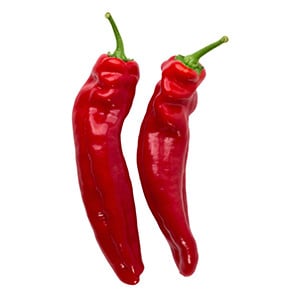
Red Augsburg bell pepper has sweet, pointed, bright red fruits. It enriches salads and vegetable pans, but tastes especially good as a snack, for example, with cream cheese. The variety is very suitable for outdoor cultivation, but can also be grown under shelter. It is very precocious.
Non hybrid
Not frost resistant
Growing tips
Red Augsburg was tested in a two-year screening and in cooperation with ARCHE NOAH from more than 50 Capsicum cultivars for their suitability for cultivation under low-input conditions in pots and in the field.
Details


Light requirement
Sunny

Water requirement
Moist

Soil
Light (sandy)
Nutrient requirement
High

Light germinator

Germination temperature
24 - 28 °C (Degrees Celsius)

Plant distance
50 cm

Row spacing
50 cm

Seeding depth
0.5 cm

Companion Plants
Basil
Bean ((Scarlet) runner bean)
Bean (Broad bean / Faba bean / Field bean)
Bean (Dwarf bean)
Bean (Lima Bean)
Bean (Runner bean)
Borage
Broccoli
Brussels sprouts
Brussels sprouts
Cabbage (Cabbage)
Cabbage (Pointed cabbage)
Cabbage (red cabbage)
Cabbage (Savoy cabbage)
Carrots
Cauliflower
Celery (Leaf celery / Chinese celery)
Chinese kale - Kai-lan / Chinese broccoli
Chives
Collard greens (Kale)
Collard greens (Tuscan kale / Dinosaur kale / Palm tree kale)
Common marigold
Cucumber / Gherkin
Dill
Garlic
Garlic chives
Kohlrabi / German turnip / Turnip cabbage
Lavender
Leeks
Lettuce (Common chicory)
Lettuce (Endive / Escarole / Erisée)
Lettuce (Lamb's lettuce)
Lettuce (Lettuce)
Lettuce (Puntarelle / Cicoria di catalogna / Cicoria asparago)
Lettuce (Radicchio / Italian chicory)
Lettuce (Sugar loaf)
Nasturtium
Onion
Onion (Spring onion)
Ornamental alliums
Parsley
Radish
Radishes
Rosemary
Savory
Spinach (Summer)
Spinach (Winter)
Thyme
Vegetable cabbage - Forage cabbage

Antagonistic Plants
Aubergine / Eggplant
Beetroot
Broccoli raab / Stem cabbage / Cima di rapa
Chili
Courgette / Zucchini
Cucumber (Caigua)
Fennel
Florence fennel / Finocchio
Garden squash - Patisson / UFO squash
Hair cucumbers / snake gourds
Napa cabbage / Chinese cabbage
Nightshades (Other)
Ornamental pumpkin
Pea
Potato
Pumpkin / Squash
Rapeseed
Rapeseed - Sheer cabbage / Siberian cabbage
Rapini / Broccoli rabe
Rutabaga / Swedish turnip
Turnip
Turnip greens - Tatsoi
Turnips - Oilseed turnips
Turnips - Wild turnips
Yalta tomatoes
Diseases
Root Rot
Powdery mildews
Blossomrot
Early blight of potato
Black spot of roses
Red spot disease
Grey mold
Pests
Land snails
Thrips
Spider mites
Aphids
White fly