OAEC Pink

Variety
OAEC Pink
Approved Data
created by Alex&Sempi at 06.01.2026
Features
Resistances
robust
resistant
Pest-resistant
Little susceptible
frost-sensitive
hardy with protection
hardy down to -5°C
krankheitstolerant
Taste
sweet
crunchy
raw edible
Edible
pleasant
edible skin
Essbarkeit: Blätter
Essbarkeit: Wurzel
Essbarkeit: Stiel
Toxizität: ungiftig
Konsistenz: festfleischig
Location
Light: Semi-Shade
planting: bed
planting: outdoor
planting: raised bed
Soil: permeable soil
soil moisture: no waterlogging
fertilization: minimal
soil moisture: moist
Soil: slightly sandy
Water: regularly
wind: airy
Fertilization: phosphate-rich
Soil: light to medium-heavy
Soil: sandy to loamy
fertilization: low-nitrogen
pH value: acidic to neutral (5,5-7)
fertilization: potassium-rich
Water: Adequate
Heat requirement: cool
Pflanztechnik: Mulchen
Herkunft: Züchtung
Fruit shape
do not produce fruit
Growth habit
Befruchtung: unfruchtbar, steril
Autumn variety
lifespan: perennial
growth habit: ground cover
root type: shallow-rooted
normal growth
Ernte: nach Frosteinwirkung
root type: rhizome
wide: 30 - 40 cm
height: 30 - 40 cm
wide: 40 - 50 cm
root type: bulb, tuber
sukkulent
propagation by offsets
propagation by division
asexual
harvest: late-ripening
Wuchsform: krautig
Ernteertrag: mittel
Color
bright
Wurzel: gelb
Oberfläche: gebuchtet
Wurzel: pink
Cultivation Break
4 Years
Season Overview
Propagating
Planting
Harvest
Harvest
J
F
M
A
M
J
J
A
S
O
N
D
1ST YEAR
FOLLOWING YEARS
Description
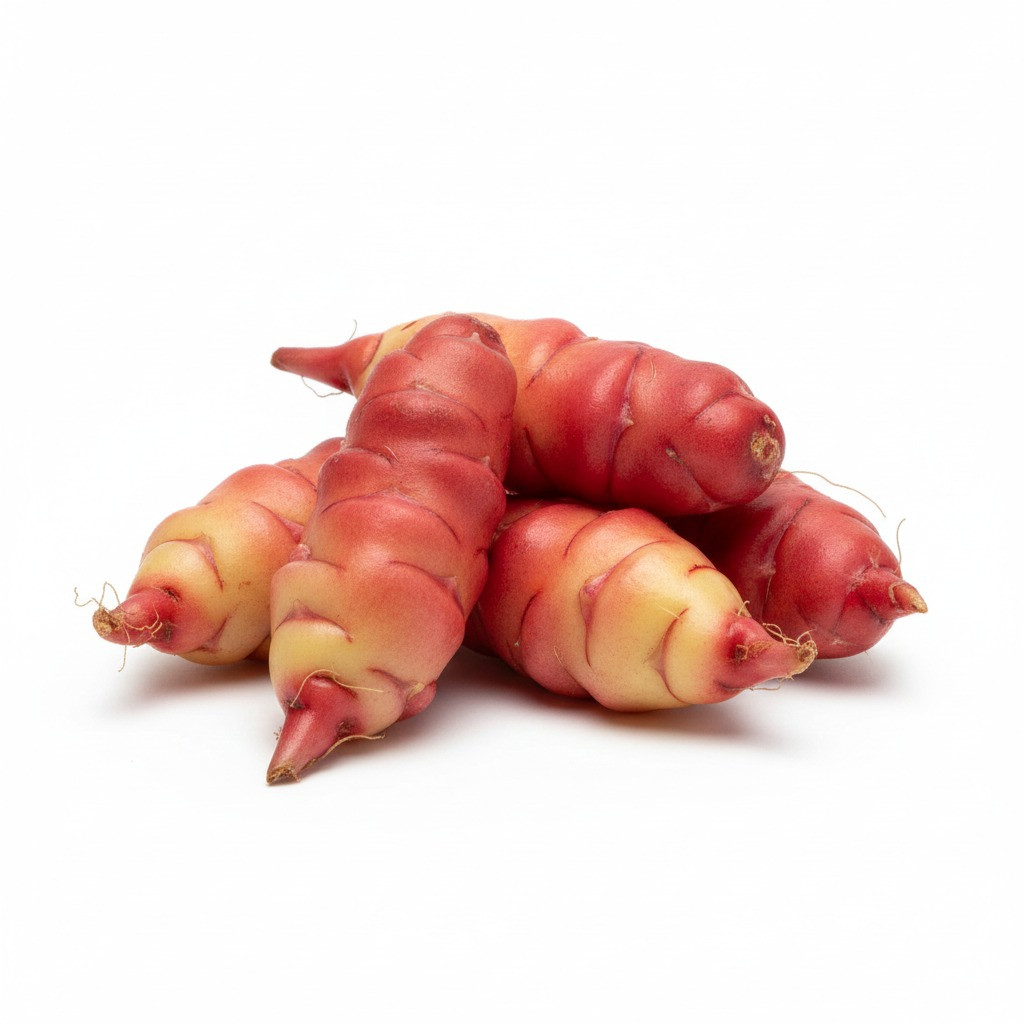
OAEC Pink is a sweet variety with a very pleasant taste. It is not only bright pink with yellow on the outside, but also on the inside. Mature stalks can be used in a similar way to rhubarb. For example, cook them and serve with sugar and vanilla sauce. But don't harvest too much, you want to have something left of the tubers. Oca (Oxalis tuberosa) is a plant species from the genus wood sorrel (Oxalis) in the wood sorrel family (Oxalidaceae), which is native to the Andes in South America. The plant is also known as Andean potato, tuberous clover or Uqa, Oka, Yam or Peruvian wood sorrel. Oca originally comes from the Andes, where it is also cultivated at altitudes of 1500-2500 m and is the oldest cultivated tuber plant in the Andes. Beyond the Andes, the tuberous wood sorrel - still the second most important tuber crop after the potato in its area of origin - has been able to establish itself in Mexico in particular and, interestingly, since the 19th century also in New Zealand. In New Zealand, the oca is somewhat misleadingly called New Zealand yam. Oca is a beautiful plant with reddish shoot tips and shoot axes as well as tubers with different bright colors and shapes. The tuberous wood sorrel is a perennial, succulent, herbaceous plant. It grows to over 30-40 cm high. The roots form strongly branched rhizomes, the tips of which swell into fleshy tubers. The waxy, more or less wrinkled, cylindrical to ellipsoid or club-shaped tubers, with notched "eyes", are 3-15 cm long, white, green, orange, pink, red or purple. The upright or prostrate, fleshy stems are up to 1 cm in diameter. They are dark green to purple in color and usually densely covered with downy hairs. The somewhat translucent leaf stalks, divided at the base by a "joint", are spread out and 7 to 10 cm long. The alternate leaves are divided into three fleshy leaflets. These are obovate with entire margins, about 25 × 22 mm in size, green to purple and have downy hairs at least on the underside. The leaflets are sensitive to touch. Oxalis tuberosa has three different flower types per plant. The inflorescences appear as umbels. The stalked, hermaphrodite flowers with a double perianth are five-petaled. The yellow flowers are up to 2 cm in diameter. The petals with striped sap marks are obovate. Small and one- to few-seeded capsule fruits are formed, albeit only rarely. The seeds have an explosive seed coat which ejects them from the fruit. As a result of intensive cultivation of the species, probably for more than a thousand years, many varieties have developed. With the aim of producing larger, more nutritious and tastier tubers, little value was placed on the flowers of the plants during breeding, resulting in varieties that are no longer able to flower or are sterile and can only be propagated via the tubers. In particular, the varieties with yellow and red tubers are sterile. Young leaves and shoots contain oxalic acid, which gives them their sour taste, usually only in small quantities so that they can be used as a salad or vegetable. The tubers contain significantly less oxalic acid, but starch and larger amounts of vitamin C. If the tubers are exposed to sunlight for a few weeks after harvesting, the acidity largely breaks down and the tubers become sweeter. The combination of the newly deposited sweetness with the acidity then results in a very special fruity taste.
F1 Hybrid
Not frost resistant
Growing tips
🌼 Pre-breeding - Most varieties in Europe rarely or never flower. - Even when they do flower, they rarely set seed. - Seed production is genetically complicated - many plants are sterile or incompatible. - Oca is almost always propagated vegetatively via tubers. - If you actually have seeds (e.g. from breeding projects or swap meets), this is the way to go: - Light germinate - Sprinkle moist potting compost - Temperature: 15-20 °C - Germination time: 2-6 weeks, sometimes longer - Young plants are tender at the beginning, grow slowly. - Plenty of light, no direct blazing sun. - Treat later like pre-grown tubers. - Plants from seed are genetically different - so you will get new varieties. 🌱 Planting - Planting time: April-May, as soon as there is no threat of heavy frost. - Planting depth: approx. 5-10 cm. - Spacing: 30-50 cm. 🌤️ Location & climate - Cool, humid climate, does not cope well with heat. - A semi-shady to sunny spot is ideal, avoid direct summer heat. 🪴 Soil - Loose, rich in humus, well drained. - Slightly acidic soils. - Avoid waterlogging at all costs. 💧 Care - Water regularly and moderately. - Mulching helps to retain moisture and suppress weeds. - Oca grows slowly. 🧪 Fertilization - It is best to incorporate mature compost in spring. - Amount: about 2-3 liters of compost per m². - Alternatively: well-rotted manure, but sparingly. - Even nutrient supply during growth. - A light top dressing after 6-8 weeks is sufficient: ◦ Plant manure (e.g. nettle) heavily diluted ◦ Or a small amount of slow-release organic fertilizer (e.g. pellets) - No high nitrogen applications (blue corn, fresh manure, too much liquid manure). - leads to too much green and few tubers. - Do not over-fertilize ❄️ Harvest - does not form tubers until October/November. - Harvest after the first frost, but before the ground freezes through. - Allow the tubers to dry in the sun for a few days - this makes them sweeter. 🌱 Tip for your bed Oca grows for a long time and forms tubers late in the year. Good neighbors are therefore plants that are harvested early or do not root deeply. 🐛 Pests - Snails (young plants) - Wireworms - Aphids - Voles 🍂 Diseases - Powdery mildew (true or false) - Root rot - Virus diseases 🌿 Good neighbors - Cabbages (broccoli, kohlrabi, kale) - Beans & peas - Lettuce, spinach - Onions & garlic, chives - Dill, coriander, parsley - Corn - Sunflowers 🚫 Bad neighbors - Potatoes - Sweet potatoes - Jerusalem artichoke - Root parsley, parsnips - Radish - okra - Other Oxalis species - Tomatoes, pumpkin, melon
Details


Light requirement
Semi-shaded

Water requirement
Moist

Soil
Light (sandy)

Nutrient requirement
Medium

Light germinator

Germination temperature
15 - 20 °C (Degrees Celsius)

Plant distance
30 cm

Row spacing
40 cm

Seeding depth
8 cm

Companion Plants
Bean ((Scarlet) runner bean)
Bean (Broad bean / Faba bean / Field bean)
Bean (Dwarf bean)
Bean (Hyacinth bean / Lablab-bean)
Bean (Lima Bean)
Bean (Runner bean)
Broccoli
Brussels sprouts
Brussels sprouts
Cabbage (Cabbage)
Cabbage (Pointed cabbage)
Cabbage (red cabbage)
Cabbage (Savoy cabbage)
Cauliflower
Celery (Celeriac / Celery root)
Celery (Celery)
Celery (Leaf celery / Chinese celery)
Chinese kale - Kai-lan / Chinese broccoli
Chives
Collard greens
Collard greens (Kale)
Collard greens (Tuscan kale / Dinosaur kale / Palm tree kale)
Coriander / Cilantro
Corn / Maize
Dill
Garlic
Garlic chives
Kohlrabi / German turnip / Turnip cabbage
Leeks
Lettuce (Common chicory)
Lettuce (Endive / Escarole / Erisée)
Lettuce (Lamb's lettuce)
Lettuce (Lettuce)
Lettuce (Radicchio / Italian chicory)
Lettuce (Sugar loaf)
Napa cabbage / Chinese cabbage
Onion
Onion (Spring onion)
Ornamental alliums
Parsley
Pea
Soybean
Spinach (Summer)
Spinach (Winter)
Sunflower
Vegetable cabbage - Forage cabbage
Vegetable cabbage - Ribbed cabbage / Portuguese cabbage
Vegetable cabbage - wild cabbage / ancient cabbage
Wild garlic
Yacon

Antagonistic Plants
Chili
Courgette / Zucchini
Garden squash - Patisson / UFO squash
Green lavender cotton
Hair cucumbers / snake gourds
Jerusalem artichoke / Topinambur
Lavender
Melon (Sugar melon)
Melon (Watermelon)
Okra
Ornamental pumpkin
Parsnip
Pepper / Paprika
Potato
Pumpkin / Squash
Radish
Root parsley
Rosemary
Sage
Stem herbs
Sweet potato
Thyme
Tomato (Bush tomato)
Tomato (Cocktail bush tomato)
Tomato (Cocktail Stake Tomato)
Tomato (Stake tomato)
Yalta tomatoes

Diseases
Root Rot
Downy mildew
Powdery mildews
Pests
Land snails
Aphids
Wireworms
Voles