Orange Banana

Variety
Orange Banana
Approved Data
created by Sonja at 04.03.2021
Features
Location
planting: greenhouse
planting: outdoor
planting: bed
planting: raised bed
Heat requirement: high
sheltered from the wind
planting: house wall / wall
planting: rain-protected
Soil: permeable soil
soil moisture: no waterlogging
fertilization: high
Fertilization: single dose of compost
Fertilization: nutrient-rich
fertilization: humus-enriched
Soil: Well fertilized
soil moisture: moist
light: Full sun
soil moisture: well-drained
Water: regularly
Soil: deep
wind: airy
Soil: light to medium-heavy
planting: open balcony or terrace
Soil: sandy to loamy
planting: covered balcony or terrace
fertilization: lime-free
Soil: loosened
Water: Adequate
Planting: pots, tubs, or boxes
Light: Sun
Planting: frost-free
pH value: neutral (7)
Water: generously
Fertilization: nitrogen-rich
Fertilization: organic
Düngemittel: Pflanzenjauche
Pflanzung: Bauerngarten
Düngung: Langzeitdünger
Düngemittel: Hornspäne
Good companions: moisture-loving
Nachbarn schlecht: trockenheitsliebend
Nachbarn schlechte: Schattenpflanzen
Nachbarn schlechte: kalkliebend
Good companions: sun-loving
Nachbarn schlechte: stark wuchernd
Nachbarn schlechte: hoher nährstoffbedarf
Nachbarn gute: mit niedrigen Nährstoffbedarf
Nachbarn schlechte: hochwachsend
Nachbarn gute: niedrigwachsend
Pflanztechnik: Mulchen
Pflanzung: Gewächshaus
Herkunft: Züchtung
Düngemittel: Mist, Dung
Pflanzung: überdacht
Düngung: NPK 8/5/16
Düngung: NPK 10/7/15
Fruit shape
elongated
egg-shaped
medium-sized
Typ: Schließfrucht - Beere
Growth habit
lifespan: annual
harvest: profitable
harvest: continuously pickable
flower: flowering
root type: taproot
self-fruiting
strong leaves
fast growth
warm germination
Nutzungsart: Ur-/Alte Sorte
leaves: densely leafed
root type: heart-shaped root system
indeterminate growing
growth habit: upright slender
growth habit: needs climbing support
serrated leaves
height: 160 - 180 cm
height: 140 - 160 cm
propagation by cuttings
height: 180 - 200 cm
leaves: leafy
wide: 60 - 70 cm
hermaphroditic
feathered leaves
simple flower
star-shaped flowers
Pruning necessary
strong growth
propagation by seeds
perennial
Summer variety
Blütenstand: traubenförmig
Geschlechtertyp: einhäusig
Ernte: mittelreifend
Keimung: Lichtkeimer
Blätter: einfach
Blätter: duftend
Leaves: slightly hairy
Vermehrung: samenfest
strong lateral shoot development
insect pollination
hand pollination
Color
orange
green
glossy
bright
Flower yellow
Stamm, Stiel: grün
Wurzel: cremeweiß
Samen: gelb
Fruchtfleisch: orange
Wurzel: beige
Behaarung: silbergrau
Behaarung: weiß
Oberfläche: glatt
Samen: beige
Taste
low-core
mild
fruity
sweet
slightly sour
raw edible
Edible
tender
mildly toxic
thin skin
edible skin
soft skin
Essbarkeit: Frucht
Essbarkeit: Samen
Konsistenz: weich
Konsistenz: festfleischig
Essbarkeit: nur reif
Resistances
cold tolerant
resistant
robust
weatherproof
Krautfäule-tolerant
Cultivation Break
4 Years
Season Overview
Propagating
Planting
Harvest
J
F
M
A
M
J
J
A
S
O
N
D
Description
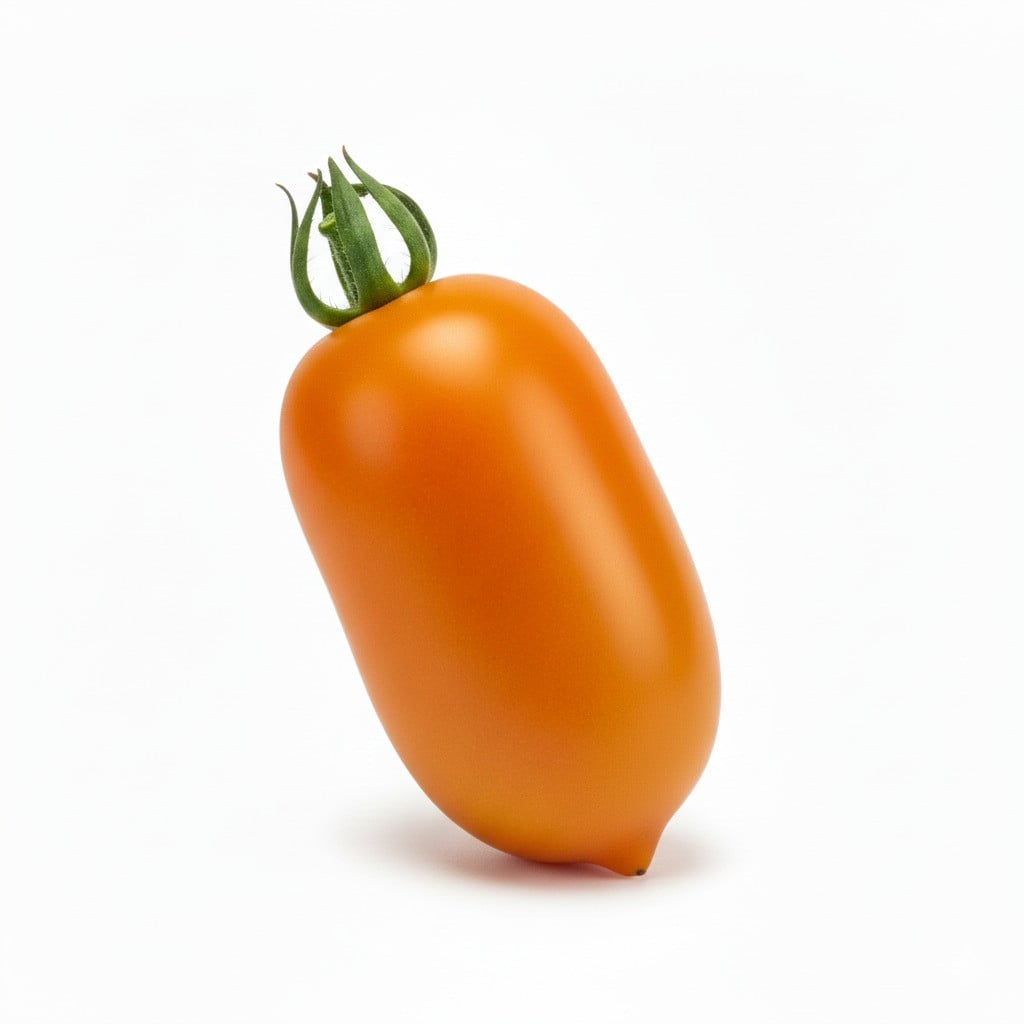
Tomato variety 'Orange Banana' exists since about 1930. It is a Russian tomato with orange, elongated to ovoid, weighing about 60-100 g. Fruits. These grow to about 5-7 cm/2-2.8 in long and 2-3 cm/0.8-1.2 in wide. Their taste is sweet, fruity, tender and mild with a firm consistency. Very robust variety. Suitable for outdoor cultivation. Good for stuffing, sauces and fresh consumption.
Non hybrid
Not frost resistant
Growing tips
🧺 Aussaat & Vorkultur • Aussaat ab März im Haus oder in der Anzuchtbox. • Keimtemperatur: 22–28 °C – warm halten, sonst keimen sie langsam. • Aussaattiefe: ca. 0,5 cm. • Keimdauer: 5–10 Tage. 🌤️ Standort • Volle Sonne – je mehr Licht, desto aromatischer die Früchte. • Ideal für Freiland mit Regenschutz, Tomatenhaus oder Gewächshaus. • Sehr robuste russische Sorte, gut für den Freilandanbau geeignet. 🌿 Pflanzung • Abhärten im Mai, dann auspflanzen. • Pflanzabstand: 50–100 cm, Reihenabstand 80 cm. • Starkzehrer → regelmäßig düngen (Kompost, Tomatendünger). • Aufbinden an Stäben oder Schnüren. • Regelmäßig ausgeizen, damit die Pflanze luftig bleibt und viele Früchte trägt. 💧 Pflege • Hoher Wasserbedarf – gleichmäßig gießen, aber Staunässe vermeiden. • Mulchen hilft, Feuchtigkeit zu halten und Krankheiten zu reduzieren. 🍅 Früchte & Verwendung • Längliche, orange Früchte, 5–7 cm lang. • Geschmack: süß, fruchtig, mild, feste Konsistenz. • Perfekt zum Füllen, für Soßen, frischen Verzehr und sogar für den Grill.
Details


Light requirement
Sunny

Water requirement
Moist

Soil
Medium (loamy)

Nutrient requirement
High

Light germinator

Germination temperature
20 - 26 °C (Degrees Celsius)

Plant distance
60 cm

Row spacing
80 cm

Seeding depth
0.5 cm

Companion Plants
Asparagus
Basil
Broccoli
Brussels sprouts
Carrots
Cauliflower
Celery (Celeriac / Celery root)
Celery (Celery)
Celery (Leaf celery / Chinese celery)
Chili
Chives
Chives
Collard greens (Kale)
Collard greens (Tuscan kale / Dinosaur kale / Palm tree kale)
Common marigold
Cress
Garlic
Garlic chives
Kohlrabi / German turnip / Turnip cabbage
Leeks
Lettuce (Common chicory)
Lettuce (Endive / Escarole / Erisée)
Lettuce (Lamb's lettuce)
Lettuce (Lettuce)
Lettuce (Radicchio / Italian chicory)
Lettuce (Sugar loaf)
Mint
Nasturtium
Onion
Onion (Spring onion)
Parsley
Pepper / Paprika
Spinach (Summer)
Tagetes / Marigolds

Antagonistic Plants
Abyssinian cabbage / Ethiopian mustard
Arugula / Rocket
Aubergine / Eggplant
Beetroot
Black salsify
Broccoli raab / Stem cabbage / Cima di rapa
Cabbage (Cabbage)
Cabbage (red cabbage)
Cabbage (Savoy cabbage)
Corn / Maize
Courgette / Zucchini
Cucumber (African horned cucumber / Kiwano)
Cucumber (Caigua)
Cucumber (Melothria)
Cucumber / Gherkin
Fennel
Florence fennel / Finocchio
Horseradish
Jerusalem artichoke / Topinambur
Melon (Sugar melon)
Melon (Watermelon)
Mustard
Napa cabbage / Chinese cabbage
Oil radish / Fodder radish
Okra
Ornamental pumpkin
Potato
Pumpkin / Squash
Radish
Radishes
Rapini / Broccoli rabe
Sponge gourd / Egyptian cucumber / Vietnamese luffa
Turnip
Turnip greens - Tatsoi
Turnips - Oilseed turnips
Turnips - Wild turnips

Diseases
Grey mold
Root Rot
Dry rot of crucifers
Powdery mildews
Early blight of potato
Blossomrot
Brown rot
Pests
Thrips
Spider mites
Land snails
Aphids
White fly