Harzer Kind

Variety
Harzer Kind
created by Unkraut-Jäti at 25.03.2025
Cultivation Break
4 Years
Season Overview
Propagating
Planting
Harvest
J
F
M
A
M
J
J
A
S
O
N
D
Description
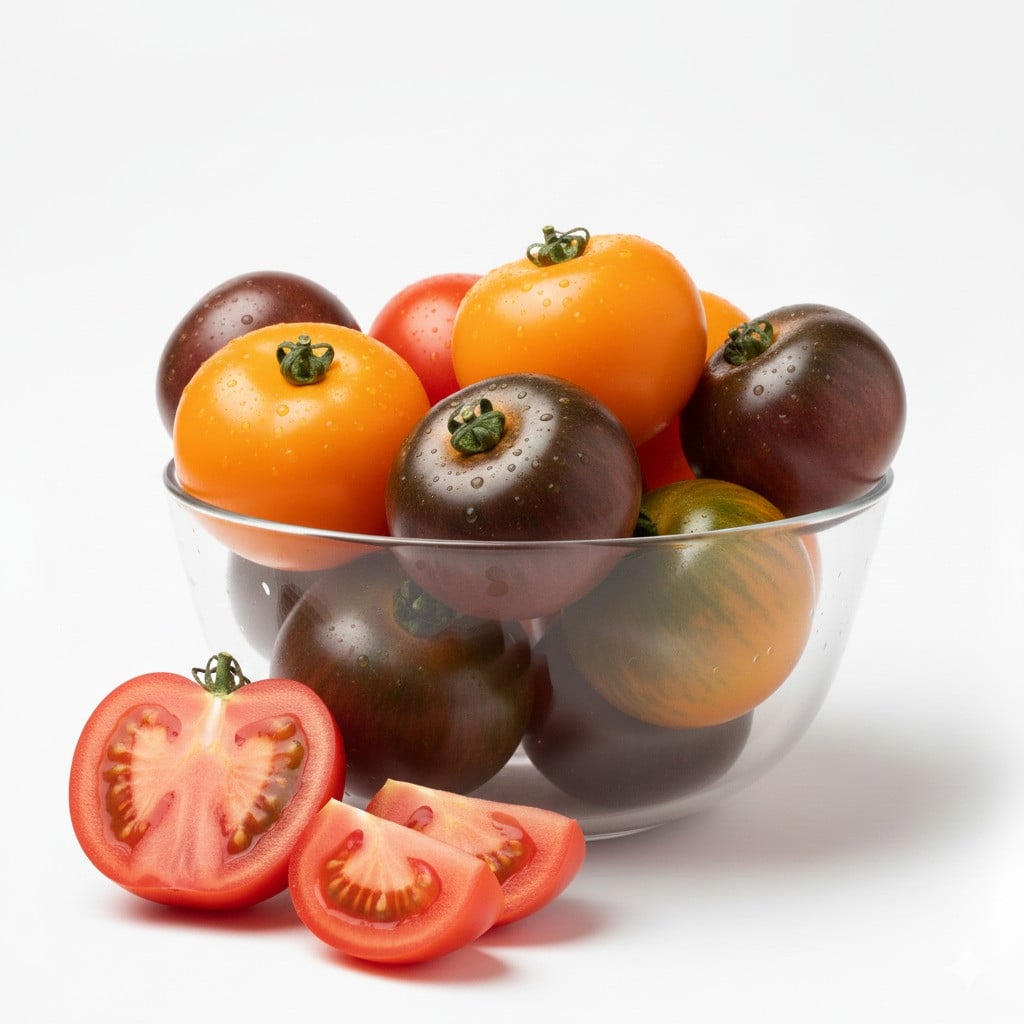
Harzer Kind, what a wonderful name for a tomato. It is an old GDR variety that came onto the market in 1953 and was bred by Paul Vogel in Quedlinburg. At first glance, the red fruits look very similar to the GDR cult variety Harzfeuer F1. However, the Harz child is older, seed-resistant and, as a light-fruited variety, does not have a green collar. The robust pole tomatoes have normal, dense, close-fitting foliage and grow to a height of around 2 meters in my garden. Harzer Kind is a medium-early ripening variety and takes around 65 days from fertilization to harvest maturity. Up to 10 tomatoes grow on each of the strong panicles. The fruits are 4 to 6 cm in size and weigh up to 100 g. The red tomatoes are quite uniform, have 2 or 3 fruit chambers, a juicy soft flesh and a firm but by no means hard skin. The fruits are largely burst-resistant, even when grown outdoors, and have a strong, fruity, sweet and sour taste.
F1 Hybrid
Growing tips
Die robuste und ertragreiche Sorte "Harzer Kind" eignet sich hervorragend für den Anbau im Gewächshaus, im Kübel oder Freiland. Dank ihrer guten Krankheitsresistenz und Kältetoleranz gedeiht sie selbst in kühleren Mittelgebirgslagen problemlos. Wichtige Kulturbedingungen: Mehrtriebkultur möglich: Die Pflanze verträgt 2–3 Triebe und bringt dennoch reiche Erträge. Regenschutz empfohlen: Geschützter Standort (z. B. unter einem Dachvorsprung oder im Gewächshaus) beugt Fäulnis vor. Mittelfrühe Reife: Nach der Befruchtung sind die Früchte in etwa 65 Tagen erntereif. Geschmack & Verwendung: Die mittelgroßen, roten Salattomaten überzeugen mit einem saftigen, aromatischen Fruchtfleisch und einer angenehm festen Schale. Ihr Geschmack ist ein harmonisches Spiel aus Süße und Säure – ideal für Salate, Saucen oder einfach zum Naschen.
Details


Light requirement
Sunny

Water requirement
Moist

Soil
Medium (loamy)

Nutrient requirement
High

Light germinator

Germination temperature
20 - 25 °C (Degrees Celsius)

Plant distance
60 cm

Row spacing
60 cm

Seeding depth
1 cm

Companion Plants
Asparagus
Basil
Broccoli
Brussels sprouts
Carrots
Cauliflower
Celery (Celeriac / Celery root)
Celery (Celery)
Celery (Leaf celery / Chinese celery)
Chili
Chives
Chives
Collard greens (Kale)
Collard greens (Tuscan kale / Dinosaur kale / Palm tree kale)
Common marigold
Cress
Garlic
Garlic chives
Kohlrabi / German turnip / Turnip cabbage
Leeks
Lettuce (Common chicory)
Lettuce (Endive / Escarole / Erisée)
Lettuce (Lamb's lettuce)
Lettuce (Lettuce)
Lettuce (Radicchio / Italian chicory)
Lettuce (Sugar loaf)
Mint
Nasturtium
Onion
Onion (Spring onion)
Parsley
Pepper / Paprika
Spinach (Summer)
Tagetes / Marigolds

Antagonistic Plants
Abyssinian cabbage / Ethiopian mustard
Arugula / Rocket
Aubergine / Eggplant
Beetroot
Black salsify
Broccoli raab / Stem cabbage / Cima di rapa
Cabbage (Cabbage)
Cabbage (red cabbage)
Cabbage (Savoy cabbage)
Corn / Maize
Courgette / Zucchini
Cucumber (African horned cucumber / Kiwano)
Cucumber (Caigua)
Cucumber (Melothria)
Cucumber / Gherkin
Fennel
Florence fennel / Finocchio
Horseradish
Jerusalem artichoke / Topinambur
Melon (Sugar melon)
Melon (Watermelon)
Mustard
Napa cabbage / Chinese cabbage
Oil radish / Fodder radish
Okra
Ornamental pumpkin
Potato
Pumpkin / Squash
Radish
Radishes
Rapini / Broccoli rabe
Sponge gourd / Egyptian cucumber / Vietnamese luffa
Turnip
Turnip greens - Tatsoi
Turnips - Oilseed turnips
Turnips - Wild turnips

Diseases
Grey mold
Root Rot
Dry rot of crucifers
Powdery mildews
Early blight of potato
Blossomrot
Brown rot
Pests
Thrips
Spider mites
Land snails
Aphids
White fly