Rutabaga / Swedish turnip

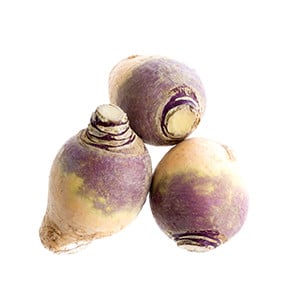
Rutabaga / Swedish turnip
Brassica napus ssp. napobrassica
Plant family
Crucifers (Brassicaceae)
Also known as
Neep
Cultivation Break
4 Years
Season Overview
Propagating
Planting
Harvest
Harvest
J
F
M
A
M
J
J
A
S
O
N
D
1ST YEAR
2ND YEAR
Details

Light requirement
Sunny
Water requirement
Moist

Soil
Medium (loamy)
Nutrient requirement
Medium

Dark germinator

Germination temperature
12 - 18 °C (Degrees Celsius)

Plant distance
40 cm

Row spacing
40 cm

Seeding depth
1.5 cm
Instructions
The season for this plant is over. The following instructions are for the next season.
Beginning of April

Sowing
Beginning of April

Fertilizing
Every two Weeks
End of April

Thinning
Description
Turnip is a subspecies of rapeseed. It is to be distinguished from the turnip and is considered a typical winter vegetable.
Origin:
The actual origin is unclear. Probably northern or central Europe.
Growing tips
The best time for direct sowing is mid-May to July, after which the turnips will not reach their full size until autumn. The seeds should not be sown too deep, 1 cm sowing depth is ideal. The turnip needs a row spacing of 30-40 cm, within the rows they grow best with a distance of 40 cm from the next plant. When the seedlings have formed the first leaves, you can separate them. Turnip is relatively uncomplicated in its care and does not require any special care. Keep the soil around the turnips nice and loose and moist so that ground fleas don't make themselves comfortable and eat the leaves. Also, a loosened soil encourages the formation of nice beet bodies. Otherwise, it behaves as with cabbage: against cabbage white butterfly, earth fleas and whiteflies helps to cover with a culture protection net. The beets can be harvested into November. Smaller turnips (about 10 -15 cm in diameter) have a more intense flavor; large turnips may tend to be woody, especially if grown under drought and heat. Turnips tolerate short-term frosts well, but should be harvested before prolonged frosts. To harvest, you can simply pull the beets out of the ground by hand if the soil is loose; if the soil is firmer, you can use a digging fork to help loosen the soil a bit beforehand.

Companion Plants
Bean (Broad bean / Faba bean / Field bean)
Bean (Dwarf bean)
Bean (Runner bean)
Celery (Celeriac / Celery root)
Celery (Celery)
Celery (Leaf celery / Chinese celery)
Chard
Common marigold
Dill
Lettuce (Common chicory)
Lettuce (Endive / Escarole / Erisée)
Lettuce (Lamb's lettuce)
Lettuce (Lettuce)
Lettuce (Oriental greens / Brown mustard)
Lettuce (Puntarelle / Cicoria di catalogna / Cicoria asparago)
Lettuce (Radicchio / Italian chicory)
Lettuce (Sugar loaf)
Pea
Savory
Soybean
Spinach (Summer)
Spinach (Winter)

Antagonistic Plants
Abyssinian cabbage / Ethiopian mustard
Broccoli
Broccoli raab / Stem cabbage / Cima di rapa
Brussels sprouts
Brussels sprouts
Cabbage (Cabbage)
Cabbage (Pointed cabbage)
Cabbage (red cabbage)
Cabbage (Savoy cabbage)
Cauliflower
Chinese kale - Kai-lan / Chinese broccoli
Chives
Collard greens
Collard greens (Kale)
Collard greens (Tuscan kale / Dinosaur kale / Palm tree kale)
Corn / Maize
Garlic
Jerusalem artichoke / Topinambur
Kohlrabi / German turnip / Turnip cabbage
Leeks
Lovage
Napa cabbage / Chinese cabbage
Onion
Pak Choi
Potato
Radish
Radishes
Rapeseed - Sheer cabbage / Siberian cabbage
Sea coal
Turnip
Vegetable cabbage - Forage cabbage
Vegetable cabbage - Ribbed cabbage / Portuguese cabbage
Vegetable cabbage - wild cabbage / ancient cabbage
Diseases
Root Rot
Club root of cabbage
Pests
Stem borers
Cabbage heart midge
Flea beetles
Aphids
Cabbage white
Cabbage fly
Nematodes
White fly