Chinese kale - Kai-lan / Chinese broccoli

Chinese kale - Kai-lan / Chinese broccoli
Brassica oleracea var. alboglabra
Plant family
Crucifers (Brassicaceae)
Cultivation Break
3 Years
Season Overview
Propagating
Planting
Harvest
J
F
M
A
M
J
J
A
S
O
N
D
Details


Light requirement
Sunny

Water requirement
Moist

Soil
Medium (loamy)
Nutrient requirement
High

Dark germinator

Germination temperature
18 - 20 °C (Degrees Celsius)

Plant distance
20 cm

Row spacing
30 cm

Seeding depth
0.5 cm
Instructions
Description
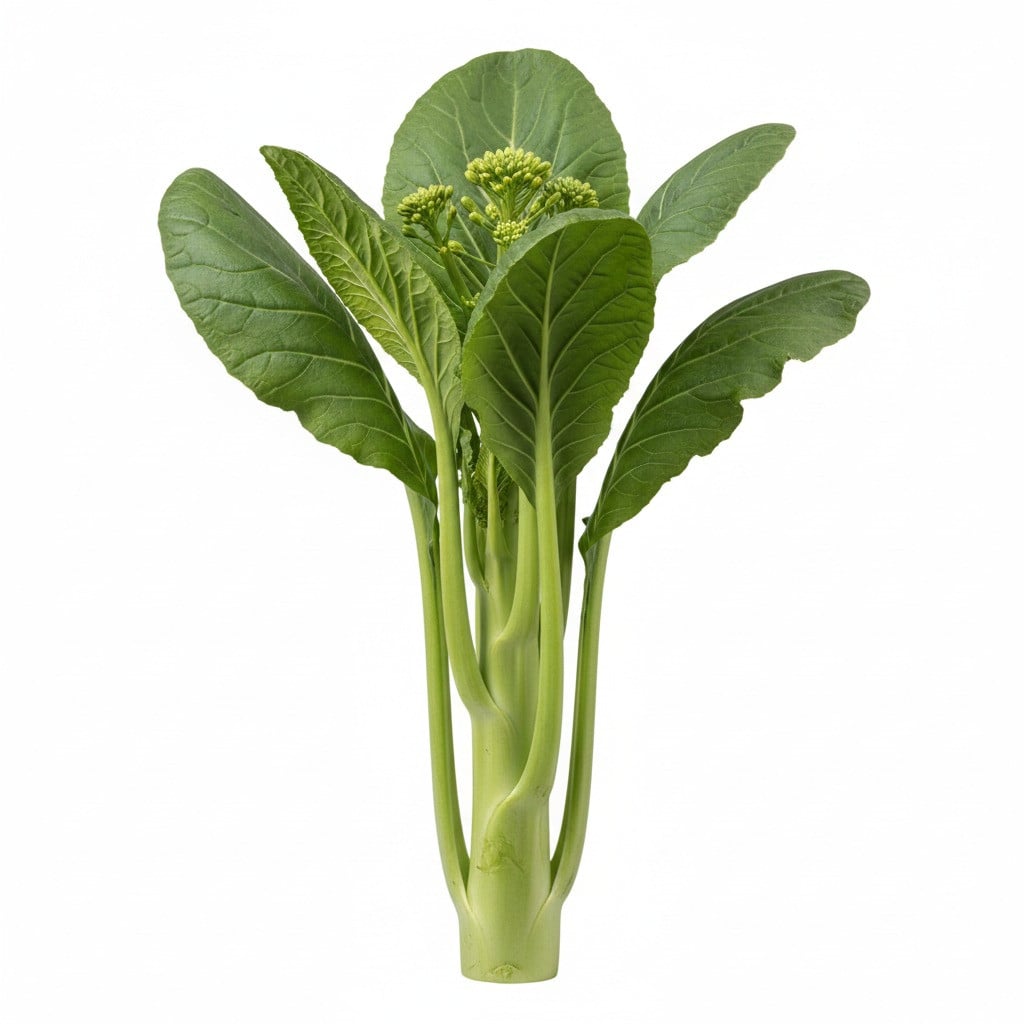
Kai-lan or Chinese broccoli (Brassica oleracea var. alboglabra) is a slightly bitter leafy vegetable with flat, shiny blue-green leaves and thick stems. Kai-lan belongs to the Brassica oleracea species in the cabbage genus (Brassica) and is thus closely related to its subspecies broccoli and kale, to which it is somewhat similar in taste. Its varieties can differ in external characteristics such as flower color, with the yellow-flowered kai-lan being a newer variety compared to the white-flowered kai-lan. Variety In Asia, there is a delicate, small-growing cultivar of this original form of the common kai-lan. There it is called siu kai-lan (small Chinese broccoli). The common kai-lan is also known colloquially as dai kai-lan or da gailan (large Chinese broccoli). An external feature that distinguishes the two varieties is the much thicker stem of the common kai-lan compared to the small-growing variety. The small-growing variety has a more delicate flavor. Both plants have similar values for the ingredients. Characteristics The Kai-lan plant can reach a height of 0.5 to 1 meter, but is usually harvested at a size of 30 to 40 cm. The main stem of the plant is straight and has no hairs. Its stem diameter is usually 1.5 to 2 cm. The leaves of the plant are elongated oval and can grow up to 10 cm long. The leaf edge is irregularly shaped and has small fringes. The leaf stalk can reach a length of 3 to 7 cm. The flower of the kai-lan can be white or yellow, depending on the species. The petal is elongated oval and can be 1 to 2.5 cm long. The diameter of the flower is at least 1.5 to 2 cm. Uses Kai-lan is widely used in Chinese cuisine, especially in southern Cantonese cuisine, for example sautéed with ginger and garlic or simply cooked in hot water and served with oyster sauce. In contrast to broccoli, where only the flower parts are eaten, kai-lan is usually prepared with leaves and stems. In some countries, the vegetable is also used as an ingredient in salads. In Asia, kai-lan has also found its way into the cuisine of Korea, Japan, Myanmar, Thailand and Vietnam.
Origin:
Coastal regions of China, Other cultivation areas in northern China, Taiwan, India, Indonesia, Japan, Malaysia, the Philippines, West Africa and the coastal region of the Mediterranean.
Growing tips
Preparation: Choice of location: Gai Lan loves the sun! Choose a sunny spot in your garden that gets at least 6 hours of sunlight per day. Partial shade is also possible, but the plants will not grow as lushly. Soil conditions: The soil should be well-drained to prevent waterlogging. Gai Lan prefers a nutrient-rich soil. If your soil is rather sandy or loamy, you can improve it with compost or other organic matter. Tilling: Loosen the soil with a spade or digging fork. Remove weeds, stones and other obstacles. Then rake the soil smooth. Fertilization: Work compost or organic fertilizer into the soil. This provides the plants with important nutrients and promotes growth. Direct sowing: 1st timing: Direct sowing outdoors is possible from mid-April to the end of August. Make sure that there is no risk of frost. 2nd sowing: Use a rake to make shallow grooves in the prepared soil. The grooves should be about 1-2 cm deep and 20-30 cm apart. 3. seeds: Sow the Gai Lan seeds into the grooves. Make sure that the seeds are not too close together. A distance of 2-3 cm between the seeds is ideal. 4. cover: Cover the seeds with a thin layer of soil and press down lightly. 5. watering: Water the soil carefully so that the seeds are not washed away. 6. moisture: Keep the soil moist, but not wet. Pre-cultivation: 1.Timing: Start pre-growing about 4-6 weeks before the last expected frost. 2. growing containers: Use seed trays, small pots or egg cartons. Fill the containers with potting compost. 3rd sowing: Sow 2-3 seeds per container. Cover the seeds with a thin layer of soil and press them down lightly. 4. watering: Water the soil carefully. 5. location: Place the seed containers in a bright and warm place. A temperature of 18-20°C is ideal. 6. humidity: Keep the soil moist, but not wet. 7.pricking out: As soon as the seedlings have 2-3 true leaves, you can prick them out. This means that you remove the weakest seedlings and transplant the strongest ones into larger pots. Planting out: As soon as the Gai Lan plants are strong enough (about 10-15 cm high), you can plant them out in the open. 1st timing: Plant out the Gai Lan plants after the last frost. 2nd spacing: Plant the plants 20-30 cm apart. 3. planting holes: Dig planting holes that are slightly larger than the root balls of the plants. 4. planting: Place the plants in the planting holes and fill the holes with soil. Press the soil down lightly. 5. watering: Water the plants thoroughly. Care: Watering: Water the Gai Lan plants regularly, especially in dry weather. Make sure that the soil is always slightly moist. Avoid waterlogging. Fertilize: Fertilize the plants regularly with compost or organic fertilizer. This provides them with important nutrients and promotes growth. Weeding: Remove weeds regularly so that the Gai Lan plants are not overgrown by weeds. Pests: Watch out for pests such as slugs, cabbage white butterflies and aphids. If necessary, you can sprinkle slug pellets or protect the plants with fleece or netting. A simple spray of water or soapy water often helps against aphids. Loosen the soil: Loosen the soil regularly so that the roots of the plants get enough oxygen. Harvest: 1st time: Harvest the Gai Lan stems when the flower buds are still closed. When the flowers open, the stems become tough and bitter. 2nd harvest: Cut the stems with a sharp knife or scissors. Leave the lower leaves so that the plant can continue to grow and form new stems. 3rd storage: Gai Lan can be kept in the fridge for about 3-4 days. Tips: Crop rotation: Do not grow Gai Lan in the same location every year. Rotate the cultivation area to prevent diseases and pests. Mixed cultivation: Gai Lan goes well with other vegetables such as carrots, radishes or lettuce. Mulching: Cover the soil with a layer of mulch (e.g. straw or grass clippings). This keeps the soil moist, suppresses weeds and protects the plants from splashing water. Choice of variety: There are different Gai Lan varieties. Find out which variety is best suited to your climate and garden. Observation: Observe your plants regularly. This will allow you to recognize problems early on and take action in good time.

Companion Plants

Antagonistic Plants
Broccoli
Broccoli raab / Stem cabbage / Cima di rapa
Brussels sprouts
Brussels sprouts
Cabbage (Cabbage)
Cabbage (red cabbage)
Cabbage (Savoy cabbage)
Cauliflower
Collard greens
Collard greens (Kale)
Collard greens (Tuscan kale / Dinosaur kale / Palm tree kale)
Corn / Maize
Kohlrabi / German turnip / Turnip cabbage
Napa cabbage / Chinese cabbage
Potato
Tomato (Bush tomato)
Tomato (Cocktail bush tomato)
Tomato (Cocktail Stake Tomato)
Tomato (Stake tomato)

Diseases
Angular leaf spot of cucumber
Club root of cabbage
Downy mildew

Pests
Caterpillars
Land snails
Flea beetles
Aphids
Cabbage white