Blutpflaume 'Nigra'

Variety
Blutpflaume 'Nigra'
Approved Data
created by Alex&Sempi at 06.11.2025
Features
Taste
mild
aromatic
fruity
sweet
Slightly savory
raw edible
pleasant
juicy
thin skin
Essbarkeit: Frucht
Toxizität: ungiftig
Konsistenz: weich
Growth habit
lifespan: perennial
growth habit: runner-forming
Game Variety
flower: flowering
self-fruiting
leaves: Deciduous
Cold germination
large shrub
tree
root type: heart-shaped root system
ornamental plant
growth habit: upright-bushy
growth habit: Trailing
growth habit: broad-rounded crown
Fragrant flowers
seed-fixed: no
serrated leaves
propagation by cuttings
wide: over 400 cm
growth habit: becoming woody
growth habit: well-branched
hermaphroditic
growth habit: upright overhanging
wide: 300 - 400 cm
height: 300 - 400 cm
simple flower
umbellate flowers
star-shaped flowers
weak to medium growth
slow growth
propagation by runners
propagation by grafting
fruit on one-year-old wood
insect pollination
Blätter: eiförmig
Blüte: mittelgroß
Blätter: zugespitzt
Blätter: mittelgroß
Geschlechtertyp: einhäusig
Ernte: mittelreifend
Keimung: Dunkelkeimer
Blätter: gesägt
Blätter: einfach
Blätter: elliptisch
Schnitt: Verjüngung
Schnitt: Form
Schnitt: nach Blüte
Schnitt: zeitiges Frühjahr
Ernteertrag: mittel
Seitentriebbildung: mäßig
Resistances
resistant
robust
drought tolerant
weatherproof
susceptible to late frost
hardy down to -20°C
Stadtklimafest
Location
planting: outdoor
light: sunny to semi-shady
Soil: permeable soil
soil moisture: no waterlogging
biotope: mountain area
Planting: mounds / ridges
Fertilization: single dose of compost
Fertilization: nutrient-rich
fertilization: humus-enriched
Soil: regular garden soil
soil moisture: well-drained
biotope: forest
Soil moisture: dry to moderately moist
Soil: deep
Soil: light to medium-heavy
Soil: sandy to loamy
Wind: windverträglich
fertilization: low-nitrogen
Planting: hedge
pH value: neutral to alkaline (7-8)
Fertilization: moderate
Water: moderately
Fertilization: organic
biotope: meadow / park
Heat requirement: moderate
Düngung: kalktolerant
Biotop: Feld
Pflanzung: Bauerngarten
Düngung: Langzeitdünger
Düngung: NPK 10/10/10
Düngemittel: Hornspäne
Nachbarn gute: trockenheitsliebende
Nachbarn schlecht: feuchtigkeitsliebend
Nachbarn schlechte: Schattenpflanzen
Good companions: calcium-loving
Good companions: sun-loving
Nachbarn schlechte: stark wuchernd
Nachbarn gute: hochwachsend
Nachbarn gute: niedrigwachsend
Gartenstil: Naturgarten
Pflanztechnik: Mulchen
Herkunft: Züchtung
Fruit shape
smooth, sleek
Steinfrucht
Color
glossy
crimson
Flower: pink
Frucht: dunkelrot
Frucht: violett
Frucht: weinrot
Blätter: weinrot
Wurzel: cremeweiß
Wurzel: gelb
Wurzel: braun
Samen: braun
Fruchtfleisch: gelb
Fruchtfleisch: orange
Stamm, Stiel: graubraun/braungrau
Herbstfärbung: keine
Oberfläche: glatt
Blätter: Austrieb dunkelrot/schwarzrot
Blätter: schwarzrot
Stamm, Stiel: schwarzbraun
Season Overview
Propagating
Planting
Harvest
Harvest
J
F
M
A
M
J
J
A
S
O
N
D
1ST YEAR
FOLLOWING YEARS
Description
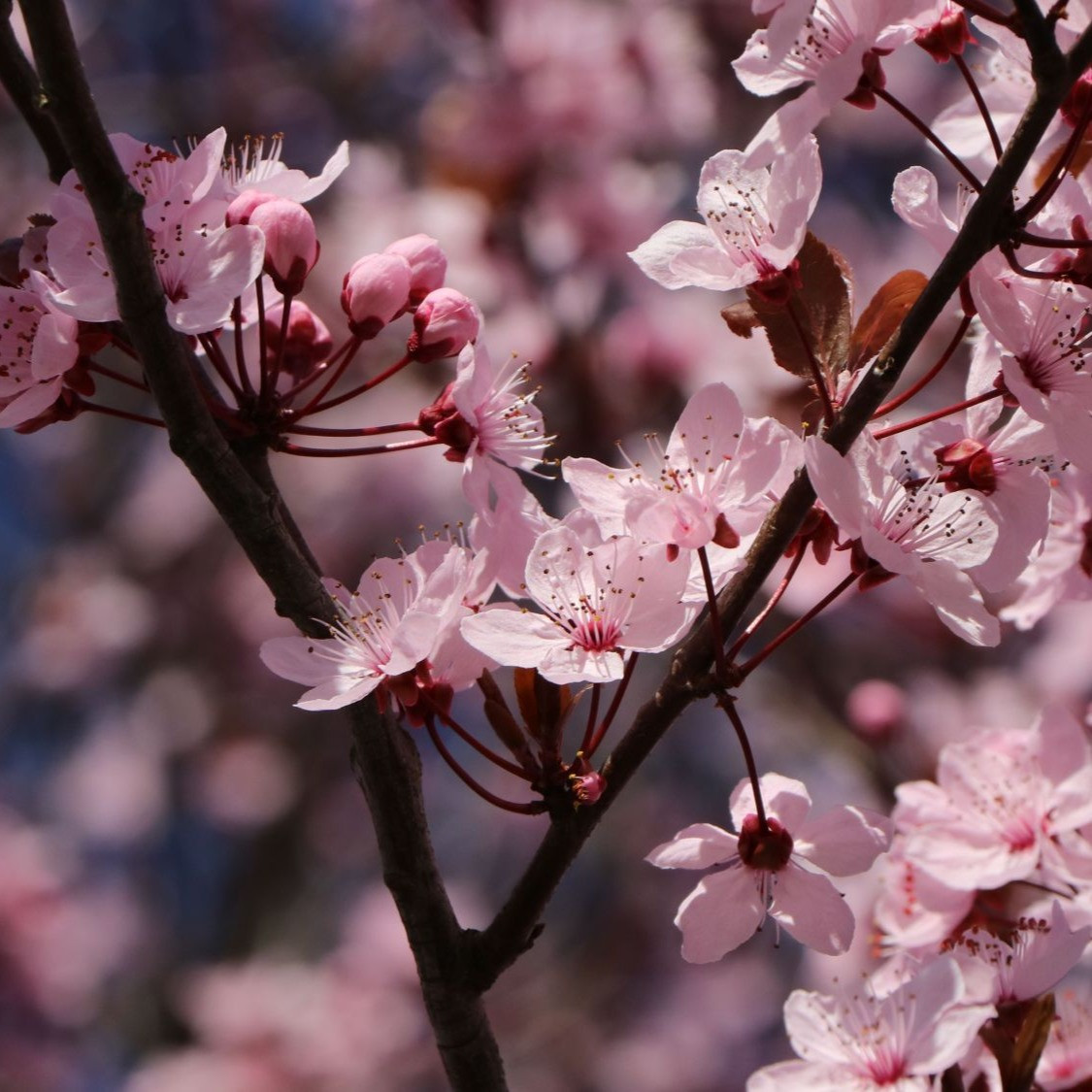
The blood plum 'Nigra' impresses with its dark red, glossy leaves and dark brown-red to blackish bark. In spring, countless small, pink-colored flowers cover the densely growing branches. They form before the foliage sprouts or at the same time as it does. This striking coloration of light and dark shades of red, brown and pink characterizes the (bot.) Prunus cerasifera 'Nigra'. This beautiful plant belongs to the rose family and is also known in many gardens as the cherry plum. The heavenly attractiveness of this shrub is particularly striking next to trees and shrubs with light green foliage. Its warm colors provide beautiful contrasts and color gradients. In the garden or in public green spaces, this whimsical coloration makes for a colorful spectacle. In autumn, the leaves take on an intense dark red color. It is particularly effective next to full and dense greenery. Prunus cerasifera 'Nigra' can be cultivated either as a free-standing shrub or as a tree with a rounded to conical crown. Outdoors, the plant becomes a shrub and develops over time into a very beautiful large shrub with tree-like dimensions. Thorough pruning over the winter ensures that the blood plum 'Nigra' branches out strongly and forms a well-branched, dense crown. The ornamental shrub develops comparatively slowly and with age into overhanging branches that make for a decorative sight. If you prefer straight-growing branches, shorten them with an annual pruning and shape them in this way. It's important to weigh things up here, as the early flowering usually means that some of the flowering is lost through pruning. Summer is therefore ideal for topiary. The plants tolerate such pruning best around St. John's Day (24.06.). Grown as trees, they reach a considerable height and width and are shown to their best advantage in a solitary position. If the enchanting blood plum is cultivated as a shrub, it is ideal for solitary plantings. It also cuts a great figure in a group. As a hedge, the ornamental shrub looks fantastic. Native birds like to build their nests in the dense branching. The blood plum 'Nigra', whose name is derived from the dark red foliage, grows best in a bright and warm location with plenty of direct sunlight. It is characterized by a high degree of tolerance to almost any garden soil and occasional drought. It is often an insensitive and attractive plant. As the Prunus cerasifera Nigra decorates in April and May, it produces small fruits that are visually reminiscent of cherries. No wonder the plant is often called cherry plum. The inconspicuous fruits are edible and have a sweet taste. They have a diameter of two to three centimetres and can be enjoyed by the family from July to August. Enjoy this delicious snack when fully ripe in late summer on a variety of occasions. The little vitamin bombs are popular for use in the kitchen. They are used in cakes, jams, liqueurs and compotes. They are also a delicious refreshment for young and old as a freshly picked snack.
F1 Hybrid
Frostproof
Growing tips
Ll
Details


Light requirement
Sunny

Water requirement
Dry

Soil
Medium (loamy)

Nutrient requirement
Medium

Dark germinator

Germination temperature
18 - 22 °C (Degrees Celsius)

Plant distance
400 cm

Row spacing
400 cm

Seeding depth
2.5 cm

Companion Plants

Antagonistic Plants
Aubergine / Eggplant
Basil
Catnip
Common mugwort
Courgette / Zucchini
Cucumber / Gherkin
Iris
Lovage
Make
Mint
Okra
Ornamental pumpkin
Peony
Pepper / Paprika
Potato
Pumpkin / Squash
Rhubarb
Sweet potato
Tomato (Bush tomato)
Tomato (Cocktail bush tomato)
Tomato (Cocktail Stake Tomato)
Tomato (Stake tomato)
Walnut family
Wild Cherry / Bird Cherry / Sweet Cherry

Diseases
Root Rot
Pests
Spotted wing drosophila
Spider mites
Common winter moth
Aphids