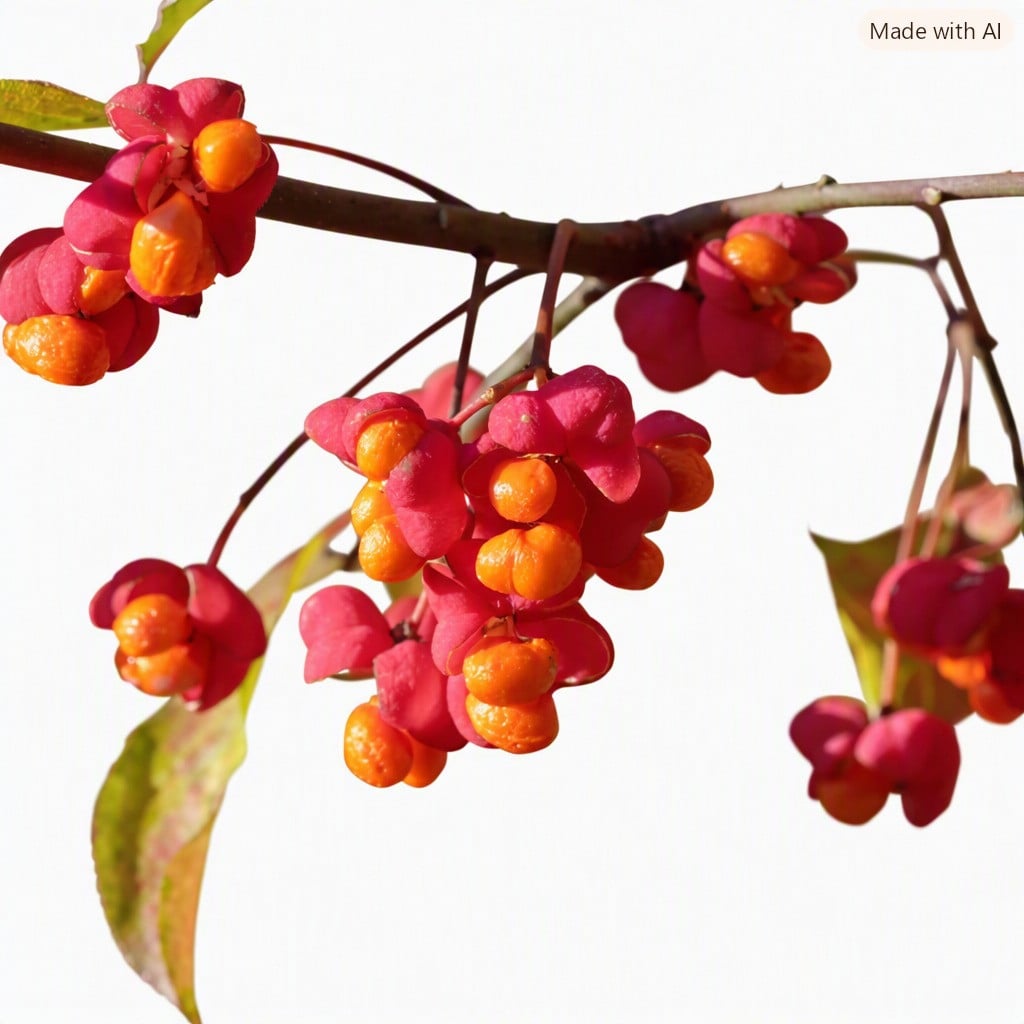
Gewöhnlicher Spindelstrauch / Gewöhnliches Pfaffenhütchen (Wildform)

Variety
Gewöhnlicher Spindelstrauch / Gewöhnliches Pfaffenhütchen (Wildform)
Approved Data
created by Alex&Sempi at 26.09.2026
Season Overview
Propagating
Planting
Harvest
J
F
M
A
M
J
J
A
S
O
N
D
1ST YEAR
FROM YEAR 7
Description
The common spindle tree (Euonymus europaeus), also known as the European spindle tree, common spindle tree, priest's cap, priest's little cap, or Spindle tree, is a plant species in the spindle tree family (Celastraceae). Because the capsule-like fruit resembles the biretta, a head covering worn by Catholic clergy, the plant is called “priest’s cap” or “priest’s bonnet.” The nickname “robin’s bread” comes from the fact that birds like to eat the seeds in winter. Distribution The spindle tree is found primarily in Europe, with a concentration in Central Europe. To the north, it extends as far as Ireland, southern Scotland, southern Sweden, and Latvia; to the south, as far as northern Spain, Sicily, and central Greece. Its range extends into Asia as far as northern Asia Minor and the Caucasus region. The plant prefers forest edges, hedgerows, and slopes. The spindle tree requires nutrient-rich, calcareous, and low-salt soils. According to Ellenberg, this plant species is an indicator of moderate warmth, an indicator of freshness in moderately nitrogen-rich sites, and a class-defining species of the blackthorn thickets and related communities (Prunetalia spinosae), but it also occurs in the Alno-Ulmion as well as in the seepage-moist Carpinion and Fagion. In the Allgäu Alps, the species reaches elevations of up to 1,100 meters above sea level in Bavaria between Hinterreute and Vorderreute near Wertach. In Graubünden, the species reaches elevations of up to 1,200 meters, and in the Uri Alps, up to 1,245 meters above sea level. Growth The common spindle tree, as a deciduous, upright, and profusely branched, spindly shrub, reaches heights of up to 3 m; as a small tree, it can grow up to 6 m. The branches, which are often bluntly quadrangular in cross-section (a characteristic of the “wand shrub”), have bark that is initially green and later turns gray-brown; two to four narrow cork strips may be present (cork wings are relatively rare, but they are also found on elm trees). As they age, shrubs and trees develop gray-brown, longitudinally fissured bark. It is wind-resistant and frost-hardy. All parts of the plant are poisonous. Leaves The opposite leaves have a short petiole and an ovate to oblong-ovate or lanceolate, with a pointed to acuminate blade, a finely notched to serrated or toothed margin, and glabrous surfaces on both sides. Some exhibit a bright red autumn coloration. Flowering Common spindle trees are mostly female or hermaphroditic. However, functionally male flowers are sometimes present as well. The flowering period extends from May to June. Short, loose, axillary, and cymose inflorescences form on a 1–3 cm long inflorescence stalk. They usually contain two to six flowers, rarely up to ten. The mostly hermaphroditic or female, stalked, four-parted flowers are small and inconspicuous, with a double perianth. The four sepals are green and 1–1.5 mm long. The four spreading, elongated petals are 3–5 mm long and greenish to white. Nectar is secreted by the fleshy, four-lobed disk and attracts many species of insects, especially ants and flies, as pollinators. The four-chambered ovary is superior, with a short style and a tiny stigma. In the female flowers, the anthers are sterile; otherwise, they look almost identical to the hermaphroditic or functionally male flowers. Fruit The fruits, arranged in a protruding inflorescence, ripen from September through October and then open with four valves. The purple-pink to reddish, four-lobed, leathery, compartment-split capsules with a persistent calyx are four-chambered, 1–1.5 cm wide, and contain one to four seeds. The white, egg-shaped seeds, 5–7 mm long, are completely enclosed by a thin, orange-colored seed coat (aril), have a green embryo, and hang from the open capsule on elongated stalks (funiculus). Toxicology All parts of the common spindle tree are poisonous. Steroid glycosides (cardenolides) are found primarily in the seeds. Ingestion of the seeds leads to abdominal pain, nausea, vomiting, and diarrhea. This can result in severe irritation of the gastrointestinal tract. The glycosides also affect the heart muscle. Kidney damage, circulatory collapse, drowsiness, and liver swelling are among the symptoms that occur when the fruits are ingested. Poisoning occurs primarily in children who are tempted by the attractive-looking fruits. This can lead to liver and kidney damage and, depending on the severity, even death. The literature provides varying information regarding the dose at which the plant becomes lethal. All symptoms can still appear up to 18 hours after ingesting the poisonous parts of the plant. First-aid measures include inducing vomiting and administering activated charcoal. Additional measures include gastric lavage, the administration of Mucilaginosa to reduce irritation of the gastrointestinal tract, and the administration of barbiturates and benzodiazepines to counteract convulsions. Uses The spindle tree is a valuable roadside shrub for erosion control and the restoration of riverbanks and slopes. Its hard, fine-grained wood is used in woodturning and for the production of drawing charcoal. It is also used to make wooden pegs for watchmakers. Because of its beautiful fall colors, red fruits, and the unusual, angular shape of its branches, spindle tree is often planted as an ornamental shrub in gardens and parks. The name “Spindelstrauch” (spindle tree) comes from the fact that the wood was historically used to make hand spindles. Birds enjoy eating the seeds in winter.
Frostproof
Growing tips
🌞 Location & Soil • sunny to partial shade • very wind-resistant • humus-rich, normal to loamy garden soil • pH: 5.5–7.5 (acidic – slightly alkaline) • nutrient-rich soil • well-drained, permeable, no waterlogging 🌱 Sowing & Planting • Preparation: Wash seeds thoroughly / soak for 24 hours / store for 4 weeks at 20–25°C • Stratification: Store for 12–16 weeks at 2–6°C • Pre-cultivation: Starting in February/March • Growing medium: Loose, well-drained (seed-starting mix + sand) • Location: bright / no direct sun • Germination temperature: 10–15 °C • Germination time: 4–8 weeks • Seeding depth: 1–2 cm (germinates in the dark) • Planting time: year-round (frost-free) / spring, fall • Keep soil evenly slightly moist • From cuttings: spring–early summer / 20–24°C / 3–6 weeks • Planting spacing: 150–350 cm 💧 Care • Low maintenance • Watering: regularly, light to moderate • Fertilization: light to moderate (compost, horn shavings, organic fertilizer in spring) Optional light organic fertilization in September 🌾 Pruning & Harvest • Fruits: poisonous (wear gloves when collecting seeds) • Pruning: not necessary, but tolerates pruning extremely well • Pruning time: Late winter / February through early March ❄️ Winter Protection • Hardy • Avoid waterlogging 🌿 Good Companion Plants • Purple bellflowers, lavender, hydrangeas • Dwarf conifers (thuja, juniper, false cypress) • Cranesbill, Waldsteinia, periwinkle • Deutzia, weigela, forsythia • Steppe sage, catnip, goldenrod, bellflowers • Sedum (stonecrop), houseleek, bugleweed, deadnettle • Summer spirea, finger spirea, low barberry, dwarf dogwood • Lamp cleaner grass, Japanese mountain grass, Carex, Festuca • Astilbe, hostas, ferns 🚫 Bad neighbors • Tall perennials (larkspur, coneflower, asters) • Rhododendrons, azaleas, bamboo, cherry laurel • Large, shallow-rooted trees and shrubs (birch, spruce, willow) • Heavy-feeding plants (tomatoes, squash, zucchini) • Vigorous ground covers (ivy, ground elder, raspberry) 🍂 Diseases • Root rot • Powdery mildew • Leaf spot 🐌 Pests • Aphids • Scale insects • Black bean aphid • Spindle tree webworm • Spindle tree leaf miner
Details


Light requirement
Sunny

Water requirement
Moist

Soil
Medium (loamy)

Nutrient requirement
Medium

Dark germinator

Germination temperature
10 - 15 °C (Degrees Celsius)

Plant distance
250 cm

Row spacing
250 cm

Seeding depth
1.5 cm

Companion Plants
barberries
Catnip
Dogwood
Evening primrose
Evergreen
False cypresses
Forsythia
Funk
Geranie/Pelargonie
Glockenblumen - lat campanula
Grasses - feather-bristled grasses, lamp-cleaning grasses
Grasses - Fescue
Grasses - Sedges
Hydrangea / Hortensia
Juniper
Lavender
Make
Purple bellflower, silver bellflower
Quadriceps
Sage
Spirea
Succulents
Tree of Life, Thuja
Weigela

Antagonistic Plants
Aster
Cherry laurel
Coneflower (Echinacea)
Courgette / Zucchini
Cucumber (Caigua)
Garden squash - Patisson / UFO squash
Grasses - Bamboos
Hair cucumbers / snake gourds
Ivy
Larkspur
Ornamental pumpkin
Pumpkin / Squash
Raspberry
Rhododendron
Spruce trees
Tomato (Bush tomato)
Tomato (Cocktail bush tomato)
Tomato (Cocktail Stake Tomato)
Tomato (Stake tomato)
Willows
Diseases
Root Rot
Powdery mildews
Pests
Caterpillars
Black bean aphid
Schildläuse
Aphids