Spindle trees

Spindle trees
Euonymus
Plant family
Stafftree family (Celastraceae)
Season Overview
Propagating
Planting
Harvest
J
F
M
A
M
J
J
A
S
O
N
D
1ST YEAR
FROM YEAR 7
Details

Light requirement
Sunny

Water requirement
Moist

Soil
Medium (loamy)
Nutrient requirement
Medium

Dark germinator

Germination temperature
15 - 20 °C (Degrees Celsius)

Plant distance
200 cm

Row spacing
200 cm

Seeding depth
1.5 cm
Instructions
Description
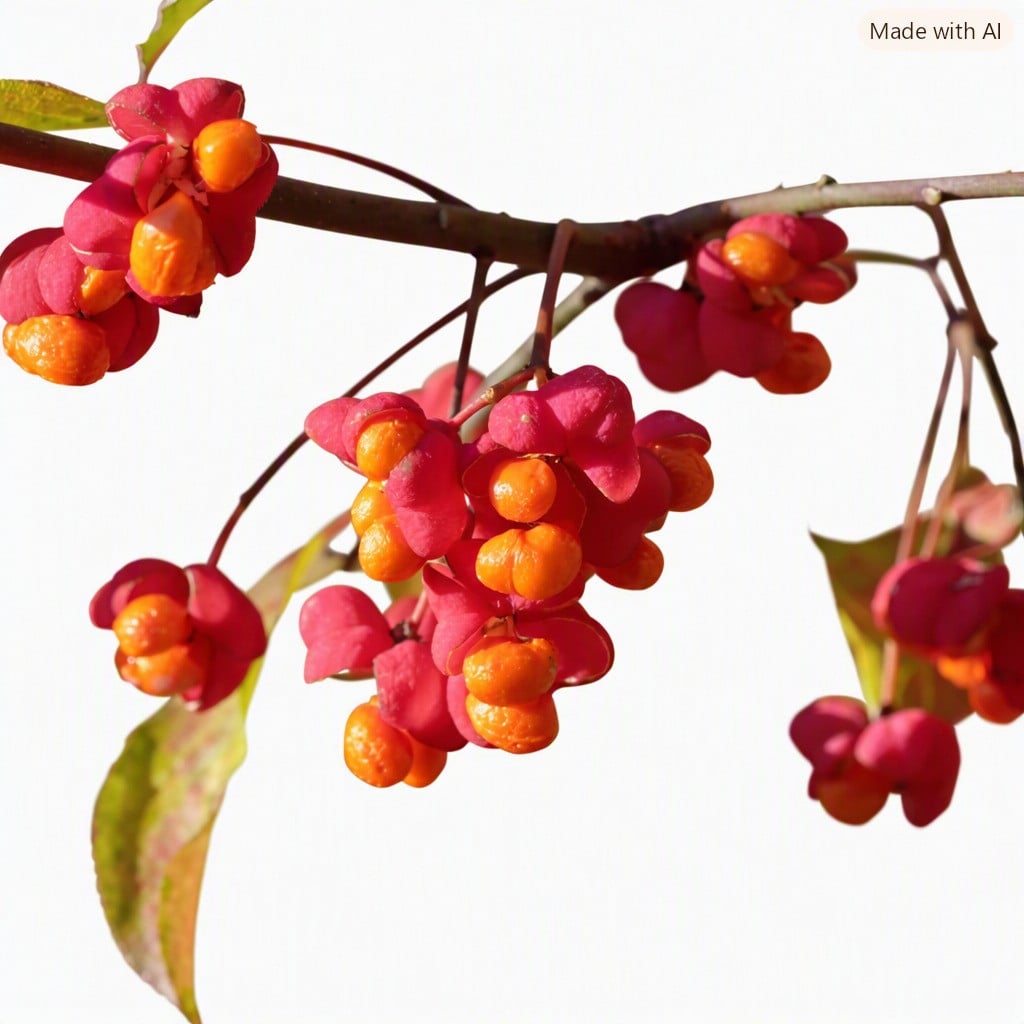
Spindle trees (Euonymus) are a genus of plants in the spindle tree family (Celastraceae). The German genus name refers to the historical use of the wood, which was processed into spindles, shoe nails, organ pipes, or knitting needles. In nurseries, they are often found under the name “cork-winged spindle tree,” as some species have fine strips of bark on their branches. Spindle tree species are woody plants: shrubs or small trees, with some species being prostrate to climbing. They are evergreen or deciduous. The plant parts are usually glabrous; rarely, they are downy. The genus Euonymus is divided into two subgenera: Subgenus Kalonymus: With winged capsule fruits. Subgenus Euonymus: With wingless capsules. There are 130 to 176 species in the genus Euonymus. Distribution Spindle trees are found in Europe, Asia, and the temperate regions of North America and Australia. One of the best-known species in our part of the world is the spindle tree. In China alone, there are 50 endemic species—that is, plants found only there. In Central Europe, the genus is represented by three species: - Common spindle tree (syn.: common spindle; Euonymus europaeus), a common shrub species with a wide, widespread distribution - Broad-leaved spindle tree (syn.: broad-leaved spindle, Pre-Alpine spindle tree; Euonymus latifolius), which occurs primarily in the Alps and the Alpine foothills - Warty spindle tree (Euonymus verrucosus), with a distribution centered in (southeastern) Europe (the Pannonian region), such as Austria, the Czech Republic, etc. Growth Spindle trees vary greatly in appearance. There are shrub-like plants, climbing or tree-like species, as well as creeping groundcovers. Climbing plants grow best when trained up a wall, fence, or other climbing supports. Some shrubs grow with many branches, while others have distinctive bark patterns with characteristic cork strips. Depending on the species, spindle trees grow to a height of two to five meters and, as they age, form a more or less spreading crown, often with dense branching. The garden forms of the creeping or climbing spindle (Euonymus fortunei) can reach similar heights with a suitable climbing support, but generally remain smaller. A typical identifying feature of all spindle shrubs is their square-shaped branches: The bark of most species is covered with four cork strips, some more pronounced than others. Leaves Due to the large number of Euonymus species, only general statements about leaf shape are possible. The leaves are usually opposite, less commonly whorled. The shape is simple, and the leaf margin is smooth, serrated, or notched. The plants produce stipules. Leaf sizes and colors vary among the different species. Some species develop decorative fall foliage that withers and falls off. Other species are evergreen. All deciduous species display intense orange to red foliage in the fall with a strong luminosity. Even the evergreen climbing spindle tree turns its foliage a light pink to reddish hue in the fall and winter. Flowering The spindle tree genus typically produces axillary, cymose inflorescences in the spring (May). The greenish-yellow flowers are hermaphroditic and have four to five parts. The distinctive petals range in color from bright yellow to purple or carmine red. The fleshy receptacle is ring-shaped and has four or five lobes. The flowers’ up to five carpels are fused into a single ovary. Fruit The capsule fruits of the genus Euonymus are spherical and have four or five compartments. In some species, they have up to five lobes and are ribbed or winged. The elliptical seeds inside are more or less enclosed by a red or orange fleshy coat. Uses Numerous spindle trees are popular ornamental shrubs in gardens and parks due to their bright capsules and decorative foliage. With regular pruning, some species form evergreen hedges or ground covers. These can be combined with grasses or perennials in flower beds as foliage plants. Many Euonymus plants are suitable for container gardening and provide year-round ornamental value on patios or balconies. The evergreen species provide structure to gardens and perennial beds throughout the winter. In addition, evergreen, climbing spindle trees beautify walls or concrete surfaces year-round. Spindle trees serve as an important food source for birds in the fall and winter.
Origin:
Europe, the Himalayas, India, China, Japan, Malaysia, Madagascar, North America
Growing tips
🌞 Location & Soil • sunny to partially shaded • tolerant of wind • humus-rich, standard garden soil • pH: 6–7 (neutral) • nutrient-rich soil • well-drained, permeable, no waterlogging 🌱 Sowing & Planting • Preparation: Wash seeds thoroughly / soak for 24 hours • Stratification: Store for 8–12 weeks at 2–6°C / some seeds require 2 winters • Pre-cultivation: Starting in October/November • Growing medium: loose, well-drained (seed-starting mix + sand) • Location: bright / no direct sun • Germination temperature: 15–20 °C • Germination time: several weeks to months • Seeding depth: 1–2 cm (germinates in the dark) • Planting time: year-round (frost-free) / spring, fall • Keep soil evenly slightly moist • From cuttings: spring–early summer / 20–24°C / 3–6 weeks • Planting spacing: 25–300 cm, depending on the species 💧 Care • Low maintenance • Watering: regularly, lightly to moderately (depending on species) • Fertilization: moderate (compost, horn shavings, organic fertilizer in spring) Light top-dressing in July / Japonicus varieties need a bit more 🌾 Pruning & Harvest • Fruits: poisonous • Pruning: tolerates pruning (depending on species) Do not prune variegated varieties too heavily • Pruning: depending on species ❄️ Winter Protection • Hardy • Japanese spindle tree with light winter protection or in sheltered locations • Avoid waterlogging 🌿 Good neighbors • Purple bellflower, lavender, hydrangeas • Dwarf conifers (thuja, juniper, false cypress) • Cranesbill, Waldsteinia, periwinkle • Deutzia, weigela, forsythia • Steppe sage, catnip, goldenrod, bellflowers • Sedum (stonecrop), houseleek, bugleweed, deadnettle • Summer spirea, finger spirea, dwarf barberry, dwarf dogwood • Lamp cleaner grass, Japanese mountain grass, Carex, Festuca • Astilbe, hostas, ferns 🚫 Bad Neighbors • Tall perennials (labradorias, coneflowers, asters) • Rhododendrons, azaleas, bamboo, cherry laurel • Large, shallow-rooted trees and shrubs (birch, spruce, willow) • Heavy-feeding plants (tomatoes, squash, zucchini) • Vigorous ground covers (ivy, ground elder, raspberries) 🍂 Diseases • Root rot • Powdery mildew • Leaf spot 🐌 Pests • Aphids • Scale insects • Black bean aphid • Webworm

Companion Plants
barberries
Catnip
Dogwood
Evening primrose
Evergreen
False cypresses
Forsythia
Funk
Geranie/Pelargonie
Glockenblumen - lat campanula
Grasses - feather-bristled grasses, lamp-cleaning grasses
Grasses - Fescue
Grasses - Sedges
Hydrangea / Hortensia
Juniper
Lavender
Make
Purple bellflower, silver bellflower
Quadriceps
Sage
Spirea
Succulents
Tree of Life, Thuja
Weigela

Antagonistic Plants
Aster
Cherry laurel
Coneflower (Echinacea)
Courgette / Zucchini
Cucumber (Caigua)
Garden squash - Patisson / UFO squash
Grasses - Bamboos
Hair cucumbers / snake gourds
Ivy
Larkspur
Ornamental pumpkin
Pumpkin / Squash
Raspberry
Rhododendron
Spruce trees
Tomato (Bush tomato)
Tomato (Cocktail bush tomato)
Tomato (Cocktail Stake Tomato)
Tomato (Stake tomato)
Willows
Diseases
Root Rot
Powdery mildews
Pests
Caterpillars
Black bean aphid
Schildläuse
Aphids