Märchenglanz

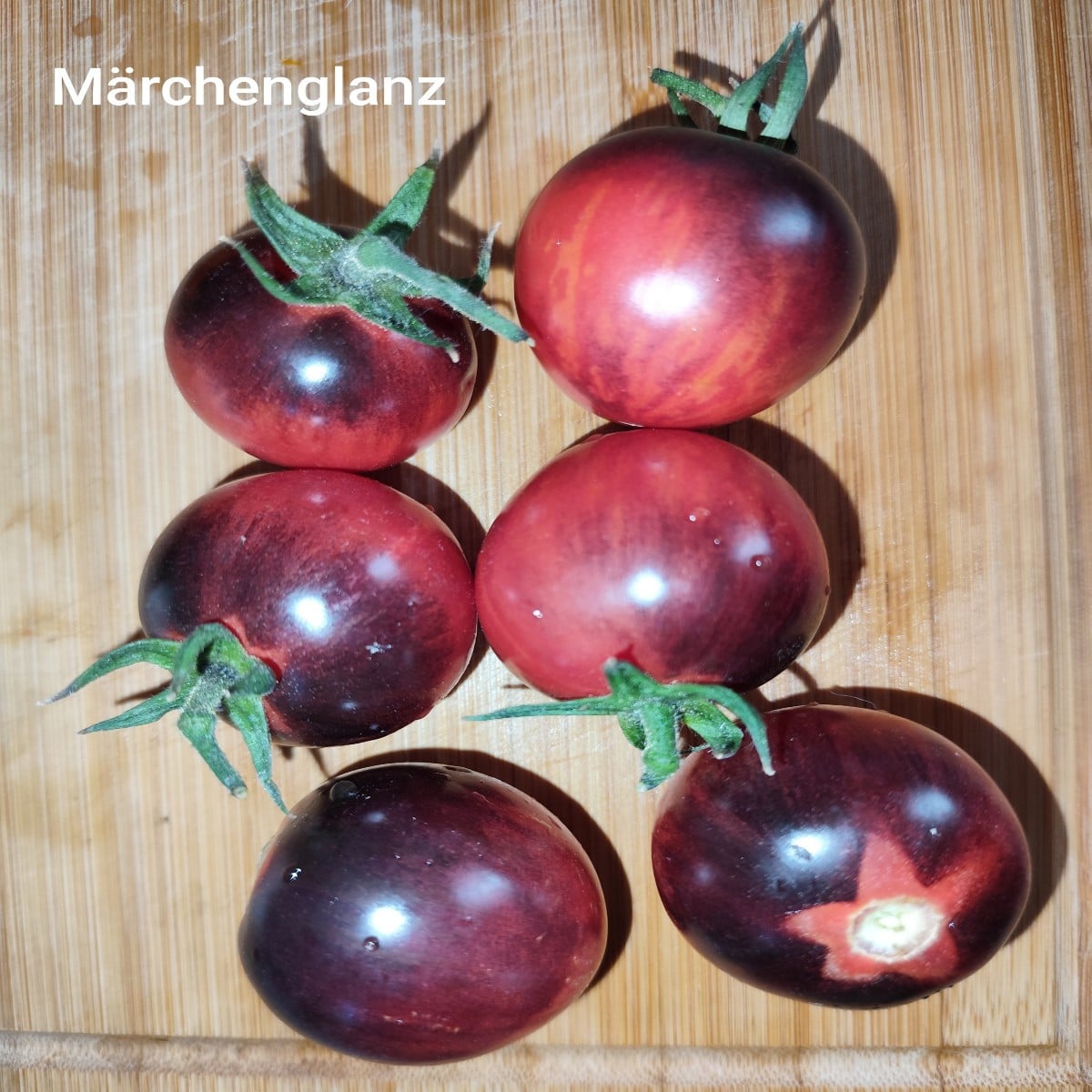
Variety
Märchenglanz
created by Gaja at 09.08.2026
Features
Growth habit
lifespan: annual
growth habit: high
harvest: profitable
growth habit: multi-stem cultivatable
growth habit: needs climbing support
height: 180 - 200 cm
wide: 60 - 70 cm
propagation by seeds
Color
pink
multicolor
blue
golden yellow
Frucht: schwarzrot
Fruchtfleisch: rosa
Resistances
resistant
robust
Location
planting: greenhouse
fertilization: high
Soil: Well fertilized
light: Full sun
Soil moisture: moderately dry to fresh
Water: warm water
Fruit shape
Form: rund
Cultivation Break
4 Years
Season Overview
Propagating
Planting
Harvest
J
F
M
A
M
J
J
A
S
O
N
D
Description
Open-source variety from the Kleverhof "Fairy Tale" series Height: 2.0 m Fruit weight: 25–35 g Cluster: Herringbone Internodes: 16–20 cm Fruit shape: Round External fruit color: Dark red/pink. However, a rich black predominates on the sun-exposed sides of the tomato. Shiny skin! Internal fruit color: Pink Flavor: No acidity, tart, aromatic
Non hybrid
Not frost resistant
Growing tips
1. Choosing Varieties Hardy, disease-resistant varieties. For balconies and outdoor beds: bush tomatoes. For greenhouses: stake tomatoes. 2. Location Sunny, warm, sheltered from the wind. Ideal: south-facing wall, greenhouse, or covered balcony. 3. Soil Loose, rich in humus, and nutrient-rich. Work in compost or tomato fertilizer before planting. 4. Planting Starting in mid-May (after the last frost). Planting deeply—up to the first leaves—promotes root development. 5. Pruning Can be grown as a multi-stemmed plant, as this is a vigorous variety. 6. Watering Water evenly in the morning, directly at the base of the plant. Avoid waterlogging. Mulch helps retain moisture. 7. Fertilizing Every 2–3 weeks with organic tomato fertilizer or nettle liquid manure. 8. Protection Protect tomatoes from rain under a roof or plastic sheeting (prevents brown rot). 9. Promote Pollination In a greenhouse, assist pollination by gently brushing the flowers with a toothbrush or lightly shaking them. 10. Companion Planting Good companions: basil, onions, lettuce. Bad companions: potatoes, fennel. 🌱 Important Tips for Starting Tomatoes from Seed • Sowing time: ◦ Optimal: Early March through late April. ◦ Sowing too early (February) often results in weak, leggy plants. • Germination conditions: ◦ Germination temperature: 20–25 °C. ◦ After germination: 18–20 °C to keep the plants compact. ◦ A bright windowsill or grow light prevents a lack of light. • Sowing technique: ◦ Use seed-starting mix (low in nutrients, loose). ◦ Cover seeds only lightly with soil and keep moist. ◦ A mini-greenhouse or cover ensures consistent moisture. • Pricking out: ◦ As soon as the seedlings have two true leaves, carefully transplant them into larger pots. ◦ Plant them deeper so that additional roots form on the stem. • Location: ◦ Bright, but not too hot. ◦ Direct sunlight in a sunroom or greenhouse is ideal; a windowsill also works. • Hardening off: ◦ Starting in late April/early May, place the plants outdoors in a sheltered spot during the day. ◦ This helps them acclimate to wind and temperature fluctuations. • Planting out: ◦ Plant in a garden bed or large container only after the last frost (mid-May). ◦ Plant deeply, filling in soil up to the lower leaves. ⚠️ Avoid Common Mistakes • Sowing too early: Plants become leggy and weak. • Insufficient light: Leads to leggy, thin stems. • Soil that’s too rich in nutrients: Promotes leaf growth instead of root development. • Planting directly outdoors before mid-May: Risk of frost damage. 📋 Practical checklist 1. Sow from early March through late April. 2. Germination temperature 20–25 °C, then 18–20 °C. 3. Transplant when two true leaves appear. 4. Start hardening off in late April. 5. Plant out after the last frost. 🌱 Good Companion Plants for Tomatoes • Onions & garlic → help combat fungal diseases and pests. • Basil → keeps whiteflies away and improves the flavor of the fruit. • Marigolds & tagetes → protect the roots from nematodes. • Carrots & radishes → use the space efficiently; no competition. • Lettuce & spinach → grow quickly and loosen the soil. • Celery → promotes healthy growth and deters pests. 🚫 Bad neighbors for tomatoes • Cucumbers → require a lot of water, promote fungal diseases. • Potatoes → same diseases (late blight). • Peas & beans → prefer different soil conditions, have different nutrient requirements. • Fennel → inhibits the growth of many plants, including tomatoes. • Corn → requires a lot of light, shades tomatoes. 🍅 Common tomato diseases • Late blight (Phytophthora infestans) ◦ Symptoms: brown spots on leaves and fruit, rapid plant death. ◦ Prevention: Grow tomatoes in a location sheltered from rain; keep leaves dry; intercrop with onions or garlic. • Powdery mildew (Oidium neolycopersici) ◦ Symptoms: whitish coating on leaves; stunted growth. ◦ Prevention: Well-ventilated location; do not plant too densely. • Alternaria leaf spot (Alternaria solani) ◦ Symptoms: Concentric brown spots on older leaves. ◦ Prevention: Practice crop rotation; keep plants vigorous. • Didymella fruit and stem rot ◦ Symptoms: Dark, sunken spots on stems and fruit. ◦ Prevention: Use clean seeds; avoid waterlogging. 🐛 Common Pests • Aphids ◦ They suck plant sap; leaves curl up. ◦ Control: Encourage beneficial insects such as ladybugs; spray with stinging nettle or soap solution. • Whiteflies ◦ Small white insects that cause honeydew and fungal infections. ◦ Control: Yellow sticky traps, neem oil. • Spider mites ◦ Fine webs; leaves become dotted and turn yellow. ◦ Control: Increase humidity; introduce predatory mites. • Fungus gnats ◦ Larvae damage roots in potting soil. ◦ Control: Cover with sand; use nematodes. • Snails ◦ Eat young plants and fruit. 🍅 Harvesting Tips • Harvest time: Depending on the variety, from late June through October. • How to tell when ripe: Fruit is fully colored, slightly soft, and has an aromatic scent. • Harvesting method: Gently twist the fruit off or cut it with scissors. • Storage: Keep cool, but not in the refrigerator—this affects the flavor. • Seed collection: Cut open ripe fruits and let the seeds dry—ideal for preserving your own varieties. ◦ Control: Snail barriers, hand-picking.
Details


Light requirement
Sunny

Water requirement
Moist

Soil
Medium (loamy)

Nutrient requirement
High

Plant distance
50 cm

Row spacing
70 cm

Seeding depth
0.5 cm

Companion Plants
Asparagus
Basil
Bean (Broad bean / Faba bean / Field bean)
Broccoli
Brussels sprouts
Cabbage (Cabbage)
Cabbage (Savoy cabbage)
Carrots
Cauliflower
Celery (Celeriac / Celery root)
Celery (Celery)
Chili
Chives
Collard greens (Kale)
Collard greens (Tuscan kale / Dinosaur kale / Palm tree kale)
Common marigold
Cress
Garlic
Kohlrabi / German turnip / Turnip cabbage
Leeks
Lettuce (Common chicory)
Lettuce (Endive / Escarole / Erisée)
Lettuce (Lamb's lettuce)
Lettuce (Lettuce)
Lettuce (Radicchio / Italian chicory)
Lettuce (Sugar loaf)
Mint
Napa cabbage / Chinese cabbage
Onion
Onion (Spring onion)
Oregano
Pak Choi
Parsley
Pepper / Paprika
Radish
Radishes
Spinach (Summer)

Antagonistic Plants

Diseases
Root Rot
Dry rot of crucifers
Powdery mildews
Brown rot
Blossomrot
Grey mold
Early blight of potato

Pests
Land snails
Thrips
Aphids
Spider mites
White fly