Hoher Wiesenknopf 'All Time High'

Variety
Hoher Wiesenknopf 'All Time High'
created by Möwe at 04.03.2026
Seed packet
Features
Growth habit
lifespan: perennial
growth habit: high
growth habit: upright
growth habit: stable
growth habit: horst-forming
simple flower
spicate flowers
leaves: Deciduous
feathered leaves
Color
Flower: white
Resistances
robust
Winter hardy
Location
planting: outdoor
planting: bed
light: sunny to semi-shady
Soil: permeable soil
Season Overview
Sowing
Harvest
Harvest
J
F
M
A
M
J
J
A
S
O
N
D
1ST YEAR
FOLLOWING YEARS
Description
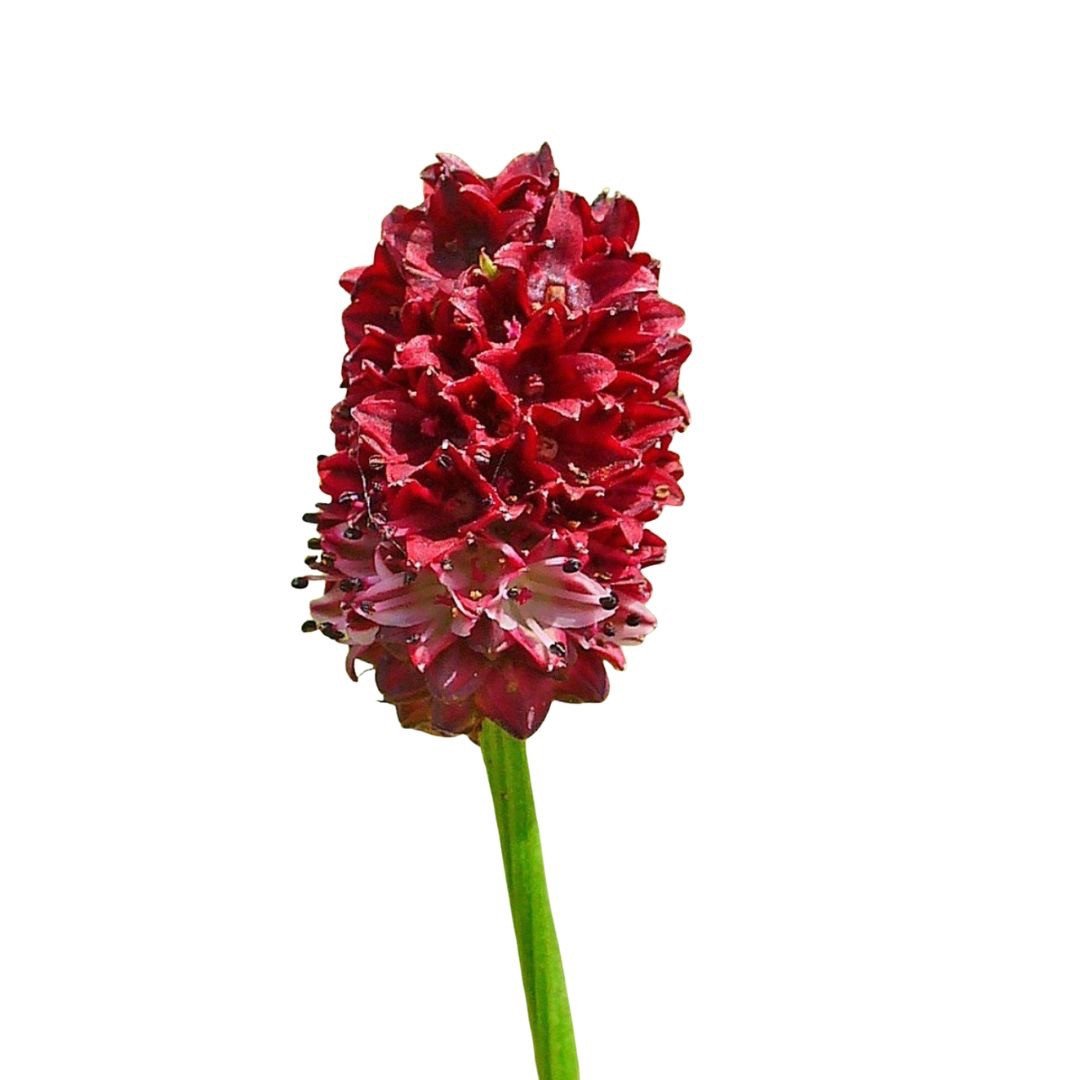
The plant genus Sanguisorba belongs to the rose family (Rosaceae). Within this family, it forms the subtribe Sanguisorbinae. These are perennial herbaceous plants that occur in the temperate zones of the northern hemisphere. The distribution area of these flowering plants extends from Eurasia to North America. The first scientific identification and the genus name were given in 1753 by the Swedish botanist Carl von Linné. The genus name comes from the Latin sanguis, meaning blood, and sorbere, meaning to absorb, and refers to its hemostatic effect. This is particularly true of the species Sanguisorba officinalis, which played a role in folk medicine. Depending on scientific opinion, there are between 15 and 30 species of great burnet plants. Leaves Some Sanguisorba species form a rosette of leaves at the base. The leaves of the perennials are arranged alternately on the stems and are imparipinnate. The leaves consist of 7 to 25 small leaflets. These have serrated edges. There are also stipules that are fused with the petiole. Flower The genus Sanguisorba has spike or head inflorescences with many flowers. They are terminal and have bracts and bracteoles. The individual flowers are small and usually hermaphroditic. The flowers have a calyx and a disc. Depending on the species, there are mainly four, sometimes seven petal-like sepals. These are usually red, pink or purple, white and, more rarely, green. There are usually four stamens inside the flower. The flowering period varies between species. They bloom between May and November. Fruit The small seeds remain on the plant throughout the winter. Growth Meadow knapweeds usually grow as perennial herbaceous plants. They grow up to 120 centimeters tall and have upright stems with alternate leaves. The flowers are usually clustered at the ends of the stems. Some species in the Mediterranean region also form small shrubs that can grow between 50 and 200 centimeters tall. The plants usually have a woody rhizome as a survival organ. This is bare or sparsely hairy. The tall meadow knapweed 'All Time High' belongs to the rose family and impresses with its very stable appearance. This impressive perennial originates from the traditional wet meadows and sparse pastures of Europe. It has been further developed by renowned breeders to enrich gardens with its delicate beauty. The hanging, pure white flowers on delicate but sturdy stems appear in a spike-like arrangement from August to September. Although the individual flowers are small and simple, the overall inflorescence is lush and gives the plant an elegant appearance. This floral splendor is complemented by the feathery foliage. It has a medium green tone and captivates with its natural leaf structure. In fall, Sanguisorba tenuifolia 'All Time High' displays a subtle coloration that lends a pleasant warmth to the falling leaves. In the garden, the tall burnet 'All Time High' is versatile. Whether planted as a solitary plant in a perennial bed or arranged in groups, it blends harmoniously into a variety of design concepts and also serves as a bee pasture. With a growth height of 100 to 140 cm and a width of 40 to 50 cm, Sanguisorba tenuifolia 'All Time High' is well suited for planting at the back of beds, where it acts as a structuring element. The hanging, pure white flowers are particularly attractive at the edge of ponds or wooded areas.
Non hybrid
Frostproof
Growing tips
Location Meadow knobs prefer a sunny to semi-shady location. They can be found on rough or dry grassland, on calcareous or loose loamy soil or on wet meadows and moorland. The different species grow in the lowlands and can be found in alpine regions up to 2,300 meters. Utilization Some species of meadow knobs are popular deciduous ornamental plants that are mainly found in cottage gardens. They adorn herbaceous borders and combine wonderfully with other garden plants. However, the plants do not play a major role. However, as a burnet, the small meadow button is an important ingredient in the well-known Frankfurt sauce. Medicinally, the plants are of little importance today. Some species are an important food source for butterflies. Care/pruning The plants are deciduous and perennial. Plant lovers can cut off the faded shoots. The meadow knobs will sprout again in spring. Diseases/pests No specific diseases or pests are known. All Time High' prefers sunny to semi-shady locations. A normal, moist and well-drained soil with a humus structure is recommended for this perennial.
Details


Light requirement
Sunny

Water requirement
Dry

Soil
Medium (loamy)
Nutrient requirement
Low

Plant distance
30 cm

Row spacing
30 cm

Seeding depth
0.2 cm

Companion Plants

Antagonistic Plants
Aubergine / Eggplant
Chili
Courgette / Zucchini
Cucumber / Gherkin
Grasses - Bamboos
Grasses - feather-bristled grasses, lamp-cleaning grasses
Grasses - Pampas grass
Grasses - reeds, cattails, bulrushes
Ivy
Mint
Okra
Ornamental pumpkin
Pepper / Paprika
Potato
Pumpkin / Squash
Sunflower
Sweet potato
Sweet woodruff / Sweetscented bedstraw
Tomato (Bush tomato)
Tomato (Cocktail bush tomato)
Tomato (Cocktail Stake Tomato)
Tomato (Stake tomato)
Walnut family
Diseases
Blossomrot
Powdery mildews
Pests
Cicadas
Land snails
Aphids