Akebia, blue cucumber vine

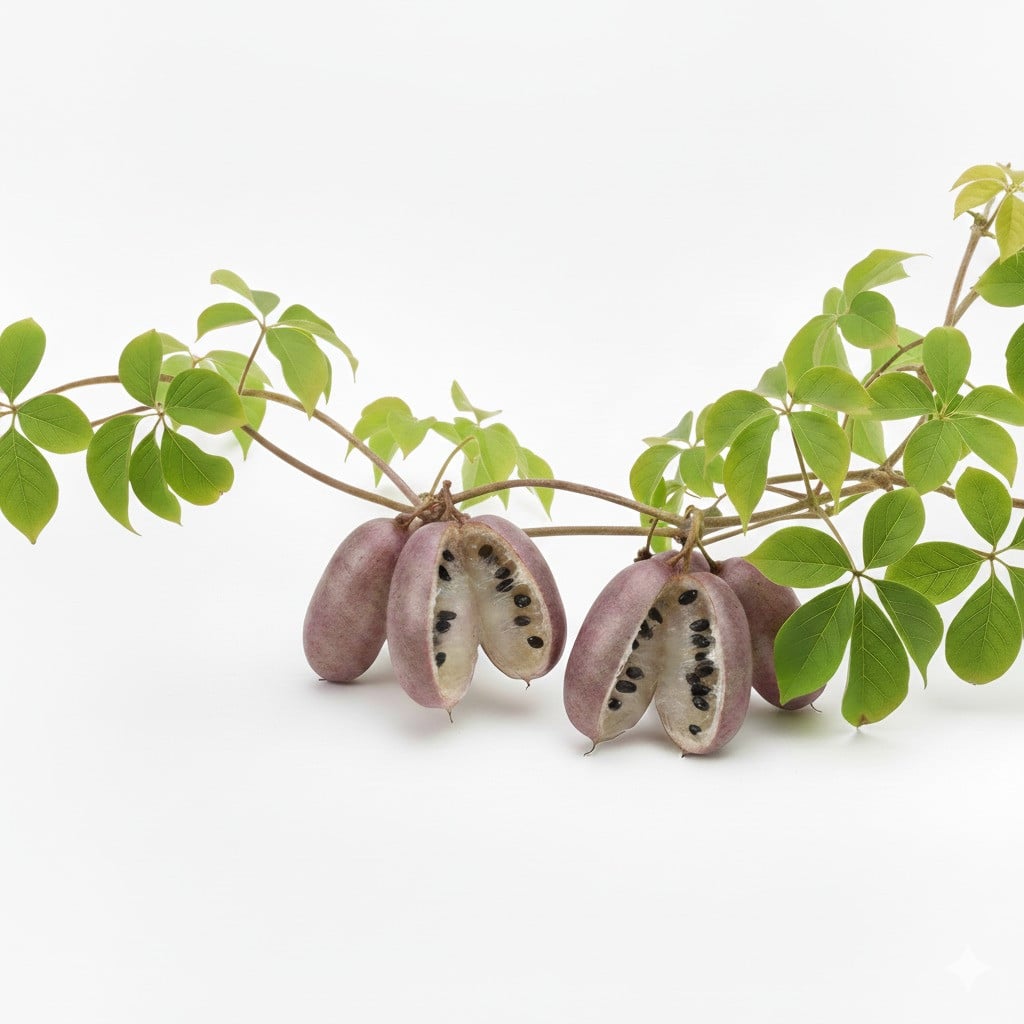
Akebia, blue cucumber vine
Akebia
Plant family
Cecropia family (Lardizabalaceae)
Season Overview
Propagating
Planting
Harvest
Harvest
J
F
M
A
M
J
J
A
S
O
N
D
1ST YEAR
FOLLOWING YEARS
Details


Light requirement
Semi-shaded

Water requirement
Moist

Soil
Medium (loamy)

Nutrient requirement
High

Light germinator

Germination temperature
20 - 22 °C (Degrees Celsius)

Plant distance
200 cm

Row spacing
200 cm

Seeding depth
0.2 cm
Instructions
Description
Akebia (bot. Akebia) is a genus of plants in the finger fruit family (Lardizabalaceae). It is also known as the blue cucumber vine. This name comes from its bluish foliage leaves and the cucumber-like, distinctive fruits. They are woody climbing plants that are mainly native to temperate latitudes. Botanists distinguish between five species that are native to the mountain forests of East Asia. They are widespread in China, Korea and Japan. The flowering liana first came to Europe in 1845 and is still a rare climbing beauty here today. The plants of the Akebie genus are not entirely hardy and can reach up to ten meters in height in a sheltered location. Leaf Akebia plants develop different leaf shapes. There are species with finger-shaped and ovate leaves, as well as those with trifoliate, clover-like leaves. These leaves are usually dark green on the upper side and bluish-green on the underside. These climbing plants are evergreen. Flowering Akebias flower from April to May. The plants are monoecious with separate sexes. They produce male and female flowers on one plant. The flowers are in racemose inflorescences. The female flowers are brown-purple and grow to around three centimeters in size. The male pink flowers are smaller. The flowers have a sweet, vanilla-like fragrance. They are stalked and terminal. They usually have three sepals. Flowering can be expected after five years. Fruit Cucumber-like or finger-shaped bellows fruits develop from the flowers in summer. They reach a length of between five and ten centimetres and have pink to purple-red flesh. They ripen between September and October. There are numerous dark seeds inside. When they crack open, seeds fall out of the jelly-like shell. The fruits of the finger-leaved akebia are edible and are considered a delicacy in their native country. Growth Akebias are evergreen climbing plants. They grow up to over ten meters high with an appropriate climbing aid. The plants are vigorous and have slender shoots. The Akebia genus generally grows well-branched and quickly upwards, depending on the species. The woody lianas climb trees, house walls or pergolas. Distribution Akebias grow wild in the mountain forests of China, Taiwan, Korea and Japan. They grow in their natural habitat at altitudes between 1,500 and 2,400 meters. There are now occurrences of feral columbines in some regions of North America. In Europe, the plants are less common in gardens or parks. The best known are the finger-leaved akebia (Akebia quinata) and the clover-leaved akebia (Akebia trifoliata). Akebia chingshuiensis is divided into three subspecies.
Origin:
Mountain forests of China, Taiwan, Korea and Japan, North America
Growing tips
Location This tropical plant needs a warm and sheltered location in a sunny or semi-shady spot. A special substrate is not required for the undemanding climbing plants of the Akebia genus. They develop very well in humus-rich, nutrient-rich and deep soil. Despite their origin, the plants can cope with winter frosts in a warm and sheltered location, for example on a house wall, even in our latitudes. Utilization Akebias are suitable as ornamental plants due to their vigorous growth and evergreen leaves. They are used to green facades and climb pergolas. In Asia, the leaves of some species are used as tea. The bark plays a role in folk medicine. The cucumber-like fruits are considered a delicacy. Care/pruning Akebias are vigorous growers and can tolerate pruning or thinning out without being damaged. The best time for this is spring. Diseases/pests There are no known diseases or pests of columbines.

Companion Plants

Antagonistic Plants

Diseases
Root Rot
Pests
No pests