Säulenpflaume 'Königin Viktoria'

Variety
Säulenpflaume 'Königin Viktoria'
created by Alex&Sempi at 05.11.2025
Features
Growth habit
lifespan: perennial
harvest: profitable
growth habit: stable
flower: flowering
growth habit: columnar
root type: shallow-rooted
self-fruiting
leaves: Deciduous
tree
Nutzungsart: Ur-/Alte Sorte
cross-pollination
root type: heart-shaped root system
growth habit: upright slender
medium to strong growth
columnar fruit trees
seed-fixed: no
serrated leaves
height: 250 - 300 cm
propagation by cuttings
growth habit: becoming woody
wide: 80 - 90 cm
hermaphroditic
fruit on two-year-old wood
height: 200 - 250 cm
simple flower
umbellate flowers
star-shaped flowers
propagation by grafting
fruit on three-year-old wood
limited growth
insect pollination
Summer variety
Blätter: eiförmig
Blüte: mittelgroß
Blätter: zugespitzt
Blätter: mittelgroß
Geschlechtertyp: einhäusig
Ernte: mittelreifend
Blätter: gesägt
Blüte: duftend schwach
Wuchs: nicht invasiv
Blätter: einfach
Schnitt: Form
Schnitt: Erhaltung
Schnitt: Spätwinter
Schnitt: notwendig
Wuchsform: verzweigt
Seitentriebbildung: mäßig
Taste
aromatic
fruity
sweet
delicate
refreshing
raw edible
very juicy
thin skin
Essbarkeit: Frucht
Aroma: Honig
Konsistenz: mittelfest
Location
planting: bed
planting: outdoor
sheltered from the wind
light: sunny to semi-shady
Soil: permeable soil
soil moisture: no waterlogging
Fertilization: single dose of compost
Fertilization: nutrient-rich
fertilization: humus-enriched
Soil: Well fertilized
soil moisture: moist
soil moisture: well-drained
Water: regularly
Soil: light to medium-heavy
planting: open balcony or terrace
Soil: sandy to loamy
fertilization: low-nitrogen
pH value: acidic to neutral (5,5-7)
fertilization: potassium-rich
Water: Adequate
Planting: hedge
Planting: pots, tubs, or boxes
fertilization: sufficient
Fertilization: organic
Heat requirement: moderate
Düngung: kalktolerant
Pflanzung: Bauerngarten
Düngung: Langzeitdünger
Düngemittel: Hornspäne
Good companions: moisture-loving
Nachbarn schlecht: trockenheitsliebend
Nachbarn schlechte: Schattenpflanzen
Nachbarn schlechte: kalkliebend
Good companions: sun-loving
Nachbarn schlechte: stark wuchernd
Nachbarn schlechte: hoher nährstoffbedarf
Nachbarn gute: mit niedrigen Nährstoffbedarf
Nachbarn gute: niedrigwachsend
Gartenstil: Naturgarten
Pflanztechnik: Mulchen
Boden: mittelgründig (30-60)
Herkunft: Züchtung
Color
grey-green
glossy
Flower: light pink
blue-violet
Flower: white
Blätter: dunkelgrün
Frucht: goldgelb
Frucht: rotviolett/violettrot
Herbstfärbung: gelb
Wurzel: gelb
Wurzel: braun
Samen: braun
Fruchtfleisch: gelb
Fruchtfleisch: orange
Wurzel: beige
Stamm, Stiel: graubraun/braungrau
Blätter: Austrieb hellgrün
Oberfläche: glatt
Resistances
robust
weatherproof
hardy down to -30°C
Fruit shape
large
Steinfrucht
Season Overview
Planting
Harvest
J
F
M
A
M
J
J
A
S
O
N
D
1ST YEAR
FOLLOWING YEARS
Description
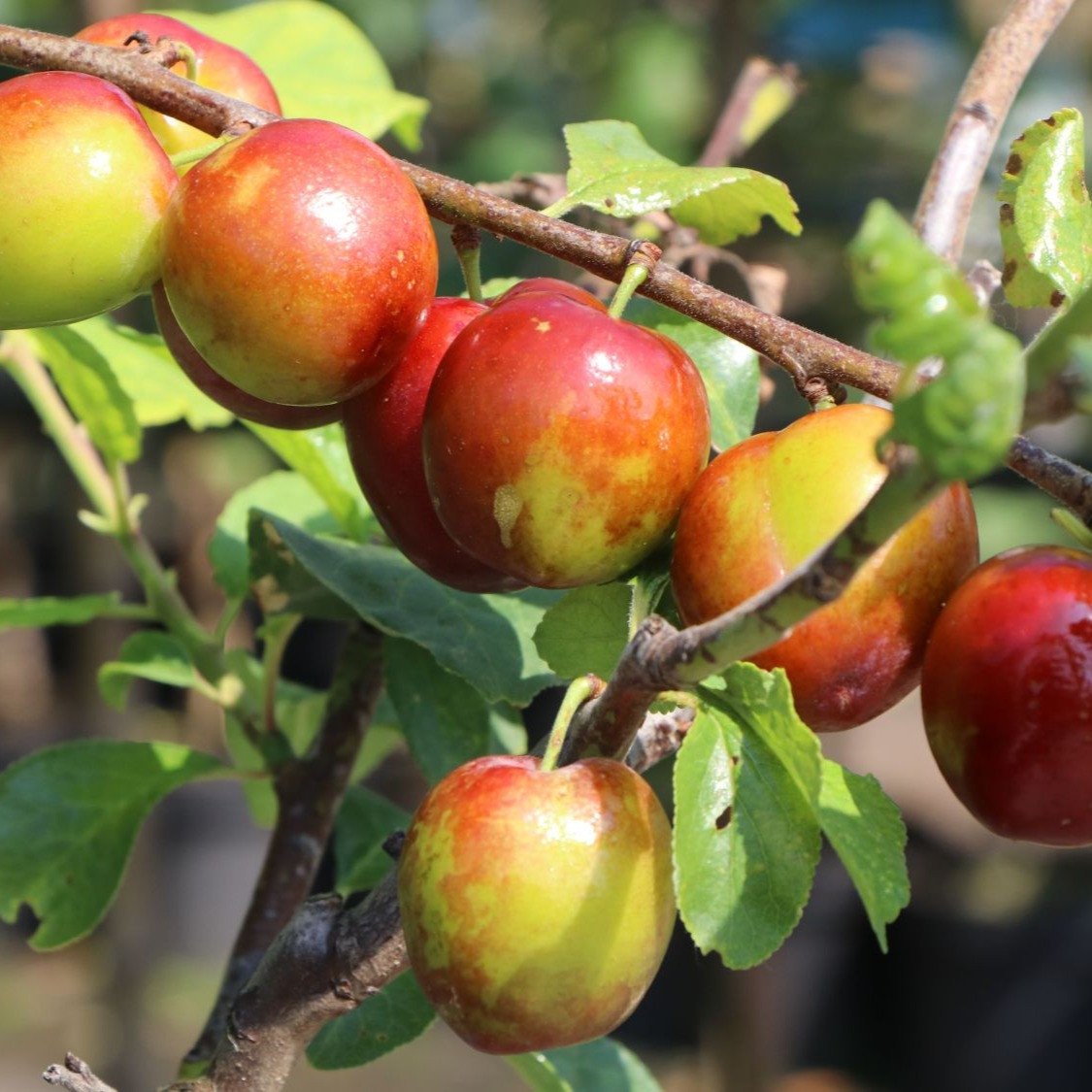
The columnar plum 'Queen Victoria' is an old plum variety from England dating back to 1844. It has very large fruits with golden-yellow, violet-red skin on the sunny side. The honey-colored flesh is very juicy, sweet and aromatic. High to very high, early yields. Excellent for fresh consumption. Ripening time from August. Growth Appearance: The 'Queen Victoria' plum impresses with its medium-sized, oval fruits with a red to purple skin and juicy, yellow-orange flesh. The leaves are green and slightly toothed, making it an attractive foliage plant in the garden. Flowering time and duration: This plum variety blooms in spring, around April, with delicate, white to light pink flowers. The flowering phase lasts around two to three weeks and is a real eye-catcher in any garden. Special characteristics: 'Queen Victoria' is particularly well known for its sweet, aromatic fruit and ease of handling in the garden. It is not only bee-friendly, but also an excellent choice for nature lovers who value home-grown fruit.
F1 Hybrid
Frostproof
Growing tips
Location
Details


Light requirement
Sunny

Water requirement
Moist

Soil
Medium (loamy)

Nutrient requirement
High

Plant distance
100 cm

Row spacing
150 cm

Seeding depth
Not specified

Companion Plants
Apple
Arugula / Rocket
Asian Pear / Nashi Pear
Bean (Dwarf bean)
Chard
Chives
Comfrey
Currant
Dwarf pear
Elderberry
Funk
Garlic
Garlic chives
Geranie/Pelargonie
Gooseberry
Hazelnut
Lettuce (Common chicory)
Lettuce (Endive / Escarole / Erisée)
Lettuce (Lamb's lettuce)
Lettuce (Lettuce)
Lettuce (Oriental greens / Brown mustard)
Lettuce (Puntarelle / Cicoria di catalogna / Cicoria asparago)
Lettuce (Radicchio / Italian chicory)
Lettuce (Sugar loaf)
Melissa
Pear
Radishes
Sour cherry / Tart cherry
Spinach (Summer)
Spinach (Winter)
Sweet woodruff / Sweetscented bedstraw
Thyme
Wild Cherry / Bird Cherry / Sweet Cherry

Antagonistic Plants
Aubergine / Eggplant
Basil
Catnip
Chili
Common mugwort
Corn / Maize
Courgette / Zucchini
Cucumber / Gherkin
Daylilies
Iris
Lilies
Lovage
Make
Mint
Okra
Ornamental pumpkin
Peony
Pepper / Paprika
Pumpkin / Squash
Quadriceps
Tomato (Bush tomato)
Tomato (Cocktail bush tomato)
Tomato (Cocktail Stake Tomato)
Tomato (Stake tomato)
Walnut family
Wild garlic

Diseases
Root Rot
Pests
Common winter moth
Spider mites
Aphids