Rockflower

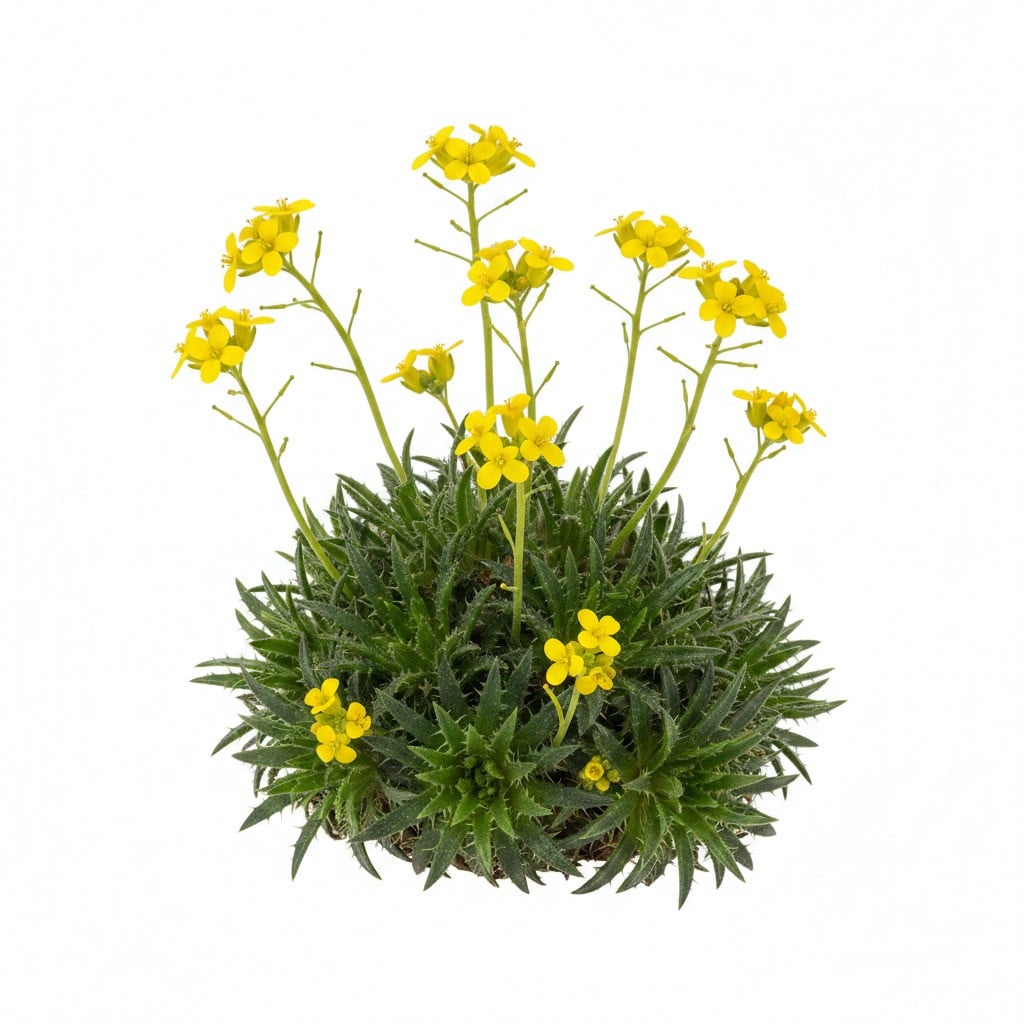
Rockflower
Draba
Plant family
Crucifers (Brassicaceae)
Season Overview
Propagating
Planting
Harvest
Harvest
J
F
M
A
M
J
J
A
S
O
N
D
1ST YEAR
FOLLOWING YEARS
Details


Light requirement
Sunny

Water requirement
Dry

Soil
Light (sandy)

Nutrient requirement
Low

Light germinator

Germination temperature
15 - 20 °C (Degrees Celsius)

Plant distance
15 cm

Row spacing
15 cm

Seeding depth
0.5 cm
Instructions
Description
The plant genus of rock flowers (botanically Draba), a few are known as starvation flowers, belongs to the cruciferous family (Brassicaceae). The genus includes more than 350 different Draba species. Stony, open soils are preferred by the various types of rock flowers. Accordingly, these cruciferous plants can be found on rocks, rock debris and crevices or even on patchy dry grassland. Well-known plant species from the Draba genus include the Siberian starflower (Draba sibirica) and the evergreen rock flower (Draba aizoides). The name of the genus is derived from the Greek word "drabe" and means burning, bitter or pungent. Leaf The leaves of the rock flowers are distributed alternately on the stem and are mainly arranged in rosettes directly above the ground. Sometimes the stem appears without any leaves at all. The basal leaves of this genus are often stalked, less stalkless and the leaf blades have either a toothed or completely smooth leaf margin. The edge of the leaves is rarely lobed. The leaves of the stems, if there are any, can be stalkless or petiolate. In addition, the leaf blades often have a wedge-shaped or, less frequently, a serrated base. Their leaf margins are also toothed or smooth. The foliage of these rampant cruciferous plants is winter green. Flower The four-petalled flower of the rock flower is bisexual and is predominantly yellow, white or pink. It also often has umbrella-shaped inflorescences. The inflorescence stems of the richly flowering Draba species can elongate until the fruit ripens. This results in racemose fruit and inflorescences. Bracts are also present. The sepals of this plant genus, which are membranous at the edge, are rarely elliptical in shape, but rather elongated and ovoid. Fruit The rock flowers have thin fruit stalks that are spreading or upright to ascending. Their seeds are arranged in two rows within the fruit. As soon as the fruits of the Draba species are ripe, they open and release the seeds. Growth habit In exceptional cases, the plants of this genus grow as semi-shrubs. More often they are herbaceous plants, which in some species become woody with age. Some species in the genus are annuals, others are perennials.
Origin:
North America to Mexico, northwestern Africa and Eurasia, South America, mainly northern hemisphere
Growing tips
Location The majority of Draba species thrive in a subarctic to arctic or a subalpine to alpine flora. The rock flowers enjoy a location in full sun. So choose a sunny spot with well-drained soil. Rock flowers thrive well in rock gardens, dry stone walls or in poor meadows. Soil: A sandy, stony soil with a high pH value (7.0-8.0) is ideal. If the soil is too heavy, you can loosen it up with sand or gravel. Water requirements: The rock flower prefers drier conditions, so you should avoid waterlogging. Water moderately after planting, later only during longer periods of drought. Winter hardiness: The plant is hardy to around -20°C and does not normally need winter protection.

Companion Plants

Antagonistic Plants

Diseases
Root Rot
Angular leaf spot of cucumber
Powdery mildews
Pests
Spider mites
Flea beetles
Aphids