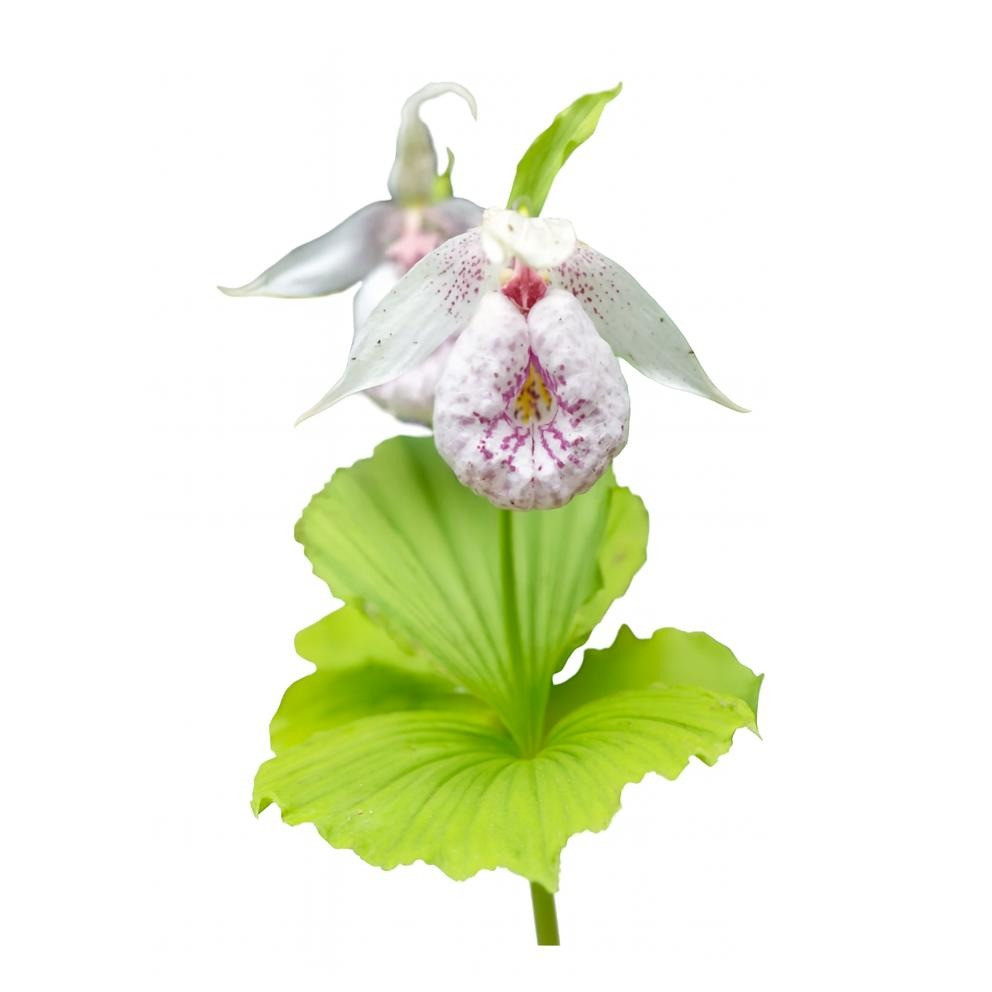
Taiwan - Frauenschuh (Wildform)

Variety
Taiwan - Frauenschuh (Wildform)
Approved Data
created by Alex&Sempi at 19.02.2026
Features
Color
light green / pale green
Location
biotope: mountain area
Light: Partial Shade to Shade
Taste
not edible
Fruit shape
capsule
Resistances
hardy down to -20°C
Growth habit
Blätter: gefaltet
Season Overview
Sowing
Harvest
Harvest
J
F
M
A
M
J
J
A
S
O
N
D
1ST YEAR
FOLLOWING YEARS
Description
Cypripedium formosanum, also known as Taiwan lady's slipper, is a terrestrial orchid. It is a hardy species with beautiful spring flowers in shades of pink and white. As it has become rare in its country of origin, it is one of the lady's slippers that is easiest to adapt, provided that a few precautions are taken. Once well established, it spreads and forms beautiful pastel-colored patches in shady beds. Endemic to the mountains of central Taiwan, where it grows at altitudes above 2000 m, Cypripedium formosanum is closely related to Cypripedium japonicum. These two species differ in terms of size, color, and shape of the flowers, as well as in their cultivability. In nature, the Taiwan lady's slipper grows in forests and moors. Cypripedium formosanum is a terrestrial herbaceous plant with deciduous leaves that develops from a slightly creeping rhizome. The rhizomes branch out and, over time, this plant can form large colonies over extensive areas. In April and May, it develops two broad, fan-like folded, opposite leaves on a slightly hairy stem. This stem then extends to a height of up to 40 cm and forms a single flower. The flower has a swollen lip base with an oval, ribbed opening, above which are white and pink sepals. The flowers are pale pink overall, but they are spotted and marbled with a more intense pink. These marbling patterns form stripes near the opening of the lip and are also more pronounced at the base of the petals and dorsal sepals. The petals are particularly broad. Pure white forms exist, but are very rare. There is no vegetation in winter. Cypripedium formosanum is a hardy mountain plant that is relatively adaptable and grows outdoors. It thrives in partial shade at the edge of the forest in light, humus-rich, well-drained soil that is slightly acidic to acidic and does not contain lime. The soil should not be too wet in winter and not too dry in summer. Plant it in the shade in a cool rock garden between rocks or at the edge of shady undergrowth together with Arisaema, Calanthe, Paris, Bletilla, and ferns. The lady's slipper orchid genus (bot. Cypripedium) comprises herbaceous, perennial plants. Cypripedium belongs to the Cypripedioodeae subfamily of the orchid family (Orchidaceae). According to botanical classification, the family belongs to the class of angiosperms (Magnoliopsida) and the suborder of monocotyledonous plants (Monocotyledons). According to the narrower definition, the family belongs to the order of asparagus-like plants (Asparagales). For a long time, all lady's slipper species were grouped together in the genus Cypripedium. According to new definitions, the subfamily Cypripedioideae contains around 120 species and is divided into five subgenera: Cypripedium, Paphiopedilum, Phragmipedium, Mexipedium, and Selenipedium. Cypripedium mainly includes lady's slipper orchids from the northern hemisphere. This is followed by a division into two subgenera: Cypripedium subgen. Cypripedium and Cypripedium subgen. Irapeana Eccarius. For a more precise classification of the plant species, both subgenera are divided into sections. Eleven species and four subspecies are listed in the subgenus Cypripedium section Cypripedium. The yellow lady's slipper (Cypripedium calceolus) has all the essential characteristics of this category. It is the type species for the classification of lady's slipper species. This classification of the genus Cypripedium follows the new system published in 2009 by the Angiosperm Phylogeny Group. Leaves Cypripedium has deciduous leaves. They are mostly pointed. Some species have lanceolate, oval, or fan-shaped leaves. In most species, they are uniformly green. Some have reddish-brown spotted leaves. The leaves are usually between five and thirteen centimeters long. All have light, fine hairs on the underside. Some species have glandular hairs. The leaf margins are entire and sometimes ciliate. Almost all species have pores (stomata) on the upper and lower surfaces. The parallel veins are strong. The leaves enclose the stem. The stiffening caused by longitudinal folds is striking. This allows them to direct rainwater to the stem and roots. The stem has several lower leaves. They are located at the base of the plant. Flower Cypripedium has hermaphroditic and zygomorphic flowers. Only certain insects can access the flower. The perianth shows no division into calyx and corolla. The flower consists of lateral inner petals that are ciliate. It has four outer perigone leaves, often five centimeters long. The perigone leaves are lanceolate and taper to a point. The color varies. Sometimes it is purple or chocolate brown. The petals stand out and surround the very large lip (labellum). It is formed from an upper, inner perigon leaf that is puffed up and forms the shoe. The shoe is between four and eight centimeters long, sometimes yellow. The flower has a stem. This bends and twists 180° when the flower opens. Only through this twist does the lip point downwards and reveal the characteristic shoe. The plants belong to the pitcher plant family. Pollinators are strong small insects. They fall into the pitcher through a hole at the base of the labellum. The plant has a kind of guidance system that guides the insects to the outside. Guided by light windows, the path leads to two hair stairs on the back wall of the slipper. The insects must pass the stigma and the two stamens on this path. The plant's construction prevents self-pollination. The pollen of this orchid genus is powdery and consists of individual pollen grains. The insects find no food in the flowers of the lady's slippers. These types of flowers are called deceptive flowers. Fruit The ovary is single-chambered. The plant forms triangular capsule fruits. They contain up to a million dust-fine seeds. A buoyant, air-filled shell increases their buoyancy. The wind transports them. The seeds have no endosperm around the embryo. The seedling is dependent on the help of certain fungi. Growth Cypripedium are orchids that grow in soil. The seed lives in symbiosis (community) with a root fungus for several years. The decomposition of the protein-containing fungi provides the seedling with the necessary nutrients. This enables the plant to bridge the very long development period, which lasts between four and fourteen years. Only then does the first green leaf appear. From this point on, the orchid, like other plants, feeds itself through photosynthesis. Cypripedium is between fifteen and sixty centimeters tall. It forms a hairy and leafy stem. Usually one flower, sometimes up to four flowers, sits on the shoot. The stem springs from a short rhizome. Location Cypripedium is predominantly frost-hardy. The orchids need loose, nutrient-rich, slightly moist, and humus-rich soil. It may be slightly acidic. The soil in sparse beech forests, with herbaceous vegetation and flowering plants in spring, is ideal. Some species tolerate small amounts of lime. Light is important. Direct sunlight damages the plant. The species native to Europe usually lose their stems and leaves in the fall. They sprout again in the spring from the rootstocks. The surface of the soil must not be compacted and there must be space between other plants. Orchids cannot cope with root pressure from shrubs and assertive perennials, or heavy shade. Cypripdium varieties thrive in the vicinity of ferns or Solomon's seals, in the light shade of tall deciduous trees. Distribution The genus is represented by a few species in Europe. In Germany, the yellow lady's slipper (Cypripedium calceolus L.) forms small wild populations. America is home to several species that occur in the temperate zone. Cypripedium kentuckiense grows exclusively in the USA. The small-flowered lady's slipper (Cypripedium parviflorum var. parviflorum) has developed in the USA and Canada. Cypripedium parviflorum var. exiliens Sheviak is specialized to the conditions in Alaska. In East Asia, Cypripedium ludlowii in Tibet, Cypripedium franchetii in central China, and Cypripedium shanxiense on the island of Sakhalin and in northern Japan have developed. Almost all species are high on the Red List of Threatened Plants. Under the European Union's Flora-Fauna-Habitat Directive (FFH), Cypripedium species are designated as priority species requiring special protection. The main cause of their decline is wild harvesting. The plant dies in very dense forests. Use Many varieties have been bred as ornamental plants. Varieties of the yellow lady's slipper are suitable for gardens in Central Europe. Cypripedium is available as a potted plant for bright, cool rooms.
Non hybrid
Frostproof
Growing tips
Plant the Cypripedium formosanum in partial shade in a humus-rich soil with heath soil, light, without lime, neutral to acidic. This terrestrial orchid does not tolerate heavy and moist soils or dry soils. When planting, add 1/3 peat and 1/3 lime-free fine gravel mixed with garden soil. Water the plant moderately and ensure that the soil always remains slightly moist in summer. Cypripediums do not tolerate fertilizers and do not like to be disturbed. In the first year, protect the rootstock with a 10 cm thick layer of foliage. Cultivation in pots is possible, but the plants often produce many new shoots at the expense of flowering. Location Partial shade preferred; morning or evening sun is ideal, avoid direct midday sun. Soil: Fresh, humusy, slightly acidic, well-drained. Bog beds or damp garden areas are particularly suitable. Climate range: Summer not above 33 °C, winter at least 2-3 months below +5 °C. Planting Time: Spring or fall. Depth: Plant rhizomes shallowly, loosen soil well. Companion plants: Ferns, woodland perennials or other shade plants are ideal partners. Care Watering: Keep evenly moist, but avoid waterlogging. Ensure sufficient moisture, especially in summer. Fertilizing: Only sparingly, as they prefer nutrient-poor soil. Winter protection: Generally not necessary, as hardy down to -25 °C. Protect from late frosts in spring (e.g. with fleece or a bucket over the shoots). Special features Flowering time: May to June, large shoe-shaped flowers in pink, white, yellow or purple. Life span: Perennial, forms strong clumps over time. Propagation: Division of the rhizomes in fall or spring. Special protection: Wild species such as Cypripedium calceolus are strictly protected and may not be taken from the wild.
Details


Light requirement
Semi-shaded

Water requirement
Moist

Soil
Light (sandy)

Nutrient requirement
Low

Light germinator

Plant distance
30 cm

Row spacing
30 cm

Seeding depth
2 cm

Companion Plants

Antagonistic Plants

Diseases
Root Rot
Septoria
Grey mold
Angular leaf spot of cucumber
Pests
Land snails
Aphids
Voles