Taro

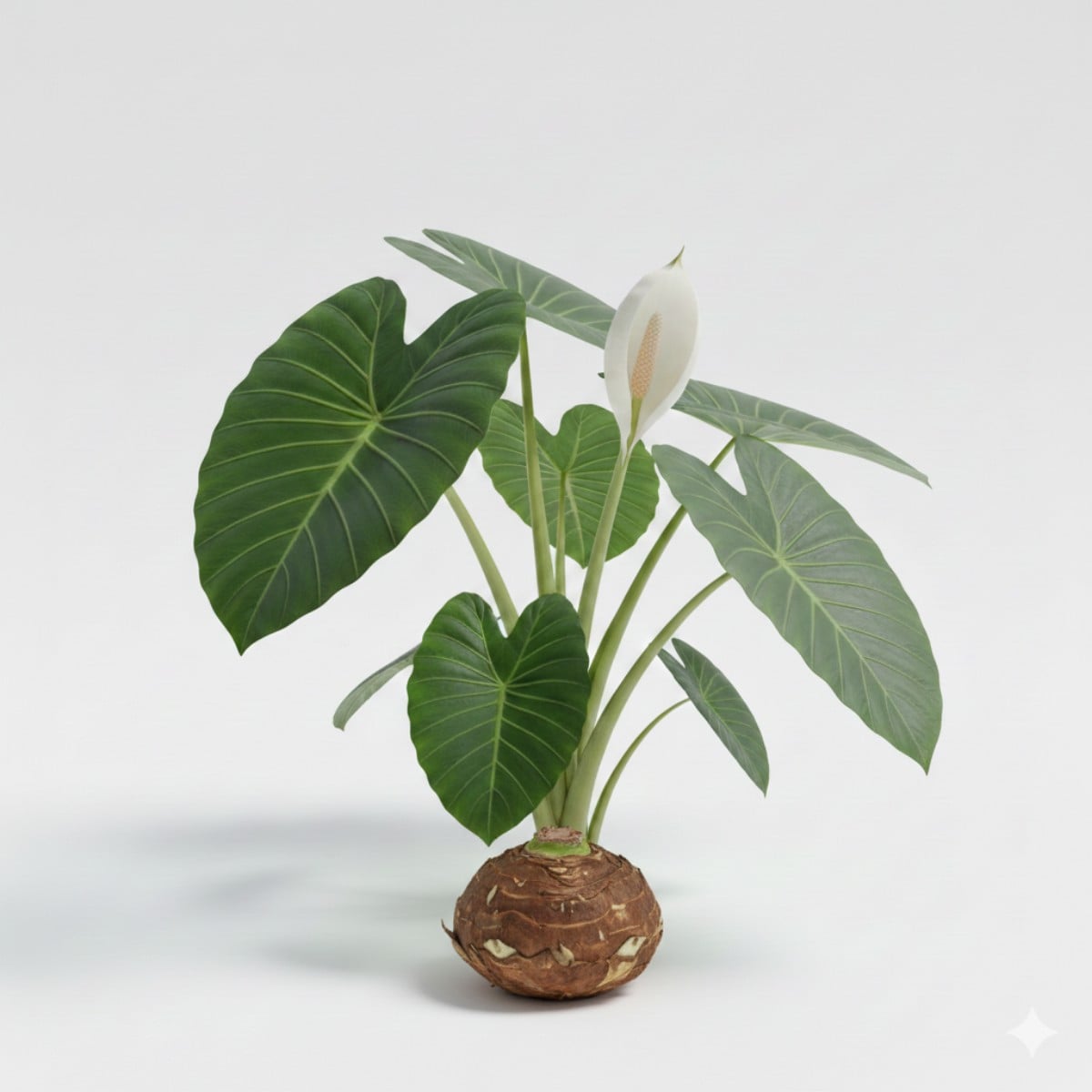
Taro
Colocasia
Plant family
- others -
Cultivation Break
3 Years
Season Overview
Propagating
Planting
Harvest
Harvest
J
F
M
A
M
J
J
A
S
O
N
D
1ST YEAR
FOLLOWING YEARS
Details


Light requirement
Semi-shaded

Water requirement
Moist

Soil
Medium (loamy)

Nutrient requirement
High

Dark germinator

Germination temperature
22 - 28 °C (Degrees Celsius)

Plant distance
70 cm

Row spacing
70 cm

Seeding depth
8 cm
Instructions
Description
Colocasia, also known as Zehrwurz, is a plant genus within the arum family (Araceae). The up to 20 species are found in tropical to subtropical Asia. Taro (Colocasia esculenta) is an important tropical food plant. Colocasia species grow as large, evergreen or seasonally green, perennial herbaceous plants which, depending on the species, can grow to enormous heights for herbaceous plants. They contain milky sap. They often form rhizomes or rarely stolons and usually a short "stem" on which the leaves are arranged in a spiral. The simple leaves are stalked and can be between 20-150 cm long. Leaves and inflorescences are present at the same time. Colocasia are monoecious (monoecious). As is common in the arum family, the inflorescence consists of an inflorescence stem, a bract (spatha) and the spadix. There are female, sterile and male sections in the spadix. Berries with a few to many seeds are formed. Colocasia species are food plants for caterpillars of some butterfly species (Lepidoptera), for example of the genus Palpifer: Palpifer murinus and Palpifer sexnotatus. The taro (Colocasia esculenta) is a plant species in the arum family (Araceae). It is an important crop for humans. The starchy rhizomes are eaten boiled or roasted. Other names for taro are water bread root, colocasia, taioba, eddo, eddro and dasheen, cocoyam, macabo, mankani, koko, lambo, ede, elephant ear plant, gabi. Distribution Today, taro is distributed pantropically, but in most places it was introduced by humans. Research suggests that the original wild taro originated from the Malay Peninsula, but there were also natural occurrences in India, where the species was cultivated as early as 5000 BC. From there, the species initially spread throughout Southeast Asia, China and Japan as a result of human activity. Other researchers claim that there were also original taro deposits on New Guinea. Taro arrived in the Pacific when the islands were first colonized up to 3500 years ago. The largest stands of taro are found in plantations in fields or water fields. Wild taro often forms large colonies in damp locations along rivers, canals or ponds. However, colonies can also be found in damp places in forests or swamps. Growth Taro is an evergreen, perennial, herbaceous plant that grows to a height of between 1 and 2 meters. The plants form ellipsoid to club-shaped rhizomes that grow both vertically and horizontally in the soil. The potato-like rhizomes are fleshy and have an average diameter of 3-5 cm. In cultivated forms, the rhizomes reach diameters of up to 15 cm. They have a brown, rough skin with scattered, thin root threads and ring-shaped scars that surround the whitish, often brownish to purple spotted, to purple, starchy "flesh". They can weigh 3.5 to 4 kg, in individual cases up to 24.5 kg. In addition to the rhizomes, taro forms long, horizontally spreading stolons. The stolons form thickened nodes. Leaf Each plant forms 2, 3 or more simple, arrow- to heart-shaped shield leaves (i.e. the leaf stalk is attached to the underside of the blade) with rounded lobes, which are stalked eccentrically towards the base of the blade. The leaves can be pendulous, horizontal or upright with the tip pointing upwards or downwards on the stem. Sometimes the leaf base is also folded to shell-shaped on the upper side. The soft, leathery, smooth, velvety leaf blades are hairless and green, dark green, sometimes also whitish or bluish-purple variegated, paler on the underside. There are also variations with blue-violet or slightly bluish leaves, as well as black-blue and orange-bluish leaves. The surface of the blade is waxy and water-repellent. The tip is pointed to obtuse-angled or acuminate, occasionally also pointed. The leaf margins are entire to bight and often slightly wavy or partially curved. The blades usually measure between 10 and 45 cm in length and 10-35 cm in width, but can also be significantly larger (up to 80 cm). They are also known as "elephant ears" due to their size. The veins are whitish to purplish or brownish, but there are also variations with purple veins and edges. There are three main primary veins, one in the middle towards the tip and two towards the basal lobes. The secondary lateral veins run obliquely from the basal point, parallel forwards and backwards, the tertiary ones are reticulate. The normally green, upwardly tapering, upright to outwardly curved, smooth petioles are basally equestrian and between 20-80 cm long. The lower part, one third to one half, is groove-shaped on the upper side, the groove edges are partly curled. The inside of the leaf stalks is spongy (succulent) with air bubbles. There are variations with partly orange as well as reddish or dark purple stems. Flower As is common in the arum family, the inflorescence consists of an inflorescence stem, a bract (spatha) and the spadix. A single inflorescence is usually formed on a 15-50 cm tall stem. The lanceolate spatha is between 10-40 cm long and up to 6 cm wide. On the lower 4-5.5 cm it forms a green tube up to 2 cm in diameter, which then opens once the fruit is ripe. The spatha is cream to golden yellow and hooded, boat-shaped (cymbiform), with a curled tip. It usually surrounds the slightly protruding spadix on the back. However, it can be shaped differently, bent back, rolled back, hanging backwards, twisted, as well as rolled back and bent forward or also protruding flat backwards. The sterile flowers are cream-colored to yellowish and measure about 0.5 mm in diameter. Fruit The fruits are green or reddish-orange, ellipsoid berries measuring around 3-5 mm in diameter. The ovoid, longitudinally ribbed, light yellowish-brownish seeds are between 1-1.5 mm long and about 0.8 mm wide; there can be up to 50 seeds per berry. The thousand-grain mass is only 0.2 grams. Utilization Taro has probably been cultivated as a food plant on the Malay Peninsula for more than 7000 years. Today, taro is an important crop. The starchy rhizomes of the plant are mainly used. These consist of two thirds water and about one third carbohydrates, mostly starch. The protein content is seven percent of the dry matter. In the countries where it is grown, however, almost all other parts of the plant are also eaten; leaf stalks and leaves are particularly rich in protein. In Hawaii, the plant species called kalo is one of the most important traditional crops with great cultural significance. Poi, a paste, is made from the rhizomes. In some areas, the rhizomes are also used to produce flour; the tubers are treated with sulphurous acid, dried and then ground. Taro is also important as animal feed; surplus parts of the plant above ground are usually fed to livestock. The grated taro rhizomes (tubers) are used in naturopathy in cooling compresses to treat bruises, strains and inflammations, for example.
Origin:
Malay Peninsula, India, Southeast Asia, China, Japan
Growing tips
🌞 Location & soil - Sunny and semi-shady, indirect (morning or evening sun), warm location - Protected from wind - Humus, loose, slightly loamy, deep, slightly moist - Nutrient-rich, plenty of compost - slightly acidic to neutral (pH 5.5-7) - well-drained, permeable, no heavy waterlogging 🌱 Sowing & planting - Pre-cultivation: February - April - Substrate: loose, humus-rich soil (vegetable soil + coconut fiber) - Germination temperature: 22-28 °C - Germination period: 2-6 weeks - Humidity: high (60-80%) - Sowing depth: 5-10 cm (tubers) - Planting time: mid/end of May (12-15°C at night) - Planting distance: 60-80 cm - Row spacing: 60-80 cm 💧 Care - Watering: keep evenly moist, must never dry out, mulch - Basic fertilization: plenty of compost or well-rotted manure in spring - Fertilization: regularly every 2-3 weeks (plant manure, compost tea, horn shavings) - Remove damaged or torn leaves 🌾 Pruning & harvesting - No topiary - Leaves: only young leaves (1-2 per plant), use like chard - Tubers: After 7-12 months, when leaves turn yellow - Only cooked (poisonous when raw) ❄️ Winter protection - Sensitive to frost (not below 10°C) - Overwinter plants in containers in frost-free conditions (10-15 °C) - Alternatively, dig up tubers, allow to dry and store like dahlias 🌿 Good neighbors - Sweet potato, ginger, turmeric, okra, bananas - Basil (tropical), water spinach, mint, chard, spinach - Elderberry, hazelnut, chokeberry, sea buckthorn, umbrella bamboo, fig - Dogwood (with spacing), currant, hydrangea, strawberries - Ferns, funkia, begonias 🚫 Bad neighbors - Nightshades, onions, leeks - Pumpkin plants, cabbage plants, rapeseed, turnips - Rosemary, oregano, thyme, sage, lavender, sedum, houseleek - Celery, beans, lettuce, carrots, parsnips, salsify, beet - hellebore, purple bellflower, reeds - Birch, maple, walnut, pine, spruce, cherry laurel, apple, cherry, plum, willow - Spirea, rose, summer lilac, privet, forsythia, raspberries, blueberries, gooseberries 🍂 Diseases - Leaf spot diseases - Powdery mildew - Brown rot - Root rot 🐌 Pests - Spider mites - Aphids - snails - fungus gnats - voles

Companion Plants

Antagonistic Plants
Abyssinian cabbage / Ethiopian mustard
Almond tree
Apple
Apricot
Aubergine / Eggplant
Bean ((Scarlet) runner bean)
Bean (Broad bean / Faba bean / Field bean)
Bean (Dwarf bean)
Bean (Hyacinth bean / Lablab-bean)
Bean (Lima Bean)
Bean (Runner bean)
Beetroot
Black salsify
Blueberry
Broccoli
Broccoli raab / Stem cabbage / Cima di rapa
Brussels sprouts
Brussels sprouts
Buddleja / Butterfly Bushes
Cabbage (Cabbage)
Cabbage (Pointed cabbage)
Cabbage (red cabbage)
Cabbage (Savoy cabbage)
Carrots
Cauliflower
Celery (Celeriac / Celery root)
Celery (Celery)
Celery (Leaf celery / Chinese celery)
Celtuce / Stem lettuce
Cherry laurel
Chili
Chinese kale - Kai-lan / Chinese broccoli
Chives
Chives
Collard greens
Collard greens (Kale)
Collard greens (Tuscan kale / Dinosaur kale / Palm tree kale)
Courgette / Zucchini
Cucumber (African horned cucumber / Kiwano)
Cucumber (Caigua)
Cucumber (Melothria)
Cucumber / Gherkin
Forsythia
Garden squash - Patisson / UFO squash
Garlic
Garlic chives
Garlic mustard
Gooseberry
Grasses - reeds, cattails, bulrushes
Hair cucumbers / snake gourds
Hellebores
Kohlrabi / German turnip / Turnip cabbage
Lavender
Leek and Savory
Leeks
Lettuce (Common chicory)
Lettuce (Endive / Escarole / Erisée)
Lettuce (Lamb's lettuce)
Lettuce (Lettuce)
Lettuce (Oriental greens / Brown mustard)
Lettuce (Puntarelle / Cicoria di catalogna / Cicoria asparago)
Lettuce (Radicchio / Italian chicory)
Lettuce (Sugar loaf)
Maples
Mizuna / Japanese mustard greens
Napa cabbage / Chinese cabbage
Nightshades (Other)
Onion
Onion (Spring onion)
Oregano
Ornamental alliums
Ornamental pumpkin
Pak Choi
Parsnip
Peach
Pear
Pepper / Paprika
Physalis
Pines
Plum
Plum (tree)
Potato
Privet
Pumpkin / Squash
Purple bellflower, silver bellflower
Rapeseed
Rapeseed - Sheer cabbage / Siberian cabbage
Rapini / Broccoli rabe
Raspberry
Rose
Rosemary
Rutabaga / Swedish turnip
Sage
Salpichroa
Sea coal
Sour cherry / Tart cherry
Soybean
Spirea
Sponge gourd / Egyptian cucumber / Vietnamese luffa
Spruce trees
Stem herbs
Succulents
Thyme
Tomato (Bush tomato)
Tomato (Cocktail bush tomato)
Tomato (Cocktail Stake Tomato)
Tomato (Stake tomato)
Turnip
Turnip greens - Choy Sum / Chinese flowering cabbage
Turnip greens - Mizuna
Turnip greens - Tatsoi
Turnip-rooted chervil
Turnips - Oilseed turnips
Turnips - Wild turnips
Vegetable cabbage - Forage cabbage
Vegetable cabbage - Ribbed cabbage / Portuguese cabbage
Vegetable cabbage - wild cabbage / ancient cabbage
Walnut family
Wild Cherry / Bird Cherry / Sweet Cherry
Wild garlic
Willows
Yalta tomatoes

Diseases
Root Rot
Septoria
Angular leaf spot of cucumber
Powdery mildews
Brown rot
Pests
Thrips
Aphids
Land snails
Spider mites
Voles