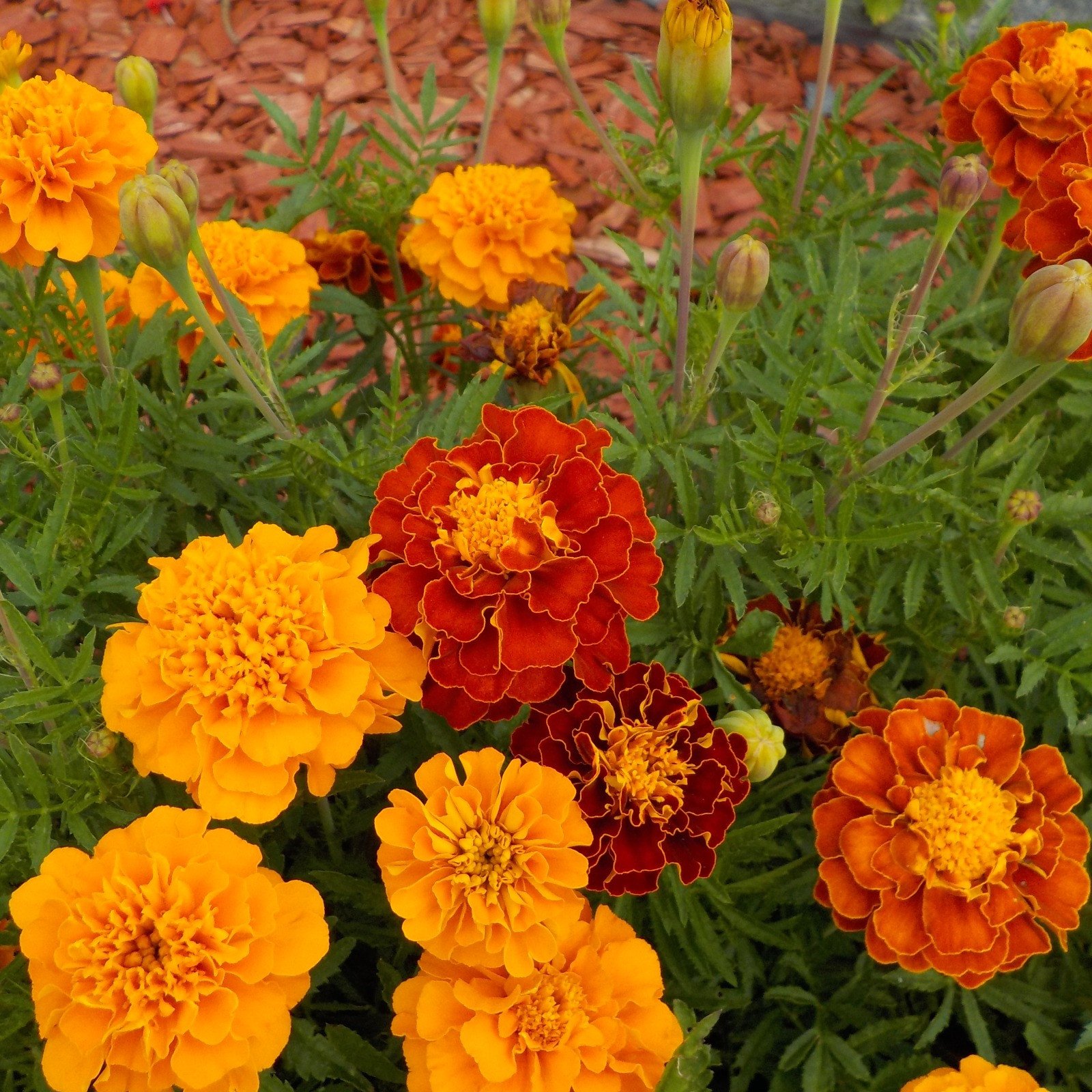
Mowgli Bicolor
Variety
created by Brianna at 14.01.2022
Propagating
Planting
Harvest
J
F
M
A
M
J
J
A
S
O
N
D
The student flower Mowgli Bicolor pleases with many densely double flowers in bright orange with brown-red accents. Rainy and cold wet weather does not bother these robust plants much. With their very low compact growth they are especially suitable for borders, group plantings on borders, in front gardens, small gardens, rock gardens, raised beds, balcony boxes and tubs for the terrace. This only 15cm tall marigold is also ideal for planting in bowls. The very long flowering period lasts from the end of May until frost in October.
F1 Hybrid
Not frost resistant
In preculture, thinly cover the seeds with soil in trays or pots, press down and keep evenly moist. Covering with transparent film or a glass pane until germination prevents drying out. Approximately 2 weeks after emergence, prick out the tender seedlings individually into pots or trays, and continue cultivation in light and airy conditions at 14-18 degrees.
Light requirement
Sunny
Plant distance
20 cm
Row spacing
25 cm
Seeding depth
0.5 cm

Abyssinian cabbage / Ethiopian mustard
Apple
Aubergine / Eggplant
Basil
Bean ((Scarlet) runner bean)
Bean (Broad bean / Faba bean / Field bean)
Bean (Dwarf bean)
Bean (Hyacinth bean / Lablab-bean)
Bean (Lima Bean)
Bean (Runner bean)
Beetroot
Black salsify
Broccoli
Broccoli raab / Stem cabbage / Cima di rapa
Brussels sprouts
Brussels sprouts
Buddleja / Butterfly Bushes
Cabbage (Cabbage)
Cabbage (Pointed cabbage)
Cabbage (red cabbage)
Cabbage (Savoy cabbage)
Carrots
Cauliflower
Celery (Celeriac / Celery root)
Celery (Celery)
Celery (Leaf celery / Chinese celery)
Chard
Chickpea
Chili
Chinese kale - Kai-lan / Chinese broccoli
Chives
Chives
Collard greens
Collard greens (Kale)
Collard greens (Tuscan kale / Dinosaur kale / Palm tree kale)
Coneflower (Echinacea)
Cucumber / Gherkin
Currant
Dill
Fig
Funk
Garlic
Garlic chives
Gooseberry
Kohlrabi / German turnip / Turnip cabbage
Lavender
Leeks
Lettuce (Common chicory)
Lettuce (Endive / Escarole / Erisée)
Lettuce (Lamb's lettuce)
Lettuce (Lettuce)
Lettuce (Oriental greens / Brown mustard)
Lettuce (Puntarelle / Cicoria di catalogna / Cicoria asparago)
Lettuce (Radicchio / Italian chicory)
Lettuce (Sugar loaf)
Melissa
Melon (Sugar melon)
Melon (Watermelon)
Mint
Mizuna / Japanese mustard greens
Napa cabbage / Chinese cabbage
Nightshades (Other)
Okra
Onion
Onion (Spring onion)
Oregano
Ornamental alliums
Pak Choi
Parsley
Parsnip
Pea
Pear
Pepper / Paprika
Physalis
Plum
Plum (tree)
Potato
Radish
Radishes
Rapeseed - Sheer cabbage / Siberian cabbage
Rapini / Broccoli rabe
Raspberry
Rhubarb
Root parsley
Rose
Rudbeckia (Coneflower / Black-eyed-susans)
Rutabaga / Swedish turnip
Sage
Snapdragon
Sour cherry / Tart cherry
Soybean
Spinach (Summer)
Spinach (Winter)
Spirea
Strawberry
Succulents
Sweet pea
Thyme
Tomato (Bush tomato)
Tomato (Cocktail bush tomato)
Tomato (Cocktail Stake Tomato)
Tomato (Stake tomato)
Turnip
Turnip greens - Choy Sum / Chinese flowering cabbage
Turnip greens - Mizuna
Turnip greens - Tatsoi
Turnip-rooted chervil
Turnips - Oilseed turnips
Turnips - Wild turnips
Vegetable cabbage - Forage cabbage
Vegetable cabbage - Ribbed cabbage / Portuguese cabbage
Vegetable cabbage - wild cabbage / ancient cabbage
Weigela
Wild Cherry / Bird Cherry / Sweet Cherry
Yalta tomatoes
Alder trees
Blackberry / Brambles
Common marigold
Common mugwort
Courgette / Zucchini
Cucumber (Caigua)
Fennel
Florence fennel / Finocchio
Garden squash - Patisson / UFO squash
Grasses - Bamboos
Grasses - reeds, cattails, bulrushes
Hair cucumbers / snake gourds
Hazelnut
Ivy
Jerusalem artichoke / Topinambur
Make
Maples
Ornamental pumpkin
Pines
Pumpkin / Squash
Rhododendron
Spruce trees
Sweet woodruff / Sweetscented bedstraw
Walnut family
Willows
Septoria
Root Rot
Downy mildew
Powdery mildews
Spider mites
Thrips
Aphids
Land snails