Spruce trees

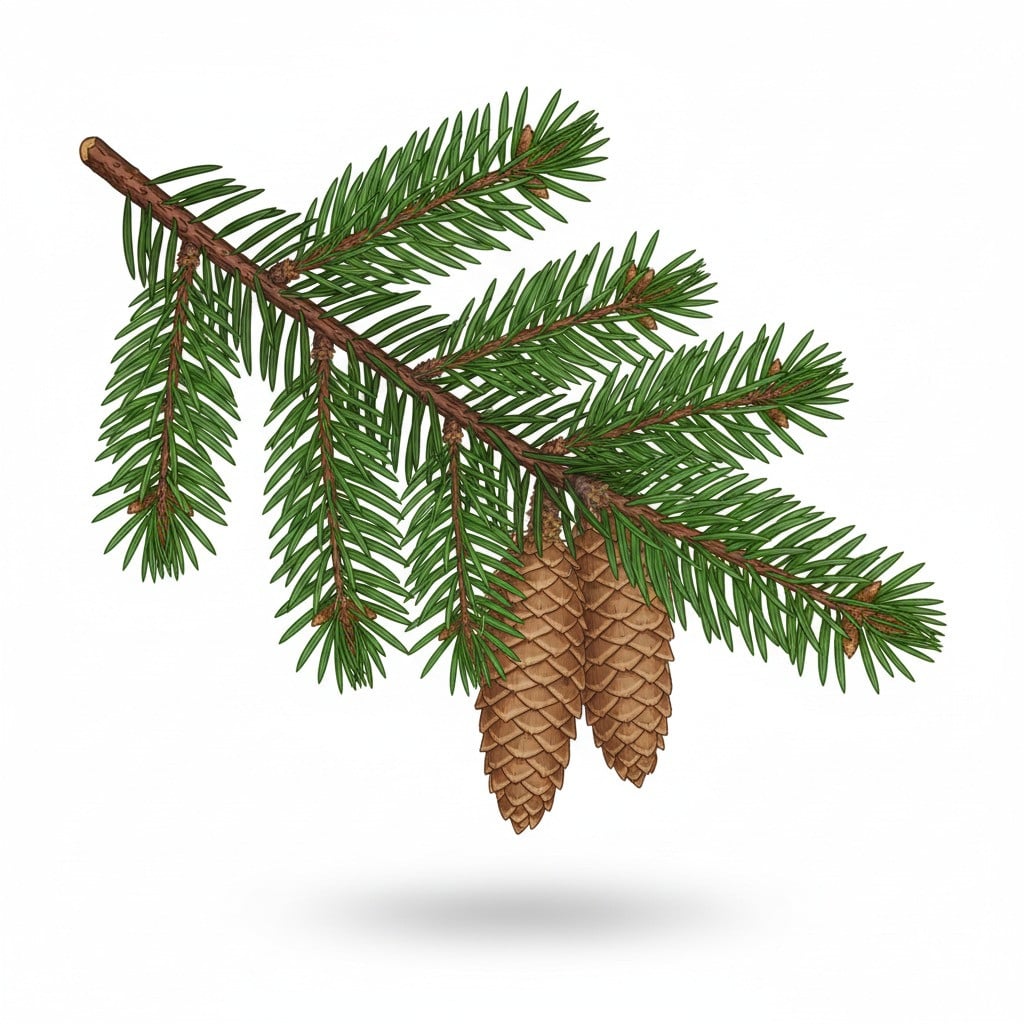
Spruce trees
Picea
Plant family
- others -
Season Overview
Planting
Harvest
Harvest
J
F
M
A
M
J
J
A
S
O
N
D
1ST YEAR
FOLLOWING YEARS
Details


Light requirement
Sunny

Water requirement
Moist

Soil
Medium (loamy)

Nutrient requirement
Medium

Light germinator

Germination temperature
15 – 20 °C (Degrees Celsius)

Plant distance
400 cm

Row spacing
600 cm

Seeding depth
0.2 cm
Instructions
Description
Spruces are one of the most species-rich genera of conifers. There are around 50 different species in total, which are distributed around the globe in the temperate to sub-polar zone of the northern hemisphere. The Serbian spruce (Picea omorika) and the blue spruce (Picea pungens 'Glauca') were very popular as garden plants in the 1970s and 1980s - they were often planted as small copses on larger plots of land. Like all taller spruces, however, they are quite susceptible to windthrow, which has led to some damage to buildings and vehicles in the past during storms. Today, most gardens plant mainly grafted spruces with special growth forms. The dwarf forms of various spruce species are particularly popular. The wild species of spruce all grow quite tall and form slender conical crowns that taper evenly towards the top and only become wider at the top in very old trees in the open. Some of the individual species look very similar and are therefore difficult to distinguish. However, they can be reliably distinguished from other conifers, especially from fir trees, which at first glance look very similar, on the basis of a few typical characteristics. Traditionally, the cones of spruce trees always grow downwards, while those of fir trees sit upright on the branches. In addition, mature spruce cones fall off as a whole. Fir cones, on the other hand, disintegrate into individual scales, while the central spindle initially remains attached to the branch and is only shed later. The evergreen spruce needles are square in cross-section, relatively thick and hard with a more or less sharp point. Fir needles are usually very thin, soft and do not prick. The male flowers of the mostly dioecious spruce are predominantly yellow, the initially upright female flowers are red in color.
Origin:
North America, Europe, Asia
Growing tips
Location and soil Most spruces prefer sunny to semi-shady locations and are extremely soil-tolerant. In their natural habitats, they usually grow on rather moist to boggy soils with very different pH values. In the long term, spruces cannot tolerate drier soils or soils that are too heavy and clayey - under these conditions, the risk of windthrow and bark beetle infestation is very high. Serbian spruce and Norway spruce have the highest drought tolerance. Planting spruces For taller species, choose a location that is as sheltered from the wind as possible. In addition, you should always position the trees in the garden so that they will not damage buildings or other structural elements in the event of a windthrow. If the soil is sufficiently well-drained and not too dry, no special preparation of the soil is required. You can plant all spruce trees offered in containers almost all year round, provided you ensure a good water supply after planting. As spruce trees are generally extremely frost-hardy, they can even be planted in winter. Larger trees should be secured after planting with a sufficiently long stake driven in at an angle to prevent them from toppling over in strong winds. A mulch layer of bark compost prevents the soil from drying out too quickly in summer. Care tips Spruce trees do not require any special care. In dry summers, however, you should not wait too long to water them, as newly planted spruces in particular quickly suffer from a lack of water and are then susceptible to plant diseases and pests. Please note that decaying spruce needles can severely acidify the soil due to their high humic acid content. It is therefore strongly recommended that you regularly test the soil in the root area for its pH value and if the value is below 5 (below 6 in loamy soils), counteract this by adding lime. Pruning spruces Spruce trees do not need regular pruning. If you want to limb the trunks, late winter is a good time. In addition, young trees sometimes form two tops - in such cases you should cut out one of them at the base as early as possible. Avoid ill-considered cuts into the old wood, as spruces, like almost all conifers, can only form new buds capable of sprouting in the area of the needled shoots. You should also not cut the leading shoot, as this completely disfigures the elegant crown of the tree. Although new tips will form, usually by side shoots growing upright, an unsightly kink will remain at this point for the rest of the tree's life. Use The larger, upright-growing species with expressive crowns, such as the Maned Spruce (Picea breweriana), the Oriental Spruce (Picea orientalis) and the Serbian Spruce (Picea omorika), are best suited for solitary planting. Larger, expressive garden forms of the red spruce, such as the hanging form 'Inversa', are also shown to their best advantage in a solitary position. The range of dwarf forms of the red spruce and other spruce species is much larger. They usually have a spherical to cushion-shaped habit and are often planted in heather gardens or rock gardens. They are also popular as rhododendron companions, as green resting spots in perennial and rose beds and as low-maintenance planting for troughs and other planters. The dwarf varieties of spruce are also frequently used as grave planting. Propagating spruces The wild species of spruce are usually propagated by sowing. Collect the ripe cones as soon as they have fallen to the ground, remove the seeds and dry them for a few days. They are then stored in paper bags in an airy, cool and dark place. Before sowing in March, they are left to soak for 48 hours in a plastic bag with moist sand in the fridge, then sown in a wide cube in trays with potting compost or directly in the garden bed and only thinly covered with soil. Nowadays, low garden varieties are usually propagated in the nursery in late summer by cuttings from new, well-lignified shoots. However, this method is usually not practical in the hobby garden, as you usually need a greenhouse with a growing bed and bottom heating as well as a misting system to keep the humidity evenly high. All taller-growing varieties as well as some wild species such as the maned spruce are propagated by grafting. This is carried out by side-grafting or side-tipping the scions in late summer onto potted, three to four-year-old red spruce seedlings. Further cultivation and overwintering takes place in a greenhouse. Diseases and pests One of the most common spruce pests is the Sitka spruce aphid. In addition to the spruce species of the same name, it also attacks Serbian spruce, red spruce and some other species. In contrast to other aphids, it is also active in winter and can be easily recognized by its characteristic red eyes. Infested spruces needle very heavily. Control is possible with preparations containing rapeseed oil, among other things, whereby the branches and twigs must be very well wetted from above and below. The treatment should be repeated several times at two-week intervals. If the needles of the spruce trees turn brown and fall to the ground for no apparent reason, a magnesium deficiency may also be the cause. This can be remedied relatively easily with Epsom salt, a special magnesium fertilizer.

Companion Plants

Antagonistic Plants

Diseases
Root Rot

Pests
Aphids