Siniglaska

Variety
Siniglaska
created by Möwe at 09.02.2025
Features
Color
blue-violet
Fruit shape
elongated
Growth habit
growth habit: compact
growth habit: bushy
growth habit: richly branched
lifespan: perennial
Location
light: sunny to semi-shady
planting: bed
planting: outdoor
fertilization: humus-enriched
soil moisture: fresh to moist
Season Overview
Planting
Harvest
Harvest
J
F
M
A
M
J
J
A
S
O
N
D
1ST YEAR
FOLLOWING YEARS
Description
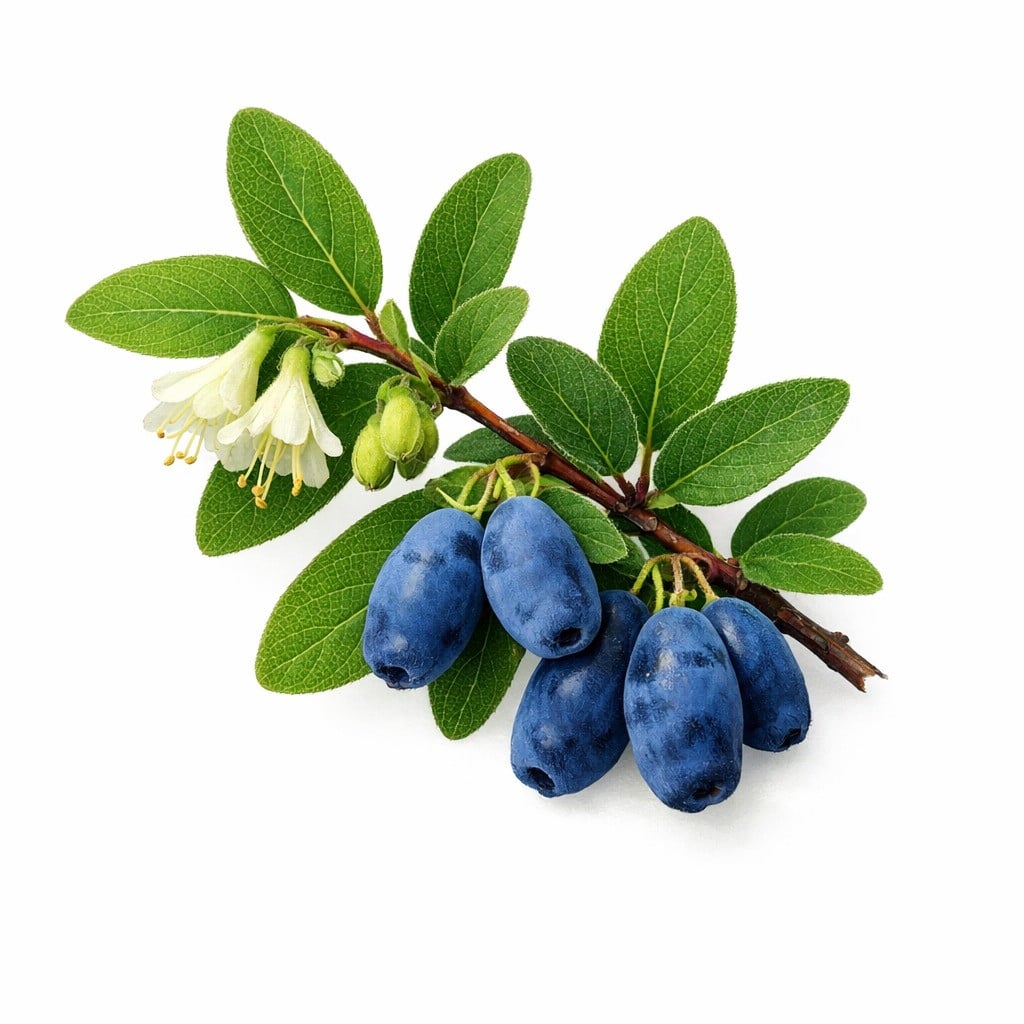
The honeyberry, actually Kamchatka honeysuckle (Lonicera caerulea var. kamtschatica) or May berry, Siberian blueberry, Haskap berry or Gimolost is a wild fruit of the honeysuckle family (Caprifoliaceae). It is found in Siberia, Kamchatka and the Kuril Islands and is related to the native red honeysuckle (Lonicera xylosteum). The Kamchatka honeysuckle grows as an upright, densely branched, deciduous shrub and reaches heights of 1 to 2.5 meters. In width, it can take up to 1.2 meters. The plant is a shallow-rooting plant. The creamy white flowers open as early as March. The first fruits are often ripe by the end of April and May at the latest. The wild fruit has juicy, sweet, oval to cylindrical, narrow, smooth fruits with a fruity, aromatic flavor. They are light to black-blue and are 1 to 3 centimetres long. The fruit juice is deep purple. The fruits taste similarly sweet, but slightly less aromatic than blueberries. They can be eaten fresh or processed into jam, compote, puree and juice. The "Siniglaska" honeyberry is characterized by its compact and bushy growth. It reaches a height of 150 to 200 cm and a width of 100 to 150 cm. The variety flowers from March to May. The 10 to 15 mm long, cylindrical, dark blue-colored fruits can be harvested from June to July. They taste fruity, sweet and sour with a slightly bitter note.
F1 Hybrid
Frostproof
Growing tips
The best time to plant is in the fall, as the plants are already well rooted by spring. Honeyberry is not self-pollinating, so at least two varieties must always be planted. Kamchatka honeysuckle is very frost-hardy. It thrives in sunny to semi-shady locations, preferring light shade. The plant thrives in almost any soil. It tolerates fresh to moist, acidic to neutral, sandy-humus, gravelly or rocky, shallow soils. The honeyberry is grateful for a compost application before budding and fertilization with nettle manure in April-May. The plant should be watered during dry periods, otherwise no watering is required. Honeyberries are pruned in a similar way to currants. Once a year, preferably immediately after the harvest, old, senescent shoots are removed close to the ground. No more than 3 ground shoots should be left standing after radical pruning. It is advisable to protect the shrub from bird damage with a protective net. The "Siniglaska" honeyberry prefers fresh, moist and sunny locations and a loose, well-drained, nutrient-rich and lime-free soil. To ensure fertilization, at least two specimens should be planted together. The variety can be cultivated well in large containers (25 - 30 liters).
Details

Light requirement
Semi-shaded

Water requirement
Moist

Soil
Medium (loamy)
Nutrient requirement
Low

Light germinator

Germination temperature
15 - 20 °C (Degrees Celsius)

Plant distance
135 cm

Row spacing
135 cm

Seeding depth
0.5 cm

Companion Plants
Arctic Bramble, Mammure
Aronia berries
Beetroot
Black salsify
Blueberry
Buddleja / Butterfly Bushes
Carrots
Catnip
Chard
Chives
Clover / Trefoil
Comfrey
Common marigold
Crocus
Currant
Daisies
Dogwood
Elderberry
Forsythia
Funk
Garden cosmos / Mexican aster
Garlic
Geranie/Pelargonie
Gooseberry
Grasses - Sedges
Hazelnut
Hellebores
Hydrangea / Hortensia
Jostaberry
Large cranberry / American cranberry
Lettuce (Lettuce)
Lung herbs
Lupine / Bluebonnet
Make
Mint
Nasturtium
Onion
Onion (Spring onion)
Parsnip
Peony
Phacelia / Scorpionweed / Heliotrope
Phlox, flame flower
Pines
Privet
Purple bellflower, silver bellflower
Quadriceps
Rhododendron
Rock pear (Amelanchier)
Rose
Rudbeckia (Coneflower / Black-eyed-susans)
Scented nettles
Snowdrop
Spinach (Summer)
Spinach (Winter)
Spirea
Spruce trees
Strawberry
Sunflower
Sweet woodruff / Sweetscented bedstraw
Tagetes / Marigolds
Weigela
Wild garlic
Women's coats
Yarrow

Antagonistic Plants
Abyssinian cabbage / Ethiopian mustard
Aubergine / Eggplant
Begonias
Blackberry / Brambles
Broccoli
Broccoli raab / Stem cabbage / Cima di rapa
Brussels sprouts
Brussels sprouts
Cabbage (Cabbage)
Cabbage (Pointed cabbage)
Cabbage (red cabbage)
Cabbage (Savoy cabbage)
Cauliflower
Chili
Chinese kale - Kai-lan / Chinese broccoli
Collard greens
Collard greens (Kale)
Collard greens (Tuscan kale / Dinosaur kale / Palm tree kale)
Common mugwort
Coriander / Cilantro
Courgette / Zucchini
Cucumber (African horned cucumber / Kiwano)
Cucumber (Caigua)
Cucumber (Melothria)
Cucumber / Gherkin
Dill
Garden squash - Patisson / UFO squash
Grasses - Bamboos
Grasses - reeds, cattails, bulrushes
Hair cucumbers / snake gourds
horse chestnut
Ivy
Kohlrabi / German turnip / Turnip cabbage
Lavender
Lovage
Maples
Melissa
Mizuna / Japanese mustard greens
Napa cabbage / Chinese cabbage
Oregano
Ornamental pumpkin
Pak Choi
Parsley
Pepper / Paprika
Potato
Pumpkin / Squash
Rapeseed
Rapeseed - Sheer cabbage / Siberian cabbage
Rapini / Broccoli rabe
Raspberry
Rutabaga / Swedish turnip
Sage
Savory
Sea coal
Sponge gourd / Egyptian cucumber / Vietnamese luffa
Stem herbs
Succulents
Thyme
Tomato (Bush tomato)
Tomato (Cocktail bush tomato)
Tomato (Cocktail Stake Tomato)
Tomato (Stake tomato)
Turnip
Turnip greens - Choy Sum / Chinese flowering cabbage
Turnip greens - Mizuna
Turnip greens - Tatsoi
Turnips - Oilseed turnips
Turnips - Wild turnips
Vegetable cabbage - Forage cabbage
Vegetable cabbage - Ribbed cabbage / Portuguese cabbage
Vegetable cabbage - wild cabbage / ancient cabbage
Walnut family
Willows
Yalta tomatoes
Diseases
Septoria
Angular leaf spot of cucumber
Powdery mildews
Pests
Caterpillars
Spotted wing drosophila
Common winter moth
Aphids