Goldgarbe 'Feuerland'

Variety
Goldgarbe 'Feuerland'
Approved Data
created by Alex&Sempi at 08.02.2026
Features
Taste
aromatic
Resistances
drought tolerant
Location
light: Full sun
Light: Sun
Growth habit
insect pollination
Fruit shape
Typ: Schließfrucht - Achäne
Color
Behaarung: silbergrau
Season Overview
Propagating
Planting
Harvest
Harvest
J
F
M
A
M
J
J
A
S
O
N
D
1ST YEAR
FOLLOWING YEARS
Description
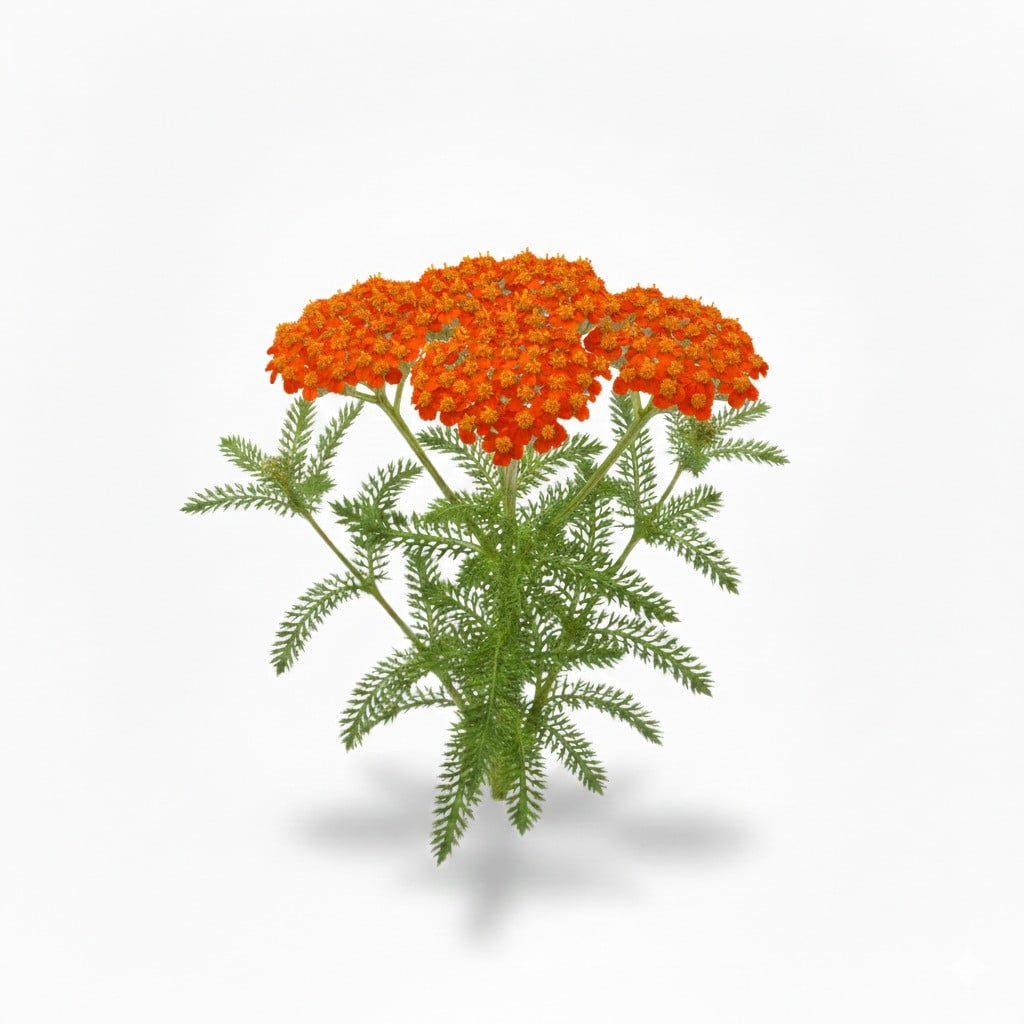
Red yarrow (Achillea x filipendulina 'Feuerland') is an attractive variety bred by the renowned perennial breeder Ernst Pagels. In summer, this bee-friendly plant adorns itself with magnificent flower clusters in fiery colors, attracting numerous insects to the garden. The varieties of golden yarrow (Achillea filipendulina) are also often called noble yarrow. Growth It forms a tall, light, and abundant clump that is deciduous or semi-perennial. If it feels comfortable in its location, it will grow to between 80 and 120 centimeters tall. It takes up 40 to 50 centimeters in width. The stem is grooved and hairy. Leaves Achillea 'Feuerland' has feathery, lanceolate leaves on its stems. Its light, very feathery, matt silver-green foliage is also intensely fragrant when dried. Flowers From June to October, red yarrow displays its striking umbels, which are up to 7 cm in size and consist of many tiny basket flowers. While the tubular flowers in the center are bright yellow, the ray flowers are a fiery red color. The color of the ray flowers changes from blood red to orange and then to apricot yellow. Bees, bumblebees, and other insects are magically attracted to their scent. Tip: By pruning, you can encourage the plant to bloom a second time in September. Fruits After flowering, red yarrow forms inconspicuous fruits. Use Whether planted individually or in small groups, red yarrow is ideal for natural and cottage gardens. Colorful partners include sage (Salvia), globe thistles (Echinops), and purple coneflower (Echinacea). Trendy perennial combinations can also be created with mountain knotweed (Aconogonon). As a cut flower, Achillea 'Feuerland' adds bright accents to bouquets. The plant actually has recognized medicinal properties: it is hemostatic, the leaves are healing, and the flowers have a stimulating, toning, and, in high concentrations, fever-reducing effect.
F1 Hybrid
Frostproof
Growing tips
🌿 Sowing - Pre-cultivation: from February - April, light - Light germinator: Press seeds lightly, barely cover - Substrate: lean, sandy growing medium - Germination temperature: 15-20 °C, slightly moist soil - Germination time: 10-20 days - Prick out after two to three true leaves - Direct sowing: April to May, in full sun, dry, well-drained soil - Keep slightly moist until germination Planting time - Planting time: from mid-May (after late frosts) - Planting distance: 25-30 cm 🌱 Location & soil - Dry, warm - Low in nutrients, sandy, gravelly - No waterlogging, well drained 💧 Care - Frugal - Water moderately during prolonged drought - little fertilization 🌿 Harvest - At the beginning of flowering (June-August) - Inflorescences & 10-20 cm stems - late morning (essential oils strongest) - Several times per season - Loosely bundled in a shady, airy place ✂️ Pruning - after first flowering (promotes second flowering phase) - Leave stems in the fall for insects and birds - Complete pruning in early spring 🌼 Propagation - Division in spring or fall - Self-seeding 🐝 Benefits for insects and the garden Yarrow is an excellent plant for bees and butterflies. It is also a good companion plant in the vegetable patch, as it attracts beneficial insects and can irritate pests with its scent. ❄️ Winter - Fully hardy (-25°C and below) - Well-drained soil without waterlogging ✅ Good neighbors - Sage, lavender, savory - Thyme, oregano, rosemary, hyssop - Catnip, quilted sage, magnificent candles - Coneflower (Echinacea), daisies, delphinium - Stonecrop (Sedum) - Grasses such as fescue or feather grass - Tomatoes, peppers, chili, pumpkin, eggplants, bush beans - Garlic, onions - Sea buckthorn, rock pear, dog rose, butterfly bush - Gorse, privet, barberry - Field maple, rowan, pine, birch, robinia ❌ Bad neighbors - Ferns, funkia, astilbe, purple bellflower, ragwort - Parsley, chives, mint, basil, chervil, coriander - Hydrangea, rhododendron, snowball, hazelnut, - Plants that like waterlogging or heavy shade - Lettuce, spinach, cabbage, celery, leek, radishes, cucumbers - Beech, ash, willow, alder, maple, spruce, fir 🦠 Diseases - Root rot - Powdery mildew - Gray mold 🐛 Pests - Aphids - Earth fleas - snails
Details


Light requirement
Sunny

Water requirement
Dry

Soil
Light (sandy)
Nutrient requirement
Low

Light germinator

Germination temperature
15 - 20 °C (Degrees Celsius)

Plant distance
40 cm

Row spacing
50 cm

Seeding depth
0.2 cm

Companion Plants
Aubergine / Eggplant
barberries
Bean (Dwarf bean)
Buddleja / Butterfly Bushes
Catnip
Chili
Coneflower (Echinacea)
Courgette / Zucchini
Garden squash - Patisson / UFO squash
Garlic
Garlic chives
Grasses - Feather grasses
Grasses - Fescue
Hair cucumbers / snake gourds
Hyssop
Larkspur
Lavender
Melon (Sugar melon)
Melon (Watermelon)
Onion
Onion (Spring onion)
Oregano
Ornamental pumpkin
Pepper / Paprika
Pines
Privet
Pumpkin / Squash
Rock pear (Amelanchier)
Rosemary
Rowanberries / Serviceberries
Sage
Savory
Sea buckthorn
Stem herbs
Succulents
Thyme
Tomato (Bush tomato)
Tomato (Cocktail bush tomato)
Tomato (Cocktail Stake Tomato)
Tomato (Stake tomato)
Yalta tomatoes

Antagonistic Plants
Alder trees
Basil
Broccoli
Brussels sprouts
Brussels sprouts
Cabbage (Cabbage)
Cabbage (Pointed cabbage)
Cabbage (red cabbage)
Cabbage (Savoy cabbage)
Carrots
Cauliflower
Celery (Celeriac / Celery root)
Celery (Celery)
Celery (Leaf celery / Chinese celery)
Chervil
Chinese kale - Kai-lan / Chinese broccoli
Chives
Collard greens
Collard greens (Kale)
Collard greens (Tuscan kale / Dinosaur kale / Palm tree kale)
Coriander / Cilantro
Cucumber / Gherkin
Fennel
Florence fennel / Finocchio
Funk
Grasses - Bamboos
Grasses - reeds, cattails, bulrushes
Hazelnut
hornbeams
Horseradish
Hydrangea / Hortensia
Kohlrabi / German turnip / Turnip cabbage
Leeks
Lettuce (Common chicory)
Lettuce (Lamb's lettuce)
Lettuce (Lettuce)
Lettuce (Puntarelle / Cicoria di catalogna / Cicoria asparago)
Lettuce (Radicchio / Italian chicory)
Lettuce (Sugar loaf)
Make
Maples
Mint
Mizuna / Japanese mustard greens
Napa cabbage / Chinese cabbage
Pak Choi
Parsley
Pimpinella
Purple bellflower, silver bellflower
Quadriceps
Radish
Radishes
Rapini / Broccoli rabe
Rhododendron
Root parsley
Spinach (Summer)
Spinach (Winter)
Spinach like plants (Water spinach)
Spruce trees
Sweet woodruff / Sweetscented bedstraw
Turnip
Turnip greens - Choy Sum / Chinese flowering cabbage
Turnip greens - Mizuna
Turnip greens - Tatsoi
Turnips - Oilseed turnips
Turnips - Wild turnips
Vegetable cabbage - Forage cabbage
Vegetable cabbage - Ribbed cabbage / Portuguese cabbage
Vegetable cabbage - wild cabbage / ancient cabbage
Wild garlic
Willows

Diseases
Grey mold
Root Rot
Downy mildew
Powdery mildews
Pests
Land snails
Flea beetles
Aphids