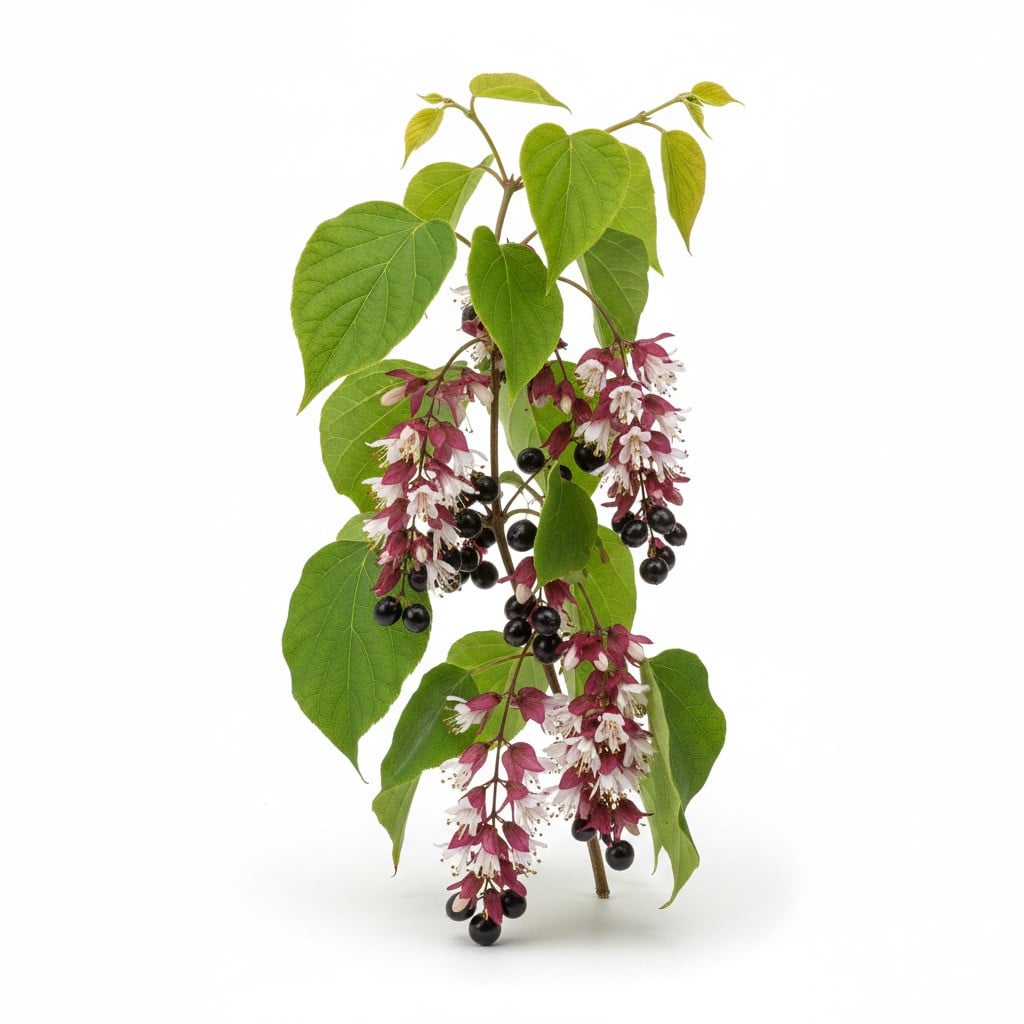
Karamellbeere, Schöne Leycesterie

Variety
Karamellbeere, Schöne Leycesterie
Approved Data
created by Alex&Sempi at 02.07.2025
Features
Color
green
red
Flower: light pink
Leaves red
Flower: white
Flower: crimson
leaves: budding coloration
Farbe: zweifarbig
Frucht: schwarzviolett/violettschwarz
Stamm, Stiel: braun
Stamm, Stiel: grün
Herbstfärbung: gelb
Herbstfärbung: orange
Wurzel: braun
Blattrippen: grün
Samen: braun
Fruchtfleisch: purpurrot
Fruchtfleisch: violett
Samen: ocker
Wurzel: beige
Growth habit
lifespan: perennial
harvest: profitable
growth habit: upright
tubular flower
flower: flowering
leaves: Deciduous
growth habit: multi-stem cultivatable
strong lateral shoot development
normal growth
warm germination
growth habit: sprawling
subshrub
leaves: densely leafed
root type: heart-shaped root system
ornamental plant
self-seeding
flower: continuous bloomer
Fragrant flowers
growth habit: slightly arching
heigth: 100 - 120 cm
height: 160 - 180 cm
height: 140 - 160 cm
propagation by cuttings
height: 180 - 200 cm
growth habit: becoming woody
height: 120 - 140 cm
wide: 100 - 150 cm
hermaphroditic
funnel-shaped
wide: 150 - 200 cm
entire leaves
large leaves
Spear shaped leaves
propagation by seeds
propagation by division
fruit on one-year-old wood
insect pollination
leaves: slightly wavy
harvest: late-ripening
Blätter: eiförmig
Blütenstand: traubenförmig
Blüte: mittelgroß
Blätter: zugespitzt
Geschlechtertyp: einhäusig
Keimung: Lichtkeimer
Blätter: gesägt
Blüte: hängend
height: 200 - 250 cm
Taste
aromatic
Licorice aroma
Caramel aroma
raw edible
Edible
thin skin
Geschmacksrichtung: Süße: stark
Konsistenz: geleeartig
Aroma: Rosine
Location
planting: bed
planting: outdoor
sheltered from the wind
light: sunny to semi-shady
Soil: permeable soil
soil moisture: no waterlogging
biotope: mountain area
Fertilization: nutrient-rich
fertilization: humus-enriched
light: light shade.
soil moisture: fresh to moist
Soil: slightly loamy
soil moisture: well-drained
biotope: forest
Soil: light
Soil: gravelly to sandy
Water: regularly
planting: heat protected
planting: open balcony or terrace
Planting: winter garden
Light: Semi-Shade
pH value: acidic to neutral (5,5-7)
planting: covered balcony or terrace
Soil: loosened
Water: Adequate
Planting: hedge
Planting: frost-protected
Planting: pots, tubs, or boxes
Fertilization: moderate
Fertilization: organic
Heat requirement: moderate
Heat requirement: cool
Düngung: kalktolerant
Düngung: flüssig
Düngung: Langzeitdünger
Düngemittel: zweimalig Kompost
Resistances
resistant
virus-resistant
robust
disease resistant
Snail resistant
Little susceptible
slugs resistant
multi resistant
hardy with protection
susceptible to late frost
hardy down to -15°C
Fruit shape
smooth, sleek
egg-shaped
small
globular
Form: langoval, zylindrisch
Typ: Schließfrucht - Beere
Steinfrucht
Season Overview
Propagating
Planting
Harvest
J
F
M
A
M
J
J
A
S
O
N
D
1ST YEAR
FOLLOWING YEARS
Description
This ornamental shrub is a stunning eye-catcher in the garden. The beautiful Leycesteria grows broadly and stands out with its special appearance. Numerous spike-shaped flowers shine from July to September and exude a mild, unmistakable fragrance. The (bot.) Leycesteria formosa 'Purple Rain' is an easy-care and undemanding plant. This makes it a popular shrub among ornamental shrubs for gardeners. A sheltered area is important, as heavy rain and storms lead to earlier flowering and damage to the shoots. The plant prefers a sunny location with normal garden soil. Loose, humus-rich soil is ideal. The beautiful leycesteria / caramel berry does not like wet feet. It reacts to this by yellowing or dropping leaves. Leycesteria formosa 'Purple Rain' develops lots of purple-red spikes during the flowering period. The foliage changes color after flowering and subsequent fruiting. In autumn, it takes on a bright orange to orange color. This splendor can be seen from afar. The ornamental shrub thrives particularly well in climatically mild wine-growing regions. In stormy and snowy regions, the beautiful leycesteria / caramel berry is hardy to a limited extent. In these areas, it requires additional protection from frost. The gardener provides winter protection with a thick layer of bark mulch over the root ball. Overwintering in the cellar or garage is not necessary.
Non hybrid
Growing tips
Hh
Details


Light requirement
Semi-shaded

Water requirement
Moist

Soil
Light (sandy)
Nutrient requirement
Medium

Light germinator

Germination temperature
18 - 22 °C (Degrees Celsius)

Plant distance
150 cm

Row spacing
150 cm

Seeding depth
0.2 cm

Companion Plants

Antagonistic Plants

Diseases
Root Rot
Pests
Land snails
Aphids
White fly