Fuchsias

Fuchsias
Fuchsia
Plant family
Evening Primrose family (Onagraceae)
Season Overview
Propagating
Planting
Harvest
J
F
M
A
M
J
J
A
S
O
N
D
1ST YEAR
FOLLOWING YEARS
Details


Light requirement
Sunny

Water requirement
Moist

Soil
Medium (loamy)

Nutrient requirement
Medium

Light germinator

Germination temperature
18 – 22 °C (Degrees Celsius)

Plant distance
40 cm

Row spacing
40 cm

Seeding depth
0.2 cm
Instructions
Description
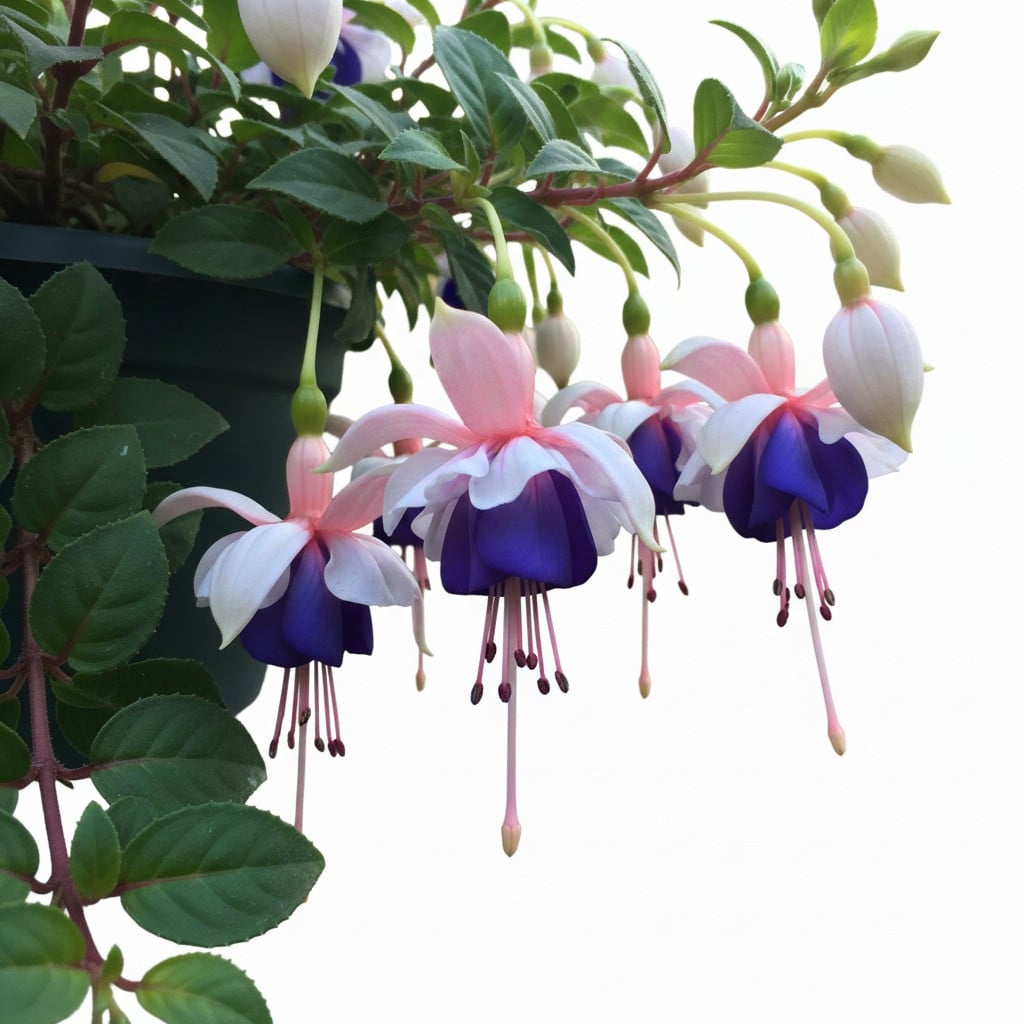
Fuchsias (bot. Fuchsia) are a genus of plants in the evening primrose family. With 107 species and over 12,000 varieties, fuchsias are one of the most diverse and widespread genera. Most species grow in the mountainous forests of North and South America. There are fewer species of fuchsia in Tahiti and New Zealand. On the European continent, the Fuchsia plant genus has been known since the 18th century. As an ornamental plant, fuchsias have been an integral part of European gardens and parks since the 19th century. The plant genus Fuchsia owes its name to Leonard Fuchs, a physician and botanist who lived in the 16th century. The individual plant species are visually very different from one another. Fuchsias are shrubs, semi-shrubs or trees that grow woody or strongly herbaceous. There are fuchsias that grow just a few centimetres high and fuchsia trees that reach up to ten meters into the sky. Most species are shrubs with dense branching and a variety of monochrome or bicolored flowers. Leaf The leaves of the plant genus Fuchsia are mostly elliptical and long-stalked. The smooth leaf surface is a medium to dark green and veined from the stem to the edges. The edge of the leaves is minimally to moderately toothed in most species. The opposite foliage hangs down slightly and is a typical characteristic of fuchsias. The central veins are lighter in color than the actual foliage, which is slightly curved and leathery in most members of the plant genus. The leaves are arranged opposite each other on the stem and branches. Depending on the species, the leaves are broader or narrow to lanceolate. Dark green foliage shines on the surface, while the underside of the leaves is lighter and dull to velvety. Flower The single, medium-sized flowers are four-petalled and sit on two to eight centimetre long flower stalks. The style depends on the species, as does the lower ovary. The ovary is green or red and consists of twelve chambers. The tubular flower axis grows on the ovary. This is colored like a crown leaf and is extremely long in some Fuchsia species. The four sepals grow from the flower axis and are bent back in most Fuchsias. The corolla consists of four to seven petals. Fuchsia species with a single flower have four petals, fuchsias with a double flower have five to seven petals. In most representatives of the Fuchsia plant genus, these differ clearly in color from the sepals. Violet, red, white and pink, as well as bicolored flowers attract attention with fuchsias. The pistil, which protrudes far out of the corolla and is surrounded by eight, usually shorter stamens protruding from the corolla, is striking. The many, intensely colored flowers make fuchsias popular ornamental plants all over the world. Fruit Fuchsias produce berry-shaped fruits that are poisonous in some species. The color of the small, inconspicuous berries is green and changes to red or black as they ripen. The size of the fruit varies according to the size of the plant and ranges from juniper berry-like to cherry-sized. Some species of the plant genus Fuchsia produce edible fruits with soft, juicy flesh. Growth Fuchsia species vary considerably in height and width. There are representatives that reach a maximum growth height of a few centimeters. Other Fuchsia species reach a height of up to ten meters and are tree-like to climbing. The growth is upright, branched depending on the species and bushy or wood-forming on the trunk. The foliage and flowers hang down. Most fuchsias are shrubs. A few species climb up larger plants and grow, for example, on tree trunks, house walls or climbing supports. Even rarer are the Fuchsia species that grow on stones, in crevices and on branches.
Origin:
Peru (Andes), Mexico, Tierra del Fuego America, Guatemala, Honduras, Venezuela, Panama, Brazil, Chile, Argentina New Zealand, Tahiti Europe (British Isles, Ireland, Scotland)
Growing tips
Location The greatest diversity of species of the Fuchsia plant genus is found in tropical areas. Fuchsias are not tropical plants, but grow mainly in the higher mountains and on the edge of the rainforest. Fuchsias grow in valleys and on slopes, especially in the southernmost areas of distribution. A sunny to semi-shady location supports the fast and vigorous growth of this plant species. Fuchsias do not tolerate waterlogging. A location at the foot of a mountain and in hollows is unsuitable. Care/pruning Perennial fuchsias require no special care and are undemanding in their choice of location. Tub and box plants spend the winter indoors. Fuchsias growing in the open require a cover of bark mulch over the roots for the winter. Larger plants should be pruned. Pruning is unnecessary for small fuchsias in semi-shrub and shrub form. Diseases/pests One of the greatest dangers for fuchsias are fungal diseases and animal pests in the form of aphids. If the humidity is too high or the soil is too moist, the Fuchsia plant genus will contract gray mold rot. The infestation causes the affected parts of the plant to die. If the gardener cuts off rotting stems and branches, the progression of the disease is halted. The Fuchsia plant species is also at risk of infestation by aphids if the air is very humid or watering is too heavy. If the leaves curl or form withered dry patches, the plant is usually a host for the green peach aphid. White and sticky areas on the foliage indicate an infestation of the whitefly. The honey-like secretion promotes the formation of sooty mold, which permanently damages the foliage of the infested plant.

Companion Plants

Antagonistic Plants

Diseases
Root Rot
Powdery mildews
Grey mold
Pests
Land snails
Thrips
Spider mites
Aphids
White fly