Pearl basket

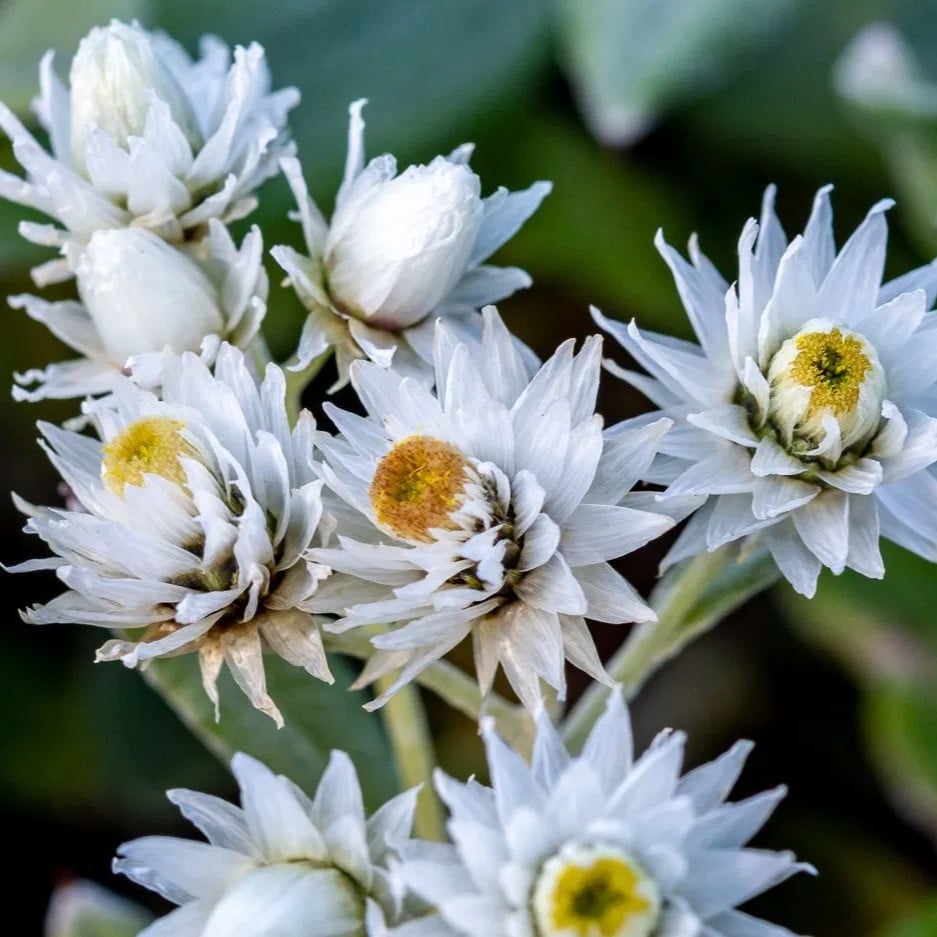
Pearl basket
Anaphalis
Plant family
Daisy family (Asteraceae)
Season Overview
Propagating
Planting
Harvest
J
F
M
A
M
J
J
A
S
O
N
D
1ST YEAR
FOLLOWING YEARS
Details


Light requirement
Sunny

Water requirement
Dry

Soil
Light (sandy)

Nutrient requirement
Low

Light germinator

Germination temperature
18 – 22 °C (Degrees Celsius)

Plant distance
35 cm

Row spacing
35 cm

Seeding depth
0.5 cm
Instructions
Description
The plant genus Anaphalis is commonly known as the pearl basket (also known as the pearl paw or summer snow). It belongs to the extensive composite family and comprises around 120 subspecies. There is also a similarity and relationship to asters, which also belong to the composite family. With its pearl-like white flowers, this perennial makes a pretty eye-catcher in the garden from June onwards. The easy-care anaphalis looks good both in the shrub bed and as a container plant and gets on well with almost all perennials. Small-growing varieties are also suitable as ground cover. If you pay attention to a few points regarding location and care, you will enjoy the white flowers of this attractive ornamental plant, which is also said to have healing properties, especially in summer. Leaf Anaphalis has elliptical, lanceolate, white-felted leaves with a grey-green to deciduous coloration. They are arranged alternately, have entire margins and grow up to 30 centimetres long, depending on the variety. The plant sheds its leaves in winter. Flower Anaphalis bears small white flowers that grow in panicles like pearls, which explains the name pearl basket. The flower shape is spherical and round with pronounced bracts, the flower eye is yellow. The individual varieties of Anaphalis can have flowers of different sizes. For example, the somewhat larger flowers of Anaphalis margaritacea (silver immortelle, silver rain or large-flowered pearl basket) are reminiscent of daisies. Depending on the variety, Anaphalis flowers between June and November. From mid/late September, the flowers of the pearl basket dry on the stem, making them ideal for making dried bouquets. Fruit The Anaphalis is sterile and therefore does not produce fruit or seeds. Growth Depending on the variety, the Anaphalis can reach a height of up to 70 centimetres. It grows bushy and compact and is not sprawling. Use The main use is as an ornamental and garden plant as well as a cut and dried flower. However, the anaphalis is also said to have medicinal properties. For example, the large-flowered pearl basket (Anaphalis margaritacea) is said to have been used by Native Americans to treat colds, rheumatism and headaches.
Origin:
Central and Southeast Asia (China, Korea, Japan, North India), Russia, North America, Europe
Growing tips
Location The pearl basket prefers a warm, sunny location. The soil should be dry, well-drained, with a sandy or gravelly subsoil and not too rich in nutrients. Accordingly, the Anaphalis can be found growing wild in dry open areas with wild shrub growth as well as mountain slopes or rocky steppes in sunny locations. It also thrives in sparse birch and pine forests, on fine-grained gravel banks of mountain rivers or nutrient-poor ruderal meadows. An alkaline soil pH of between 7.0 and 10.0 is ideal for composite plants. Care/pruning In optimal locations, the pearl basket requires little care. In order for it to thrive, waterlogging should be avoided. Normal rainfall and the basic moisture content of the soil are usually sufficient for watering. Only potted plants require additional watering as soon as the top layer of soil (approx. two centimetres) is dry. In general, Anaphalis tolerates drought better than too much moisture. Fertilizing is also practically unnecessary. Nevertheless, the perennial plant will be happy to receive a dose of compost after the fall bloom. February/March is the right time to prune the plant generously in order to encourage or enable new growth. Diseases/pests All Anaphalis species are largely resistant to pests and diseases. Only diseases caused by incorrect care or location are of concern in this genus. These include, for example, root rot due to waterlogging or burn damage due to excessive sunlight.


Antagonistic Plants

Diseases
Ascochyta blight
Root Rot
Pests
No pests