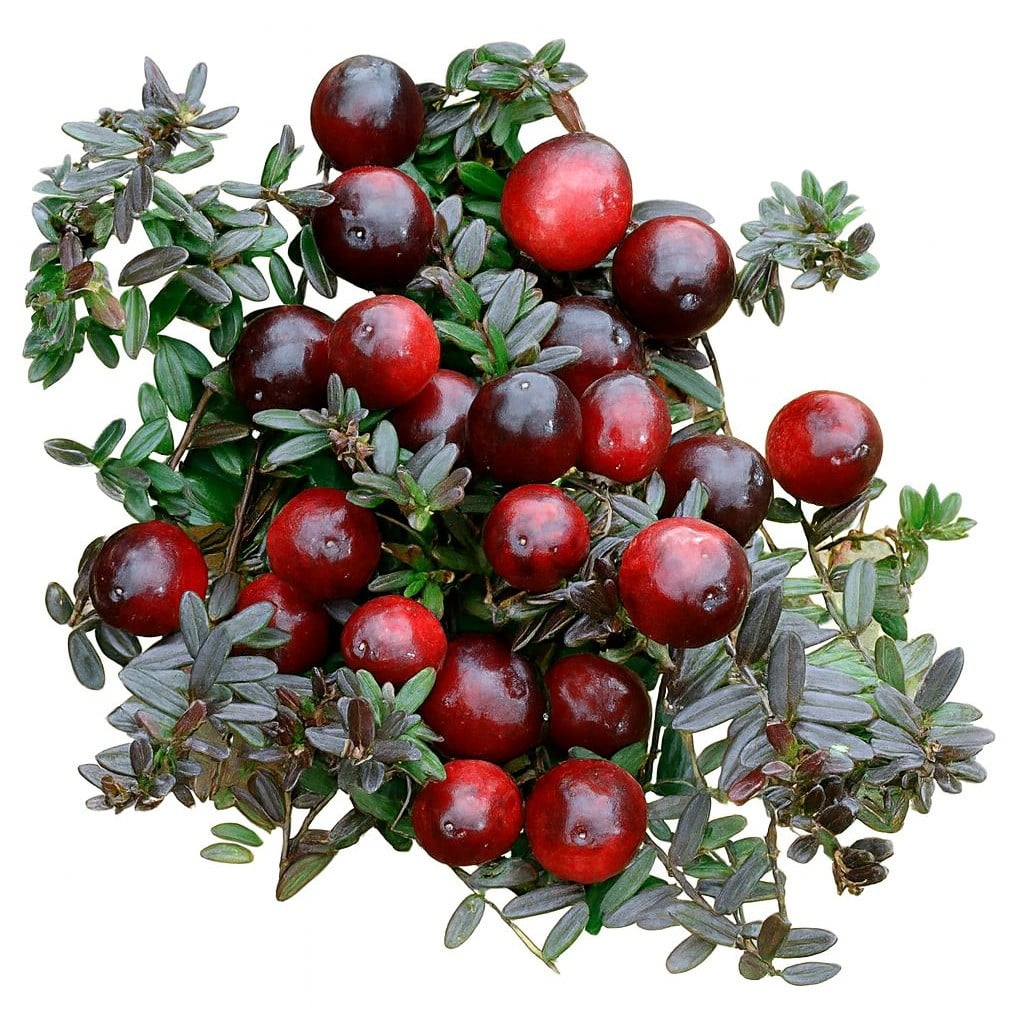
Großfrüchtige Moosbeere / Cranberry (Wildform)

Variety
Großfrüchtige Moosbeere / Cranberry (Wildform)
Approved Data
created by Alex&Sempi at 05.03.2026
Features
Resistances
robust
Taste
Edible
Essbarkeit: Frucht
Growth habit
insect pollination
Location
biotope: swamp / moor
Color
Blätter: dunkelgrün
Fruit shape
Typ: Schließfrucht - Beere
Season Overview
Propagating
Planting
Harvest
Harvest
J
F
M
A
M
J
J
A
S
O
N
D
1ST YEAR
FOLLOWING YEARS
Description
The large-fruited cranberry (Vaccinium macrocarpon), known in Low German as Kraanbeere or Kranbeere (from kraan, crane, hence also crane berry), is best known by its English name, cranberry. It is a plant species from the blueberry genus (Vaccinium) in the heather family (Ericaceae). The English name cranberry is derived from crane berries. The shape of the flowers is reminiscent of a crane's beak. Cranberries are native to Europe, Asia, and North America, with the American cranberry (Vaccinium macrocarpon) being more robust and less round than the Eurasian-North American common cranberry (Vaccinium oxycoccos). The natural habitat of Vaccinium macrocarpon is in the high bogs of eastern North America. Its range extends from New Brunswick and Newfoundland in Canada to the US states of North Carolina, Tennessee, and Virginia. In Germany, cranberries are often sold under the misleading name "Kulturpreiselbeere" (cultivated lingonberry), but they taste very different from lingonberries. They are tart and very sour. Growth The cranberry is an evergreen dwarf shrub that grows to a height of about 10-20 cm and spreads along the ground with low-lying branches, creeping about 0.5-1.5 m. Its growth habit is prostrate-ascending, which means that the older sections of the branches lie on the ground and take root along their entire length, while the ends of the branches are upright. The branches continue to grow indefinitely (up to 1 m per year), with the old rear sections dying off after a few years when they become overgrown by neighboring plants and (peat) mosses. This is why a stand of cranberries appears as a lawn-like structure (individual plants are not recognizable). Leaves The simple, entire-edged, short-stalked, almost bare, alternate leaves are leathery and thick, 0.9-1.9 cm long, ovate to elliptical, elongated, and rounded. The leaves are pale green underneath and partly "frosted," the leaf margin is slightly curved, and the short petiole is partly reddish. Flowers The flowers are usually four-petaled with a double perianth. They are arranged in "terminal" and racemose, few-flowered (up to 10) inflorescences at the base of the current year's shoots. Above this, the shoot, which is then leafy again, continues to grow. The nodding, long-stemmed flowers are white to slightly pinkish-red with strongly reflexed, lanceolate petals. The flowers are each borne on a bract (or reduced leaf); there are also two stipules. The reddish, slightly hairy flower stalks are 1.5–3 cm long. Fruits The smooth, multi-seeded, egg-shaped to round or ellipsoid fruits (pseudofruits), berries with calyx remnants at the tip, are comparable in size to small cherries. They are about 10 to over 25 mm in size (cultivated varieties are larger). The ripe fruits are bright red in color and have four air chambers inside. This makes them much lighter than water. The many (about 30) orange-brownish, slightly furrowed seeds are egg-shaped to round, flattened, and about 1.8–2.5 mm in size. Harvest Since the fruits are much lighter than water, a special harvesting method is commonly used in commercial cultivation: First, the fields are flooded with water, then the cranberries are separated from the bush by a whirlpool using special machines. The ripe fruits floating on top are then collected. The four air chambers in the berry have another use besides buoyancy during harvesting: the intact air chambers of high-quality berries allow them to bounce like a ball. Inferior fruits do not do this, so machines were developed as early as 1881 to ensure that high-quality fruits jump over a barrier. These are sold as whole fruits. Use In Germany, cranberries are increasingly being discovered as a baking ingredient, as their tart, sour taste sets them apart from other ingredients. One example is their use as a substitute for the raisins usually found in Christmas stollen. The berries are widely used in North American and Scandinavian cuisine, either fresh or dried. Soft fruits, on the other hand, are processed into compote or juice (for use in soft drinks, for example). The juice is an essential ingredient in Cosmopolitan cocktails. Internationally, cranberries are often used in cereal bars or yogurts, similar to sultanas. They are often soaked in other fruit flavors, which often masks their own taste. Varieties There are about 130 known varieties of cranberry, some with dark red to black colored fruits. However, about 99% of commercially grown fruits come from only about a dozen of the most commonly grown varieties. The most important varieties include Ben Lear, Early Black, Howes, McFarlin, and Searles.
Non hybrid
Frostproof
Growing tips
🌞 Location & soil - Sunny - semi-shady, cool location - Protected from the wind, but airy - Humus-rich, loose, sandy, acidic soil (pH 4-5) - Organic soil, coniferous litter, bark humus, boggy soil - Rather nutrient-poor soil - well drained, permeable, moist, no waterlogging 🌱 Sowing & planting - Stratify: 4-6 weeks - Sowing depth: 0.2 cm (light germinator) - Germination temperature: 18-22 °C - Germination time: several weeks to months - Planting time: March - May (alternatively September - October) - Planting distance: 50-150 cm - Row spacing: 50-150 cm - evenly slightly moist - keep moist 💧 Care - Watering: regularly, never dry out, no waterlogging, no tap water - Fertilization: not required - No fresh compost, calcareous fertilizer and strong mineral universal fertilizer - Mulching: Coniferous litter (pine, spruce), bark mulch, leaves (oak, beech) in the fall 🌾 Pruning & harvesting - Pruning not required - Harvest time: September - October - Frequency: regular harvest / ripen gradually - Pick fully ripe berries individually in dry weather ❄️ Winter protection - Thick layer of mulch (bark mulch, needle litter, leaves) around the root area - Keep soil loose, avoid waterlogging - Additionally cover young plants with brushwood - Lightly mound up heavy soil if necessary or use a raised bed - Must not dry out, water occasionally 🌿 Good neighbors - Cranberries, blueberries, allackberries - Currant, gooseberry - Rhododendron, azalea, erica, calluna, ferns - Alders, spruces, pines at a distance 🚫 Bad neighbors - Heavy eaters (cabbage, pumpkin, nightshade plants) - Maple, birch, willow, hazelnut, walnut - Strawberries, raspberries, blackberries - Mediterranean herbs, sedum - Lawns, lime-loving perennials 🍂 Diseases - Gray mold - Fruit rot - Leaf spot diseases - Shoot dieback - Root rot 🐌 Pests - Aphids - frost moth - Caterpillars - Cherry vinegar fly - gall midges - scale insects - spider mites
Details

Light requirement
Sunny

Water requirement
Moist

Soil
Light (sandy)
Nutrient requirement
Low

Light germinator

Germination temperature
18 - 22 °C (Degrees Celsius)

Plant distance
100 cm

Row spacing
100 cm

Seeding depth
0.2 cm

Companion Plants

Antagonistic Plants
Abyssinian cabbage / Ethiopian mustard
Anemone
Aubergine / Eggplant
Beetroot
Blackberry / Brambles
Broccoli
Broccoli raab / Stem cabbage / Cima di rapa
Brussels sprouts
Brussels sprouts
Cabbage (Cabbage)
Cabbage (Pointed cabbage)
Cabbage (red cabbage)
Cabbage (Savoy cabbage)
Cauliflower
Chili
Chinese kale - Kai-lan / Chinese broccoli
Clematis
Collard greens
Collard greens (Kale)
Collard greens (Tuscan kale / Dinosaur kale / Palm tree kale)
Courgette / Zucchini
Cucumber (African horned cucumber / Kiwano)
Cucumber (Caigua)
Cucumber (Melothria)
Cucumber / Gherkin
Garden squash - Patisson / UFO squash
Grasses - feather-bristled grasses, lamp-cleaning grasses
Grasses - Fescue
Grasses - Pampas grass
Grasses - Reedgrass
Green lavender cotton
Hair cucumbers / snake gourds
Hazelnut
Hellebores
Horsetail
Ivy
Kohlrabi / German turnip / Turnip cabbage
Lavender
Lily of the valley
Maples
Mizuna / Japanese mustard greens
Napa cabbage / Chinese cabbage
Nightshades (Other)
Okra
Oregano
Ornamental pumpkin
Pak Choi
Pepper / Paprika
Phlox, flame flower
Potato
Pumpkin / Squash
Rapeseed
Rapeseed - Sheer cabbage / Siberian cabbage
Rapini / Broccoli rabe
Raspberry
Rose
Rosemary
Rutabaga / Swedish turnip
Sage
Sea coal
Sponge gourd / Egyptian cucumber / Vietnamese luffa
Stem herbs
Stinging nettle
Strawberry
Succulents
Sweet woodruff / Sweetscented bedstraw
Thyme
Tomato (Bush tomato)
Tomato (Cocktail bush tomato)
Tomato (Cocktail Stake Tomato)
Tomato (Stake tomato)
Turnip
Turnip greens - Choy Sum / Chinese flowering cabbage
Turnip greens - Mizuna
Turnip greens - Tatsoi
Turnips - Oilseed turnips
Turnips - Wild turnips
Vegetable cabbage - Forage cabbage
Vegetable cabbage - Ribbed cabbage / Portuguese cabbage
Vegetable cabbage - wild cabbage / ancient cabbage
Walnut family
Wild garlic
Willows
Yalta tomatoes
Diseases
Root Rot
Septoria
Grey mold
Pests
Common winter moth
Spider mites
Schildläuse
Caterpillars
Spotted wing drosophila
Gall midges
Aphids