Horsetail

Horsetail
Equisetum
Plant family
- others -
Season Overview
Sowing
Harvest
J
F
M
A
M
J
J
A
S
O
N
D
1ST YEAR
FOLLOWING YEARS
Details


Light requirement
Semi-shaded

Water requirement
Moist

Soil
Medium (loamy)

Nutrient requirement
Medium

Light germinator

Germination temperature
15 - 20 °C (Degrees Celsius)

Plant distance
50 cm

Row spacing
50 cm

Seeding depth
0.1 cm
Instructions
Description
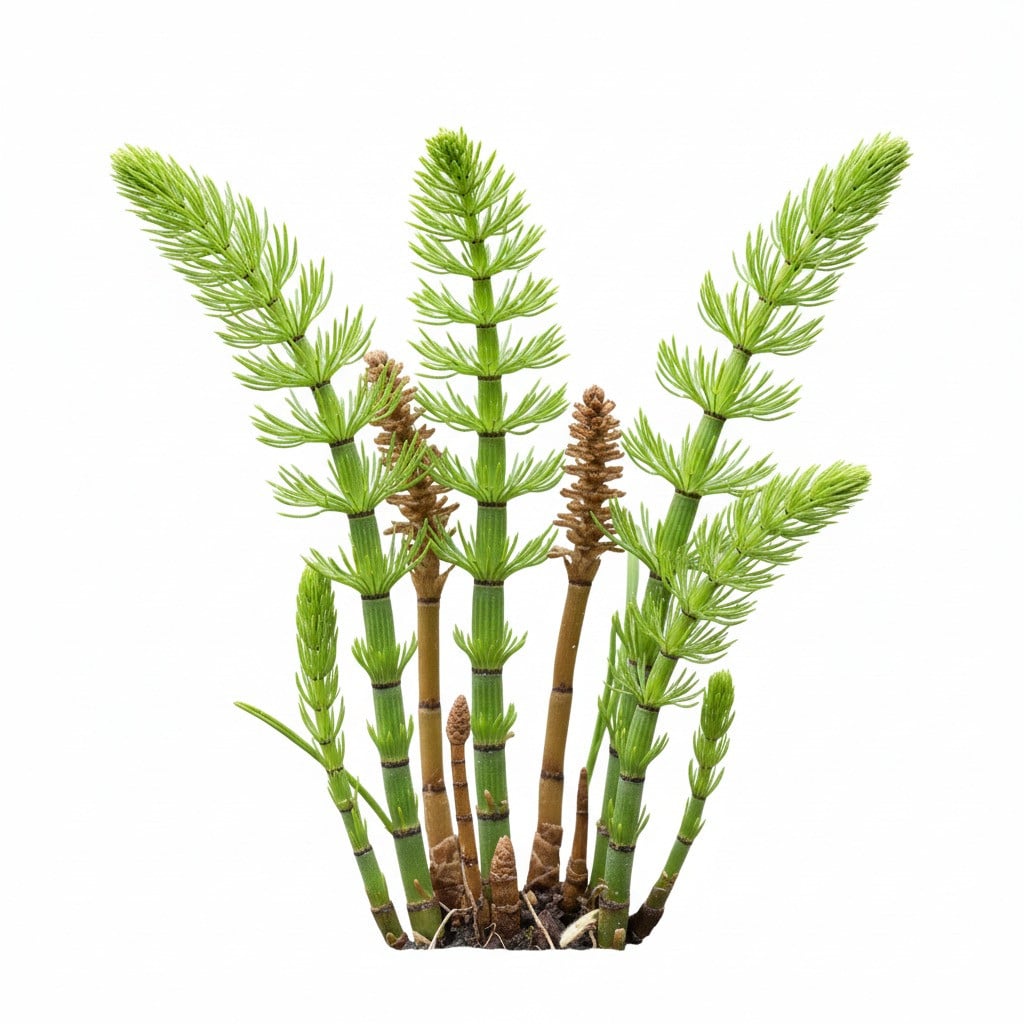
Horsetails have a long history. They are among the last survivors of the species-rich group Equisetopsida. This taxon included the calamites (calamites) known as Calamitaceae. These tree-like horsetails grew in the Permian and Carboniferous periods, as fossil finds have shown. The woody plants reached a height of up to 30 meters. With a trunk diameter of one meter, they formed a large part of the former coal forests. Today, biologists believe that the first horsetails appeared in the Upper Devonian period, 375 million years ago. This is why the plants are known as "living fossils". They owe their German genus name to their special shoot axis. This can be removed from the sheath formed by the leaves and easily reinserted. Horsetails form rhizomes up to six meters long. They reproduce by stolons. One of the peculiarities of the genus is the storage of silicate in the cell wall. In addition to the lignin substitute, the plants contain up to seven percent silicic acid. Leaf Horsetails have several nodes on the stem axis. Several leaves, the microphylls, arise from each node. They have an inconspicuous appearance. In some species of the genus, lateral shoots grow from the thickenings on the stem. The leaves and branched shoots are arranged in whorls. Flowering Horsetails do not form flowers. They have spur spikes. These are spirally or cone-shaped at the tip of the shoot. Fruit Horsetails do not form fruit. They spread via the spores. In many species, the sporangia-bearing shoots grow before the sterile ones. They die after sporulation. Regardless of the sex of the plant, the spores look identical. They have an outer layer called an exospore and two bands. These hapterenes have spatula-shaped ends. When moist, they wrap around the spore. If it dries out, the bands unfold so that they stick together. Some species of the plant genus have sporophylls on the green shoots. More rarely, they are found on special side shoots that are used exclusively for propagation. Growth The species of the horsetail genus reach a height of up to two meters. The tropical species are an exception with higher dimensions. The perennial plants spread vegetatively from their rhizome. Their shoots are a characteristic feature. Each shoot has several nodes. Between them are internodes. The term refers to the section of a plant's shoot that lies between two leaf attachment points or, as here, between leaf nodes. Hygrophytes (plants that grow in wetlands) have water gaps at the tip of their leaves. These glands serve to increase the release of water.
Origin:
The majority of horsetails grow in the northern hemisphere. In addition to European species, there are representatives in Japan and in the tropics. The plants are mainly found on banks, damp meadows or swampy areas.
Growing tips
Location and soil Horsetail prefers to grow in light shade. It prefers moist, nutrient-rich soil, but can also grow in nutrient-poor soil. It is considered an indicator plant for humus-poor, compacted and often acidic soil. Planting Ornamental forms of horsetail such as Japanese winter horsetail are best planted in spring. Care tips Ornamental forms of horsetail need moist locations. They should be watered during prolonged dry periods. Use of horsetail Horsetail can be a nuisance in the garden. Digging it out is practically impossible, the plants constantly grow back. Once you have them in the bed, it is almost impossible to get rid of them. The only thing that helps is regular weeding of the shoots. However, these can be dried and used for all kinds of applications. Dried horsetail, for example, can be spread around vegetable seedlings to act as a barrier against slugs and snails, which are reluctant to get past them. Horsetail broth can also be used for spraying to prevent fungal diseases on roses, fruit and vegetable plants. The high content of silicic acid (silicon) can strengthen the cell walls of plants, making them more resistant to fungal attack. The ingredients of horsetail are also valued in naturopathy, where they are used in a variety of applications. As a medicinal plant, horsetail is said to have anti-inflammatory, blood-purifying and diuretic properties and to help with respiratory diseases. The silicic acid it contains is also said to strengthen hair, teeth, fingernails and bones. Propagating horsetail If you really want to grow horsetail as a medicinal plant, all you need to do is stick a few pieces of rhizome or shoot into the soil and keep them moist. It is best to cultivate the plant in a planter so that it cannot spread too far. Diseases and pests The original, robust plants are generally not affected by pests or diseases.



Diseases
Powdery mildews
Pests
Land snails
Spider mites
Aphids