Schneeball

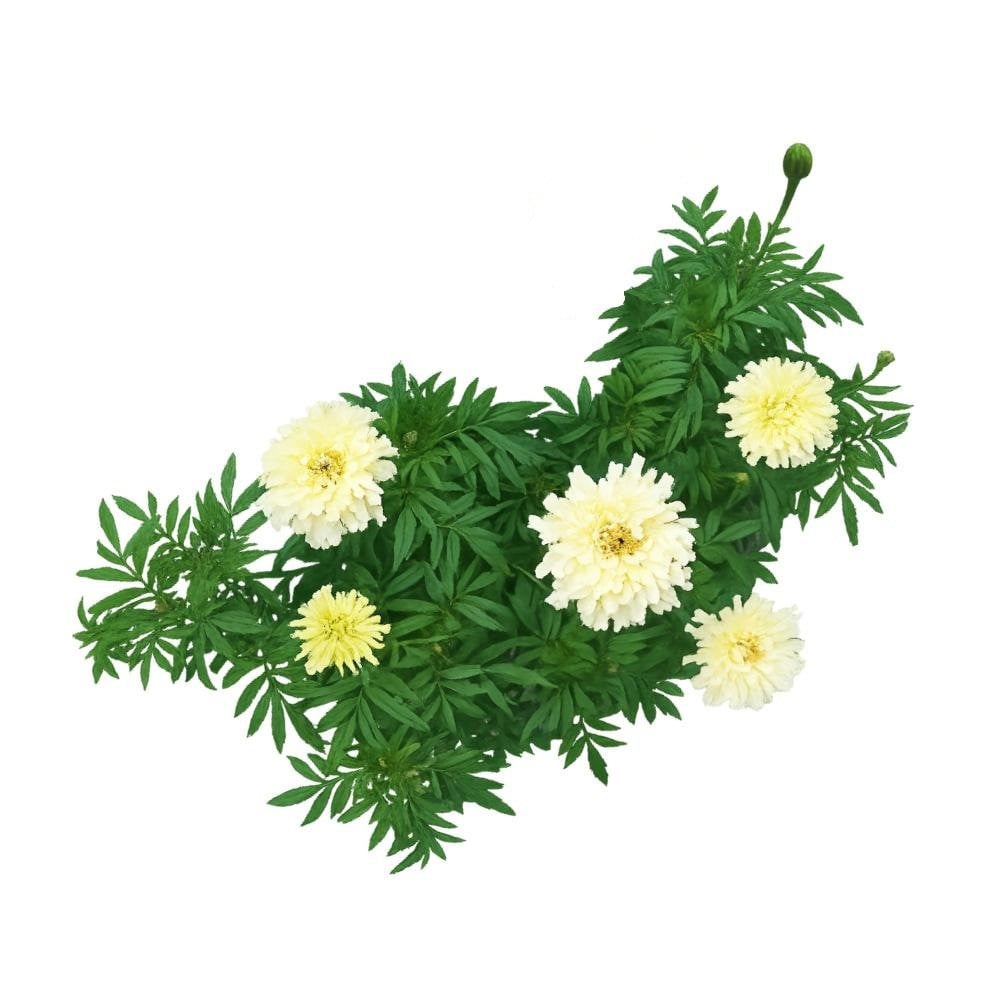
Variety
Schneeball
Approved Data
created by Alex&Sempi at 20.03.2026
Features
Resistances
robust
Taste
not edible
Toxizität: ungiftig
Location
light: Full sun
Light: Sun
Color
Flower: creamy-white
creamy-yellow
Growth habit
insect pollination
Fruit shape
Typ: Schließfrucht - Achäne
Season Overview
Propagating
Planting
Harvest
J
F
M
A
M
J
J
A
S
O
N
D
Description
Tagetes erecta 'Schneeball' is an annual, double-flowered marigold whose round, ball-shaped blooms resemble snowballs. Among marigold cultivars, white flowers are quite rare, making this variety a welcome addition. The plant is sturdy, vigorous, and well-suited for cutting. It reaches a height of 50 cm. It is particularly suitable for planting in groups in flower beds and containers, as well as for use as a cut flower and for drying. Tagetes (Tagetes), also known as marigold, velvet flower (obsolete: Sammetblume), or death flower, is a genus of plants in the Asteraceae family. The 50 to 60 species are widely distributed from the United States through Mexico and Central America to South America. Many varieties are used as ornamental plants and are among the best-known summer flowers, suitable for both flower beds and balcony planters. Tagetes are named after the Etruscan god Tages. Growth Tagetes species are strongly scented, mostly profusely branched, upright-growing, annual to perennial herbaceous plants, more rarely subshrubs or shrubs. They typically reach heights of 10 to 80 centimeters, rarely up to 200 centimeters. The leaves are mostly opposite, occasionally alternate in the upper part of the stem. They are predominantly once to thrice pinnately compound or pinnate, rarely undivided, with leaflets linear, lanceolate to ovate. The leaves are dotted with numerous glandular pits, which are filled with essential oils. The basket-shaped inflorescences are arranged in terminal, loose, raceme-like cymes, rarely singly or in dense corymbs, occasionally on long, hollow flower stalks. The flower heads contain tubular flowers inside, surrounded by a ring of two-lobed ray flowers, which may rarely be absent; however, in most cultivated varieties, only sterile ray flowers are present (double flowers). The bracts of the involucre are always arranged in a single row and fused along most of their length; they bear one or two rows of oil glands. An outer involucre is absent. The flowers are yellow, white, or orange in color, often multicolored, with red to reddish-brown tips. The ray florets—often five, up to eight in non-double varieties—are truncate or bilobed at the tip. The number of disk florets varies greatly depending on the species. The achenes are black, bluntly pyramidal or cylindrical to spindle-shaped, rarely somewhat flattened, hairy or glabrous. They have a pappus consisting of only two to five, rarely up to ten, often unequal-length scales. Uses The varieties of upright marigold (Tagetes erecta), spreading marigold (Tagetes patula), and narrow-leaved marigold (Tagetes tenuifolia) frequently cultivated in Central Europe rarely naturalize here and do so inconsistently. Shiny marigolds (Tagetes lucida) and Mexican marigolds (Tagetes minuta) are also planted, though less frequently. As an ornamental plant The colors of the inflorescences of Tagetes varieties range from lemon yellow to brownish red; some hybrids also have bicolored flower heads. In older varieties, the dark green, pinnate leaves are characterized by a strong aromatic scent that many people find unpleasant. This scent has been bred out of newer varieties. However, the intense scent of marigolds has the advantage of repelling pests such as whiteflies. Marigolds have few requirements for garden soil, but they thrive best in sunny locations. Marigolds are also grown as cut flowers. They are among the best-known summer flowers and are suitable for both flower beds and balcony planters. As companion plants In vegetable gardens and orchards, marigolds serve as companion plants. Strawberries develop a stronger aroma, and marigolds act as snail bait, protecting neighboring plants from snail damage. Planting marigolds can successfully combat “soil fatigue” caused by nematodes, which leads to reduced crop yields in vegetable plants. As a dye Tagetes are sometimes grown commercially to extract the yellow pigment lutein. Lutein is the main carotenoid in marigold flowers. Lutein is used as a food coloring with the E number E161b and as a feed additive, particularly for poultry, to yellow egg yolks. As a spice Tagetes minuta is used as a spice in Peru. The leaves of Tagetes lucida (German: Würz-Tagetes), which originates from Mexico, can also be used as a spice and for making tea. Its aroma is reminiscent of anise. The huacatay aroma is also used in South America for the production of perfume. Tagetes are also used in the cosmetics industry. In the Caucasus, the spice made from dried Tagetes erecta is known as “Imeretian saffron.” As a remedy and drug It was only a few years ago that the essential role of lutein in the visual process of the human eye was discovered. Lutein deficiency causes macular degeneration, which primarily affects older individuals. According to pharmaceutical manufacturers, a daily intake of six milligrams of lutein in multivitamin tablets can prevent this degeneration. Tagetes lucida is said to have a “psychoactive, mildly psychedelic” effect, which is believed to be due to the coumarin derivatives it contains.
Non hybrid
Not frost resistant
Growing tips
🌱 Pre-cultivation - Time: April - Planting after 3-5 weeks (after the ice saints) - Germination temperature: 18-22 °C - Germination time: usually 5-10 days - Light: bright, but no direct blazing sun during germination - Sowing container: seed tray or small pots with loose sowing soil - Sowing depth: 2-3 mm - Watering: carefully, keep the soil slightly moist, but never wet. - Covering: optional foil/cover until the seedlings appear - ventilate daily - Pricking out: as soon as the seedlings have 2-3 true leaves - Harden off: place outside during the day 7-10 days before planting out - Not too warm and not too dark - Fertilize sparingly - only after pricking out and only very mildly. 🌼 Direct sowing & planting - Direct sowing: from mid-May (after the ice saints) - Low varieties (20-30 cm high): 20-25 cm row spacing, 15-20 cm plant spacing - Medium varieties (30-50 cm high): 25-30 cm row spacing, 20-25 cm plant spacing - Tall varieties (over 50 cm): 30-40 cm row spacing, 25-30 cm plant spacing 🌱 Location & soil - Full sun is ideal. The more light, the more compact and flowering - Soil: loose, humus-rich, well-drained. No waterlogging - pH value: slightly acidic to neutral 💧 Care - Watering: regular, moderate. No waterlogging - Fertilize: sparingly - Remove faded plants 🌿 Use - Perfect for flower beds, balcony boxes, border planting. - Good companion plants in vegetable beds, e.g. with tomatoes, peppers or cabbage. - Attract pollinators and improve soil quality (nematode-reducing). 🌼 Harvest - Seeds: from August to October (seed heads brown and dry) - Carefully pull off or break apart the dried flower. - Inside you will find many narrow, black and white seeds. - Allow to dry well and store in a dry, dark, airtight place. - Flowers: are edible and are used for tea or decoration. - In the morning, when the dew has dried. - Only pick fresh, fully opened flowers. - As edible decoration for salads, cakes, drinks. - For tea (slightly lemony and spicy). - Dried as a colorant in herbal mixtures. 🌿 Good neighbors - Tomatoes, peppers & chilli, potatoes, eggplant, okra - Cucumber, celery, melon - Lettuce, spinach, chard, beet - Cabbages, turnips, rapeseed - Strawberries, roses, rhubarb - Beans, peas - Onions, leeks, garlic, chives - Carrots, parsnips, radishes, radishes, salsify - Basil, dill, parsley, thyme, oregano, marjoram, lemon balm, mint - Lavender, coneflower, sage, gaura, coreopsis, funkia, sedum - Berry bushes, summer lilac, weigelie, deutzia, spirea, fruit trees 🚫 Bad neighbors - Fennel - Wormwood / mugwort - Marigolds, ferns - Pumpkin, zucchini, corn - Rhododendrons - Jerusalem artichoke - Blackberries, hazelnut, elderberry, walnut - Spruce, fir, pine, maple, beech, willow, alder 🌿 Common diseases - Powdery and downy mildew - Root rot - Leaf spot diseases 🐛 Typical pests - Snails and slugs - Aphids - thrips - Spider mites
Details


Light requirement
Sunny

Water requirement
Dry

Soil
Light (sandy)

Nutrient requirement
Low

Light germinator

Germination temperature
18 - 22 °C (Degrees Celsius)

Plant distance
30 cm

Row spacing
30 cm

Seeding depth
0.2 cm

Companion Plants
Abyssinian cabbage / Ethiopian mustard
Apple
Aubergine / Eggplant
Basil
Bean ((Scarlet) runner bean)
Bean (Broad bean / Faba bean / Field bean)
Bean (Dwarf bean)
Bean (Hyacinth bean / Lablab-bean)
Bean (Lima Bean)
Bean (Runner bean)
Beetroot
Black salsify
Broccoli
Broccoli raab / Stem cabbage / Cima di rapa
Brussels sprouts
Brussels sprouts
Buddleja / Butterfly Bushes
Cabbage (Cabbage)
Cabbage (Pointed cabbage)
Cabbage (red cabbage)
Cabbage (Savoy cabbage)
Carrots
Cauliflower
Celery (Celeriac / Celery root)
Celery (Celery)
Celery (Leaf celery / Chinese celery)
Chard
Chickpea
Chili
Chinese kale - Kai-lan / Chinese broccoli
Chives
Chives
Collard greens
Collard greens (Kale)
Collard greens (Tuscan kale / Dinosaur kale / Palm tree kale)
Coneflower (Echinacea)
Cucumber / Gherkin
Currant
Dill
Fig
Funk
Garlic
Garlic chives
Gooseberry
Kohlrabi / German turnip / Turnip cabbage
Lavender
Leeks
Lettuce (Common chicory)
Lettuce (Endive / Escarole / Erisée)
Lettuce (Lamb's lettuce)
Lettuce (Lettuce)
Lettuce (Oriental greens / Brown mustard)
Lettuce (Puntarelle / Cicoria di catalogna / Cicoria asparago)
Lettuce (Radicchio / Italian chicory)
Lettuce (Sugar loaf)
Melissa
Melon (Sugar melon)
Melon (Watermelon)
Mint
Mizuna / Japanese mustard greens
Napa cabbage / Chinese cabbage
Nightshades (Other)
Okra
Onion
Onion (Spring onion)
Oregano
Ornamental alliums
Pak Choi
Parsley
Parsnip
Pea
Pear
Pepper / Paprika
Physalis
Plum
Plum (tree)
Potato
Radish
Radishes
Rapeseed - Sheer cabbage / Siberian cabbage
Rapini / Broccoli rabe
Raspberry
Rhubarb
Root parsley
Rose
Rudbeckia (Coneflower / Black-eyed-susans)
Rutabaga / Swedish turnip
Sage
Snapdragon
Sour cherry / Tart cherry
Soybean
Spinach (Summer)
Spinach (Winter)
Spirea
Strawberry
Succulents
Sweet pea
Thyme
Tomato (Bush tomato)
Tomato (Cocktail bush tomato)
Tomato (Cocktail Stake Tomato)
Tomato (Stake tomato)
Turnip
Turnip greens - Choy Sum / Chinese flowering cabbage
Turnip greens - Mizuna
Turnip greens - Tatsoi
Turnip-rooted chervil
Turnips - Oilseed turnips
Turnips - Wild turnips
Vegetable cabbage - Forage cabbage
Vegetable cabbage - Ribbed cabbage / Portuguese cabbage
Vegetable cabbage - wild cabbage / ancient cabbage
Weigela
Wild Cherry / Bird Cherry / Sweet Cherry
Yalta tomatoes

Antagonistic Plants
Alder trees
Blackberry / Brambles
Common marigold
Common mugwort
Courgette / Zucchini
Cucumber (Caigua)
Fennel
Florence fennel / Finocchio
Garden squash - Patisson / UFO squash
Grasses - Bamboos
Grasses - reeds, cattails, bulrushes
Hair cucumbers / snake gourds
Hazelnut
Ivy
Jerusalem artichoke / Topinambur
Make
Maples
Ornamental pumpkin
Pines
Pumpkin / Squash
Rhododendron
Spruce trees
Sweet woodruff / Sweetscented bedstraw
Walnut family
Willows

Diseases
Septoria
Root Rot
Downy mildew
Powdery mildews
Pests
Spider mites
Thrips
Aphids
Land snails