Yam

Yam
Dioscorea
Plant family
- others -
Cultivation Break
3 Years
Season Overview
Propagating
Planting
Harvest
Harvest
J
F
M
A
M
J
J
A
S
O
N
D
1ST YEAR
FOLLOWING YEARS
Details


Light requirement
Sunny

Water requirement
Moist

Soil
Light (sandy)
Nutrient requirement
Medium

Dark germinator

Germination temperature
22 - 25 °C (Degrees Celsius)

Plant distance
70 cm

Row spacing
80 cm

Seeding depth
7 cm
Instructions
End of October

Harvest
Description
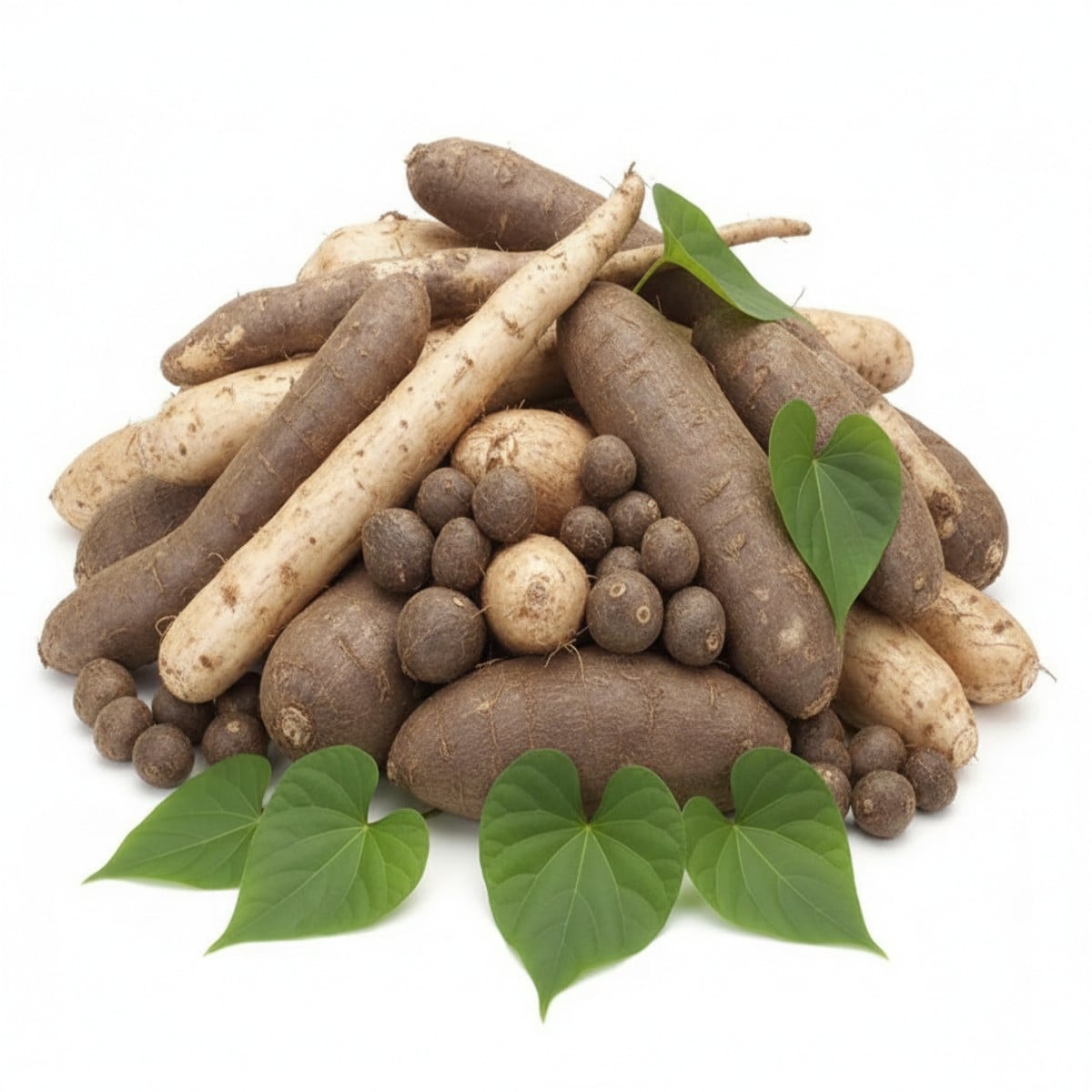
Yams (Dioscorea), also called yam or yamroot, are a genus of plants in the family Dioscoreaceae. The up to 800 species are mainly distributed in the tropics. Some species are important tropical food and medicinal plants. Distribution The genus Dioscorea is distributed worldwide, from tropical to temperate regions. In China, there are 52 species, 21 of which are endemic. Some species are neophytes in some parts of the world. The only species native to Europe are the Balkan devil's bit (Dioscorea balcanica), Dioscorea chouardii, the common devil's bit (Dioscorea communis), and Dioscorea pyrenaica. In Central Europe, only the common devil's bit is native. The genus Yams (Dioscorea) comprises about 350 to 800 species. Growth Yam species grow as twining, perennial herbaceous plants. They form rhizomes or tubers as organs for overwintering, which can vary greatly in size, shape, color, and chemical composition, as well as in their depth in the soil. Some species form brood tubers in the leaf axils (for example, *Dioscorea bulbifera*). New, twining stems are produced each growing season. The simple or branched stems twine clockwise or counter-clockwise; they are smooth or winged, polygonal or cylindrical; they are hairless or may sometimes have spines. Leaf The leaves, which are arranged spirally and alternately to seemingly opposite or whorled, are divided into a petiole and a blade. The relatively long petioles are twisted at their base. The simple or compound blade has three to nine basal veins. Flower The relatively small flowers are always unisexual. Dioscorea species are usually dioecious (dioecious), rarely monecious (monecious), with separate sexes. The flowers are radially symmetrical and have three sepals. Fruit The three-angled or -winged capsule fruits open at the top by loculicidal dehiscence when ripe. Each fruit compartment contains only two, or rarely one, seed. The flattened seeds often have membranous wings. Uses Some species and their cultivars are useful plants, both as important food plants and as medicinal plants. Many yam species are cultivated as a food source for their edible root tubers. In the most cultivated species, the underground tubers can reach a length of up to 2 meters; their flavor is sweet and similar to that of chestnuts and potatoes. They have dark brown to black skin and are rich in provitamin A as well as potassium. With the exception of the "Chinese yam" (Lichtwurzel, Nagaimo, Dioscorea polystachya, Dioscorea batatas, Dioscorea divaricata, or mistakenly also Dioscorea opposita or Dioscorea oppositifolia) and Dioscorea japonica, all yam species are toxic when eaten raw. Yams are similar in taste and appearance to sweet potatoes, but they are not related. In South America, Africa, and the Caribbean, yams are a common part of the vegetable selection, and in tropical cuisines, they are an important source of starch. Yams contain a small amount of amygdalin, which is converted into hydrogen cyanide in the intestine.
Origin:
Worldwide, China, Europe
Growing tips
🌞 Location & soil - Full sun, warm location (over 20°C) - Protected from the wind, but airy - Humus-rich, loose, sandy-loamy - Moderately to heavily nutrient-rich - Well-drained, permeable, no waterlogging 🌱 Sowing & planting - Pre-cultivation: pre-germinate tubers from March/April (the earlier, the larger the tubers) - Germination temperature: 22-25 °C - Germination period: 3-6 weeks - Sowing depth: half in moist soil - Light: bright, no direct midday sun - Planting time: mid-May (after ice saints) - Planting distance: 60-80 cm - Row spacing: 70-90 cm - Plant support: yes - Keep evenly moist 💧 Care - Watering: Evenly moist, never wet - Mulching: Retains moisture, warms the soil - Basic fertilization: Compost or well-rotted manure in spring - Fertilization: 3-4 weekly with potassium (compost, plant manure, horn shavings) - Guide shoots ❄️ Winter protection - The light root (Dioscorea batatas) can overwinter in the garden in our regions 🌾 Pruning & harvesting - Harvest time: from October before frost (depending on variety) - As soon as the leaves turn yellow, carefully dig out the tubers - Post-ripening: store in a warm and dry place for 1-2 weeks 🌿 Good neighbors - Beans, peas, corn - Basil, oregano, thyme, sage, savory, dill, coriander, lovage - Spinach, chives, onions, garlic, lettuce, carrots, parsnips, beet - Tomatoes, peppers, chili - Strawberries, gooseberries, currants - Turnips, celery - Ferns, begonias, hellebores, purple bellflower, sedum, houseleek, astilbe - Coneflower, catmint, yarrow, marigold, small ornamental grasses, cosmos - Cranesbill, lady's mantle, delphinium, limb herbs, lupine, magerites - privet, hydrangea, weigelia, potentilla, spirea, low roses - rock pear, pear 🚫 Bad neighbors - Potatoes, sweet potatoes, sunflower, Jerusalem artichoke, wormwood, mint - Turnip, rapeseed, celery - Cucumbers, pumpkin, zucchinis, cabbage - Funkia, bamboo, reeds - hazelnut, elderberry, forsythia, ivy, goutweed - Walnut, maple, birch, willow, chestnut, rhododendron, summer lilac - Ornamental cherry, hawthorn, apple - Raspberries, blueberries 🍂 Diseases - Powdery mildew - Leaf spot diseases - Root rot 🐌 Pests - Aphids - spider mites - voles - snails - Wireworms

Companion Plants
Basil
Bean ((Scarlet) runner bean)
Bean (Broad bean / Faba bean / Field bean)
Bean (Dwarf bean)
Bean (Hyacinth bean / Lablab-bean)
Bean (Lima Bean)
Bean (Runner bean)
Beetroot
Begonias
Carrots
Catnip
Celtuce / Stem lettuce
Chickpea
Chili
Chives
Common marigold
Coneflower (Echinacea)
Coriander / Cilantro
Corn / Maize
Currant
Dill
Garden cosmos / Mexican aster
Garlic
Garlic chives
Gooseberry
Hellebores
Hydrangea / Hortensia
Lettuce (Common chicory)
Lettuce (Endive / Escarole / Erisée)
Lettuce (Lamb's lettuce)
Lettuce (Lettuce)
Lettuce (Oriental greens / Brown mustard)
Lettuce (Puntarelle / Cicoria di catalogna / Cicoria asparago)
Lettuce (Radicchio / Italian chicory)
Lettuce (Sugar loaf)
Lovage
Lupine / Bluebonnet
Make
Onion
Onion (Spring onion)
Oregano
Parsnip
Pea
Peanut / Groundnut
Pear
Pepper / Paprika
Phacelia / Scorpionweed / Heliotrope
Privet
Purple bellflower, silver bellflower
Rock pear (Amelanchier)
Rudbeckia (Coneflower / Black-eyed-susans)
Sage
Savory
Soybean
Spinach (Summer)
Spinach (Winter)
Spirea
Stem herbs
Strawberry
Succulents
Sweet pea
Thyme
Weigela
Yarrow

Antagonistic Plants
Abyssinian cabbage / Ethiopian mustard
Akebia, blue cucumber vine
Apple
Blueberry
Broccoli
Broccoli raab / Stem cabbage / Cima di rapa
Brussels sprouts
Brussels sprouts
Buddleja / Butterfly Bushes
Cabbage (Cabbage)
Cabbage (Pointed cabbage)
Cabbage (red cabbage)
Cabbage (Savoy cabbage)
Cauliflower
Celery (Celeriac / Celery root)
Celery (Celery)
Celery (Leaf celery / Chinese celery)
Chinese kale - Kai-lan / Chinese broccoli
Collard greens
Collard greens (Kale)
Collard greens (Tuscan kale / Dinosaur kale / Palm tree kale)
Common mugwort
Courgette / Zucchini
Cucumber (African horned cucumber / Kiwano)
Cucumber (Caigua)
Cucumber (Melothria)
Cucumber / Gherkin
Elderberry
Forsythia
Funk
Garden squash - Patisson / UFO squash
Grasses - Bamboos
Grasses - reeds, cattails, bulrushes
Hair cucumbers / snake gourds
Hazelnut
horse chestnut
Ivy
Jerusalem artichoke / Topinambur
Kohlrabi / German turnip / Turnip cabbage
Maples
Mint
Mizuna / Japanese mustard greens
Morning glories
Napa cabbage / Chinese cabbage
Ornamental pumpkin
Pak Choi
Potato
Pumpkin / Squash
Rapeseed
Rapeseed - Sheer cabbage / Siberian cabbage
Rapini / Broccoli rabe
Raspberry
Rhododendron
Rutabaga / Swedish turnip
Sponge gourd / Egyptian cucumber / Vietnamese luffa
Sunflower
Sweet potato
Turnip
Turnip greens - Choy Sum / Chinese flowering cabbage
Turnip greens - Mizuna
Turnip greens - Tatsoi
Turnips - Oilseed turnips
Turnips - Wild turnips
Vegetable cabbage - Forage cabbage
Vegetable cabbage - Ribbed cabbage / Portuguese cabbage
Vegetable cabbage - wild cabbage / ancient cabbage
Walnut family
Willows
Diseases
Root Rot
Powdery mildews
Brown rot
Ascochyta blight
Pests
Aphids
Spider mites
Land snails
Larvae
Voles
Wireworms